Intel (INTC -5.34%) has had a strong 2026, rising over 200% this year. That has made it one of the S&P 500‘s top 10 performers, but with 2027 around the corner, is it still a good investment now?
Image source: The Motley Fool.
2027 will be a “show me” year for Intel
Intel is on shaky ground. The stock rallied from its late 2025 lows after the U.S. government and Nvidia (NVDA -2.94%) bought stakes in the company. Both want to see Intel succeed, as it is important to have a wider array of options in the chip foundry and central processing unit (CPU) marketplaces. While Intel’s CPU products are still solid and are seeing widespread adoption in data centers, the biggest questions about its future surround its chip foundry segment.

Today’s Change
(-5.34%) $-6.04
Current Price
$107.08
Key Data Points
Market Cap
Day’s Range
$105.24 – $111.60
52wk Range
$32.89 – $142.35
Volume
120.2M
Avg Vol
107M
Gross Margin
39.05%
Most companies that design computer processors don’t do their own manufacturing in-house. They contract with a chip foundry that takes their orders and produces the chips to their specs.
Intel is one of the few that did both the design and manufacturing, but over the years, its production lines had fallen behind the leading foundries in performance and technology. It got close to the point of closing down that segment of the business before outside investors stepped in. This gave Intel the funds necessary to work toward catching up to the cutting-edge with new, smaller process nodes.
Now, it’s able to produce its 18A series — 1.8-nanometer chips that are among the most powerful in the world. And the strong yields it can deliver with that feature-dense process node have gotten Intel back into the foundry game.
These developments caused a monster rally for the stock this year, and as a result, it now trades at an expensive forward price-to-earnings valuation.
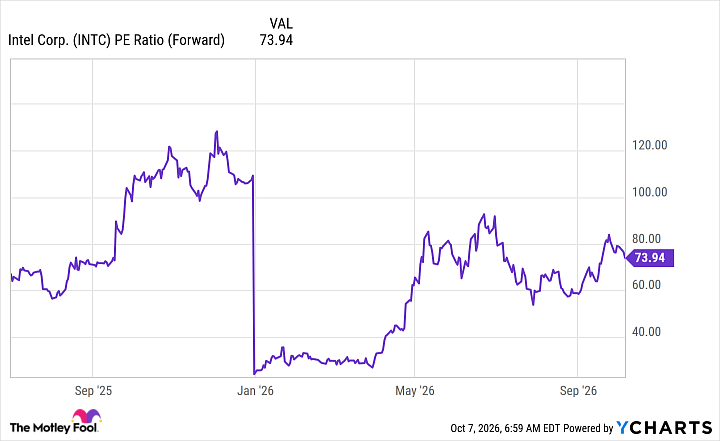
INTC PE Ratio (Forward) data by YCharts. PE = price-to-earnings.
A price tag that lofty indicates that investors are expecting a lot of growth over an extended period, and that’s where 2027’s projections come in.
I think 2027 will be a “show me” year for Intel. It has the technology; now it has to demonstrate what that does for the business. Can it attract new clients? Can it become a secondary supplier of chip manufacturing to already successful big tech companies? If it can, Intel will be able to grow into its current valuation and be a reasonable stock. If it can’t, then it may give up some of the gains it has made this year.
Right now, Wall Street isn’t bullish on its near-term prospects; the consensus outlook is only for 15% revenue growth next year. If that view proves accurate, I wouldn’t be surprised to see Intel’s stock lose some value and end up in the $85 to $89 per share range. But if Intel can sign some big clients and start to produce chips for them, a further rally could be possible, although it won’t be a large one because of the massive amount of growth already priced into the stock.
Projecting Intel to stay flat in the neighborhood of $110 per share seems like the most logical conclusion to me, which is why I don’t think it’s a great stock to continue owning from here.