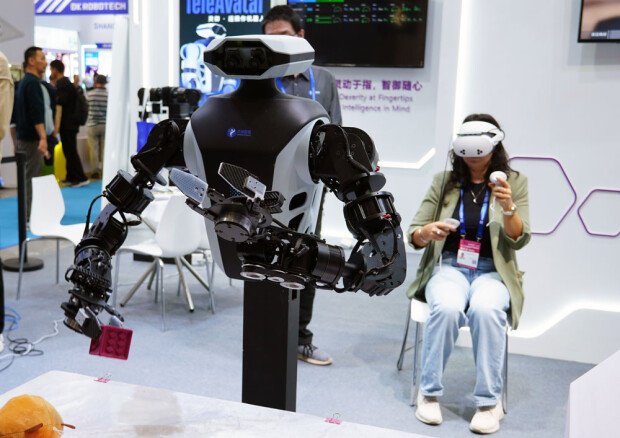

Chinese President Xi Jinping once remarked that anyone seeking to understand China over the past 500 years should visit Beijing, while those wanting to see the country’s transformation over the past 50 years should go to Shenzhen. The southern city has become a vivid symbol of China’s extraordinary economic transformation, with robots, drones and autonomous vehicles now part of everyday life. Yet South Korean experts who recently visited Shenzhen returned with a sobering assessment: South Korea is losing ground to China not only in price competition but also in the race to develop new technologies.
Industry Minister Kim Jung-kwan spoke to reporters on Nov. 25 about his visit to Shenzhen, acknowledging that South Korea was falling behind China in the time required for research and development. “We are losing ground to China in terms of time, particularly R&D time,” he said. “A Korean researcher based there told me that a project that takes a year in South Korea can be completed in China in just three months.” Falling behind in technological development puts South Korean companies at an increasing disadvantage in global markets. The gap is already apparent in scientific research. In Nature’s ranking of countries’ contributions to high-quality scientific papers, China placed first, while South Korea ranked seventh.
Shenzhen is home to some of China’s leading technology companies, including Tencent and Huawei, as well as DJI, which commands more than 70% of the global drone market; BYD, the world’s largest electric vehicle maker; and UBTECH, a humanoid robot manufacturer. The city’s breakneck pace of innovation is captured in a local saying: “Design in the morning, build a prototype in the afternoon, and start production the next day.” New vehicles that take global automakers an average of three to four years to develop can be brought to market in Shenzhen in just 18 to 24 months.
Ahn Joon-mo, a Korea University professor who recently led a National Academy of Engineering of Korea study on China’s rise in science and technology, said the country’s advances had far exceeded expectations. “In last year’s report, we talked about China’s rise. Now it seems to have broken through the clouds and climbed into the stratosphere,” he said. Competition among universities, companies and local governments in Shenzhen is so intense that engineering professors reportedly meet with students in the early hours whenever an idea strikes.
Ahn pointed to the stark contrast between the regulatory environments in the two countries. “In South Korea, getting a delivery robot approved to cross a road can require going through more than 10 government agencies. In China, by contrast, the government builds the necessary infrastructure first, while private insurance products for emerging technologies help cover potential risks,” he said. Unless Seoul eases barriers to market entry and creates an environment in which businesses can move quickly, South Korea will struggle to keep pace with China.
China has already overtaken South Korea in electric vehicle batteries, artificial intelligence, robotics and autonomous driving. It is now challenging U.S. dominance in the space industry and South Korea’s lead in semiconductors. Kim described R&D into new technologies as “the last arena in which we can compete.” He said it was painful to hear people in China question whether South Korea could afford to debate its 52-hour workweek while falling behind in the technology race. If the gap widens further, South Korea could eventually find itself with no playing field left, no matter how hard it tries to compete. The country must act now to ease market-entry and labor regulations and pick up the pace in the race for technological innovation.

