On Thursday, the same day that Dario Amodei rang the bell at Nasdaq for his $2 trillion Anthropic IPO, I later sat in a darkened Manhattan theater and watched his previous life at OpenAI as a research scientist led by Sam Altman illustrated on the silver screen. This was history, being made and recounted simultaneously, long before the story is even close to reaching some dispositive conclusion.
I went in already knowing most of the story because I followed the majority of it in real time, for years. But for all the stories, rumors, and tweets written about the rise of OpenAI and Sam Altman, this is the first major attempt to string together the many disparate moments that led to the birth of ChatGPT as a mainstream commercial, culture-reshaping product.
After seeing the film, I now know why Amazon MGM Studios mysteriously canceled its plans to release Luca Guadagnino’s film Artificial. Contrary to its title, the film is all too truthful about the dynamics of at least some of the modern technology startup and investing landscape, and the Darwinian behavior it fosters, sometimes at the expense of friendships, and possibly even humanity itself. In a less AI-obsessed alternate universe media landscape, Guadagnino’s film might have been more poetically titled Authentic.
“Prometheus wasn’t afraid of fire.” —Garfield as Sam Altman
“Yeah, but he didn’t have to make a deal with Microsoft to bring it to humanity.” —Borisov as Ilya Sutskever
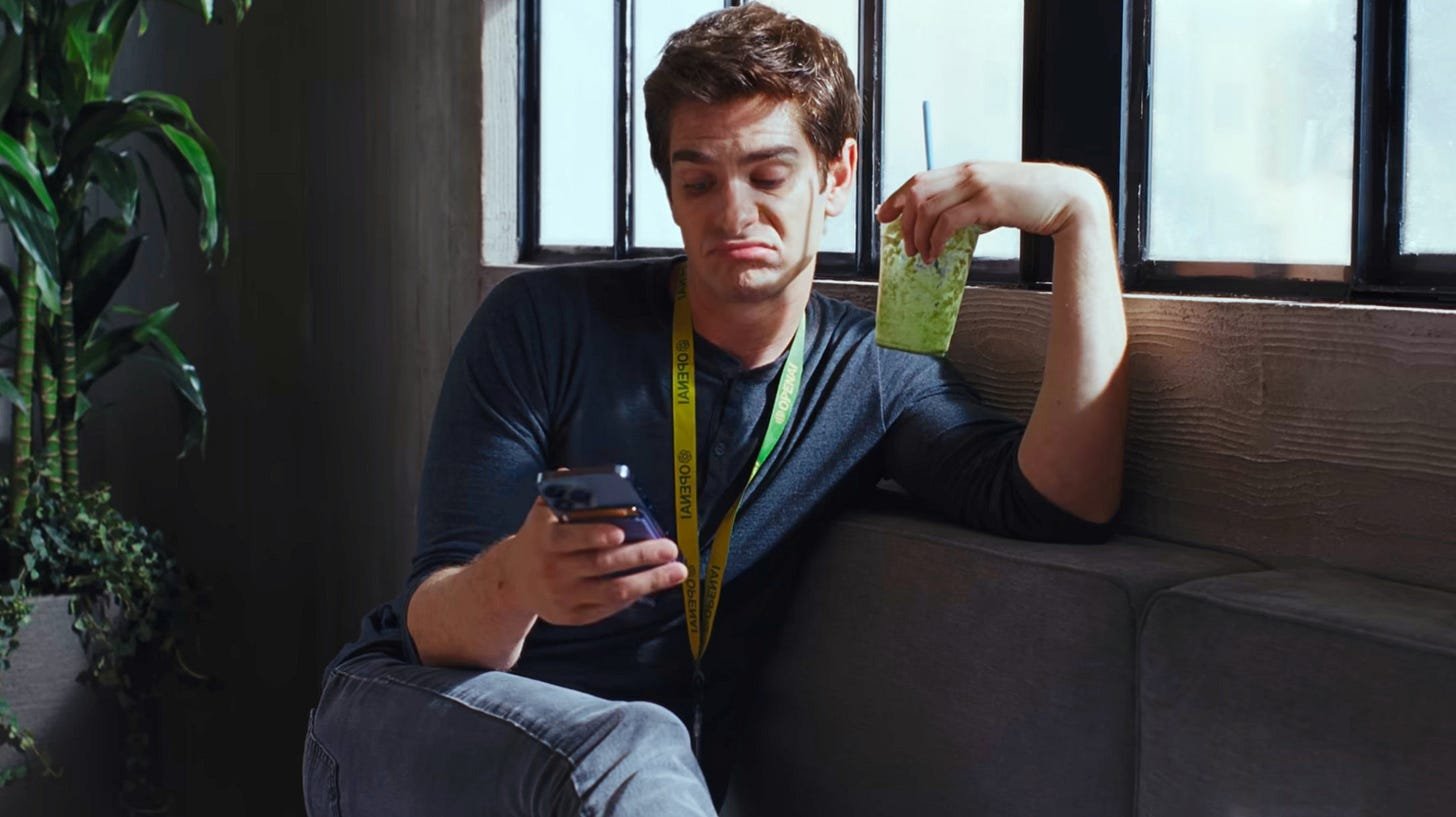
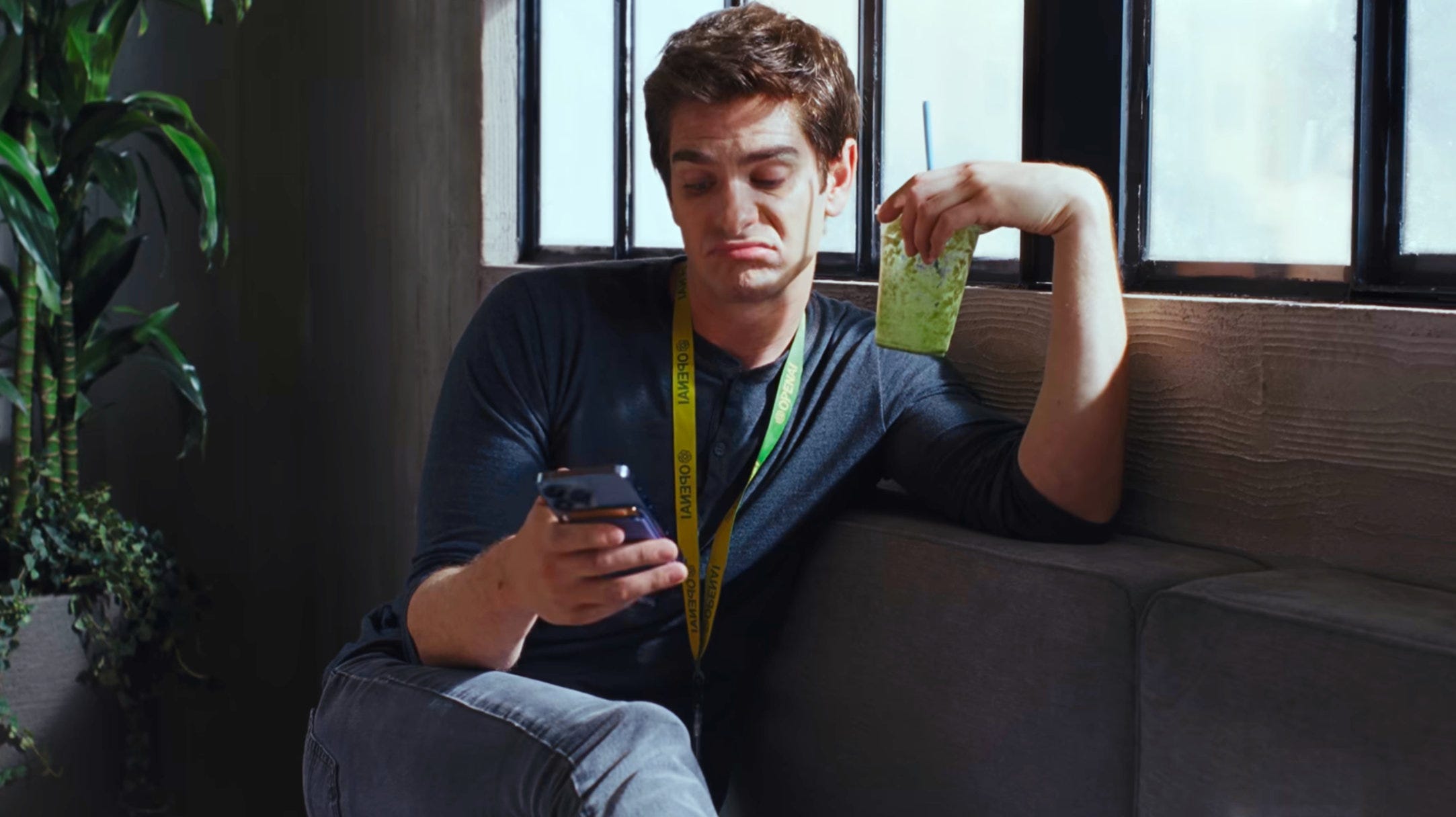
I need to get this out of the way. I’ve never really been a fan of Andrew Garfield’s work. His Spider-Man roles just didn’t do it for me. And when he portrayed Facebook co-founder Eduardo Saverin in the Academy Award-winning The Social Network, his role came off as an afterthought in an otherwise cohesive script. Nevertheless, Garfield’s talent and earnest effort have always apparent at the edges. But as a viewer, his theatrical appeal never quite hit the ON button for me. Artificial changed all that.
I’ve seen pretty much every biopic detailing the lives of technology founders. None of them come as close to climbing into the skin and radiating out what we think we know, and have definitely heard, about a tech founder like Sam Altman. At my screening, Garfield came out, along with Guadagnino, screenwriter Simon Rich, and co-star Monica Barbaro (who plays former OpenAI executive Mira Murati) and took questions after the film. My New York City-bred aggressive stoicism usually makes me a bit stingy with effusive praise in public, so I must report that I legitimately struggled to stay seated and not give Garfield a hearty Bravo! for his performance. It was that powerful. Which couldn’t have been easy.
I was half-expecting Borisov to give his Sutskever character a sort of muted comedic take on a Dune Mentat. Instead, he delivers heartbreaking naiveté and honesty wrapped in the cold calculations necessary to push forward the mission of AGI.
The real-life Altman (who, like me, Garfield says he’s never actually met) is very careful about his public persona, and strategic with his words and associations. So Garfield’s ability to embody Altman’s character in such an understated yet resonant way is a feat that not many actors would have been able to pull off so effectively. You’ve seen his perfect mirroring of Altman’s physicality and walk, but that’s just the start. Garfield became Altman, as much as one can without an electron microscopy scan of the tech founder’s brain.
During the after-film session, Garfield admitted, with classic dry British wit belying sincerity, that he had been looking for a role as a leader who won, rather than lost as he did when portraying Saverin. Altman was that role.
Second only to Garfield in delivering a sublime performance is Yura Borisov (Anora), who portrays OpenAI co-founder Ilya Sutskever, who is now the founder of Safe Superintelligence Inc. Before the film started, I was half-expecting Borisov to give his Sutskever character a sort of muted comedic take on a Dune Mentat. Instead, Borisov delivers heartbreaking naiveté and honesty wrapped in the cold calculations necessary to push forward the mission of AGI.
If the alternatively titled film called Authentic were being distributed, the name would be almost too apt, and make it even more clear that Borisov is indeed the hero protagonist of the tale.
What we didn’t get from the trailers is that Elon Musk is easily the second-biggest laugh getter in the film. Oh, maybe I should have mentioned that this is a very funny film. Not comedic, just really funny. Despite screenwriter Rich’s Saturday Night Live pedigree, the film never veers into slapstick or parody. Ike Barinholtz (Curb Your Enthusiasm, Suicide Squad) may not look exactly like Musk, and his South African accent isn’t pitch perfect, but everything else is devastatingly accurate.
At one point, when Musk realizes that OpenAI, no longer under his influence, is reaching escape velocity as a company, he sits on his private jet and whines to one of his minions, “When will Grok be ready??” That line sent waves of laughter through the audience.
As of now, Barinholtz has set the standard for the best Musk portrayal yet, in what is sure to be a series of films about the founder of SpaceX who is now the richest man on the planet.
Throughout the film, as Musk shadows OpenAI’s every move toward success without him, the Musk character (who even appears with the first Tesla, the Roadster), becomes increasingly flustered, and hilarious. I won’t give a full inventory of the best moments, viewers deserve to discover those on their own. But as of now, Barinholtz has set the standard for the best Musk portrayal yet, in what is sure to be a series of films about the founder of SpaceX who is now the richest man on the planet.
The real-life Musk probably won’t be happy with this portrayal. And friends of Musk will call it unfair. But as a theatrical mimesis, it’s difficult to argue that Barinholtz’s performance isn’t extremely close to how many in the public sphere receive Musk’s frequent appearances on stage and in interviews.
Beyond the performances, the most impressive thing Guadagnino does here is to educate the audience on the broad strokes meanings of AI and AGI, and what they could mean for humanity. It’s somewhat obvious that the director leans toward the doom side of AI, but he gives the positive potential of AI enough screen time, in fact, just enough that when the humanity-centered path of AI goes off track in the film, you can feel the sting.
Along those lines, Mark Rylance as Nobel Prize-winning Geoffrey Hinton is outstanding in his role as the human canary in the coal mine for singularity-level AI fears.
It’s also apparent that, while shooting the film, Guadagnino fell in love with San Francisco. You can see it in the (sometimes a skosh too long) meditative sequences along the city’s bridges and steep hills. That Bay Area reverence comes through again at the end of the film. Here, the director uses the people of San Francisco, from the unhoused populating its streets, to the blue-collar workers trudging to work, to normie white-collar pedestrians hurriedly sipping their lattes on the go, to bring home the point that humans are more important to him than AI. The subtext: Maybe humanity should also be more important than AI and tech startup success to everyone cheering on OpenAI and companies like it.
It’s difficult to gauge how mainstream audiences will receive this film. Imagine your favorite social media-fueled niche gossip of the day, and how you followed it beat-for-beat. Then imagine someone producing a pitch perfect retelling of that drama in a bubble that you experienced all the emotional ups and downs of, albeit parasocially. If someone gets it right, you’ll probably appreciate the difficult-to-achieve verisimilitude of the creative work.
But for anyone unfamiliar with that niche bit of history, the subsequent cinematic depiction may either come across as pedestrian, or even fall flat. My only personal clue as to how resonant the film might be with mainstream audiences is my knowledge of the fact that most of the people I watched the film with weren’t technology journalists. Therefore, my audience might not have been able to discern which parts of the story were exaggerated (I found the Helen Toner character flip toward the end odd), blurred (I don’t think Altman’s intelligence was fully expressed), or otherwise Hollywood-ified.
But if I use my audience as a tiny sample size temperature check of the film’s mainstream potential, I’m led to believe that, historically, disassociating from this film will be seen as a mistake on the part of Amazon MGM Studios. And now that we know Jeff Bezos is indeed calling the shots at the movie studio, the blame must be placed, at least in part, at his feet.
Artificial will begin showing in select theaters on Dec. 25 and go wide on Jan. 8, 2027.✍︎
MAN AND ROBOTS is a weekly column from MARS Magazine on AI, Hollywood, and the future of work. All editorial text is written by humans.