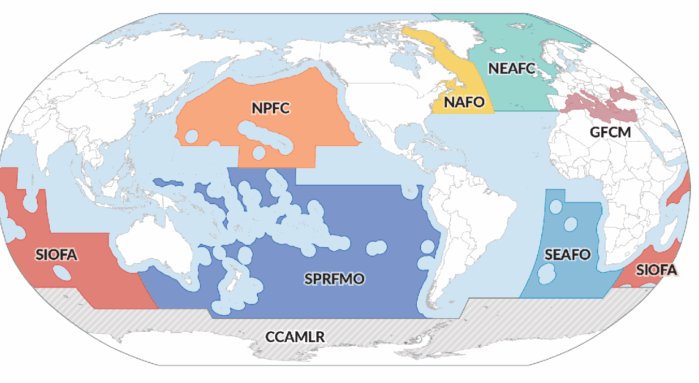
- The North-East Atlantic Fisheries Commission (NEAFC) held its annual meeting in London Nov. 10-13. Its remit includes certain fish stocks in the Northeast Atlantic Ocean, near Europe.
- The three main species that it manages have been subject to overfishing for years. One of them, Atlantic mackerel, is in particularly bad shape, with a population currently 22% below the NEAFC’s target threshold, having been fished above scientifically advised levels every year since 2008.
- At this year’s meeting, the parties made no breakthrough on how to sustainably divide the catch for the three stocks between member parties. Discussions about alleged illegal fishing by Russian vessels occupied much of the event.
- The parties did adopt a statement committing the NEAFC to develop an ecosystem approach to fisheries management, earning praise from NGO observers who said this could be impactful in the long term.
LONDON — On Nov. 10, Mongabay went to the site of the annual meeting of the body that regulates fishing in the northeastern Atlantic, where a little-known geopolitical dispute over marine resources was playing out behind closed doors. The North-East Atlantic Fisheries Commission (NEAFC), a multilateral body, governs the fishing of three major stocks of fish in international waters near Europe, as well as associated species and habitats.
Disagreement between countries over how to manage the stocks has had serious consequences, experts say. All three species — Atlantic mackerel (Scomber scombrus), Atlanto-Scandian herring (Clupea harengus), and blue whiting (Micromesistius poutassou) — have been subject to overfishing for years. The Northeast Atlantic mackerel population is in particularly bad shape, currently 22% below the NEAFC’s target threshold, having been fished above scientifically advised levels every year since 2008.
The NEAFC is one of the world’s 17 regional fisheries management organizations (RFMOs), and a fisheries governance campaigner has called it the most “fraught” and “problematic.” It has six member parties: the European Union, the United Kingdom, Iceland, Norway, Russia, and Denmark (on behalf of the Faroe Islands and Greenland; the delegation is commonly called DFG).
The three fish species are prey for marine mammals and seabirds, and are sought after on global markets. Mackerel is sold in tins, herring is eaten pickled or smoked, and blue whiting is used for aquaculture feed.
At this year’s annual meeting, held Nov. 10-13 in London, the parties made no breakthrough on how to sustainably divide the catch for the three stocks between member parties. Discussions about alleged illegal fishing by Russian vessels occupied much of the event.
The parties did adopt a statement committing the NEAFC to develop an ecosystem approach to fisheries management, earning praise from NGO observers who said this could have positive impacts in the long term.
Jonny Hughes, senior policy manager at U.K.-based NGO Blue Marine Foundation, told Mongabay that managing the three stocks was the NEAFC’s “raison d’être,” and that the lack of coordinated action to keep catches within scientific recommendations was therefore a major failure.
“The biggest problem remains that it is seemingly institutionally incapable of doing the primary part of its job,” Hughes said.
“These are countries that consistently position themselves as global leaders on conservation, particularly marine conservation,” he added. “When push comes to shove, when it comes to fishing, all of those commitments disappear.”

Coastal complications
For all the organizational drama, the NEAFC’s annual meetings can feel anticlimactic: Some of the most important stock decisions occur just outside the NEAFC’s remit, in what are known as “coastal states” meetings.
The coastal states meetings, which involve mostly the same parties as the NEAFC, determine total catch across the Northeast Atlantic ranges of the three stocks, which are worth billions of dollars. (One back-of-the-envelope estimate from Pew Charitable Trusts, a U.S.-based NGO, put their collective annual dockside value at roughly 3.5 billion euros, or $3.84 billion, with most of that coming from mackerel.) These meetings are, in effect, a series of side deals to the NEAFC.
All three stocks straddle the borders between waters under national jurisdiction and the high seas, which is the NEAFC’s regulatory area. In 2025, about one-third of the Northeast Atlantic mackerel catch was in the NEAFC’s area, and the rest of was in national waters.

There are coastal states groups for each of the three fish stocks. For mackerel, the parties are the same as for the NEAFC, except the Faroe Islands and Greenland participate separately and Russia has no seat at the table. (For herring, Russia is in and the EU and Greenland are basically out.) Norway and the U.K. consistently catch the most Northeast Atlantic mackerel, together accounting for almost half of the catch (a different stock of the same species is found near the United States and Canada).
NGO observers have for years sharply criticized NEAFC members for their mismanagement of the three stocks, citing the coastal states meetings as a major cause. The observers are generally conservation groups that monitor and advise RFMOs like the NEAFC. They say the separate coastal states talks inhibit transparent, coordinated management. Few, if any, other RFMOs in the world have such side-dealing arrangements that shape core organizational decisions.
Daniel Steadman, international fisheries officer at Pew, said the arrangement was “unique.”
“You have an agreement whose scope is effectively the entire Northeast Atlantic, and it’s a multilateral treaty, and it has defined signatories, and it has a treaty that’s deposited in a host nation, and it has a secretariat,” he said. “But then in parallel to it, you have this forum where exactly the same parties in a slightly different configuration meet to make the big, substantial decisions that really the RFMO seemingly should make.”
In October, the coastal states groups met at the NEAFC headquarters in London. Each agreed on a total allowable catch for 2027 that was in line with scientific advice from the International Council for the Exploration of the Sea (ICES), which is the case for most years. For mackerel, this was 352,938 metric tons.
The problem, say NGO observers, is that year after year, the parties don’t collectively adhere to the total allowable catch — they can’t agree on how to share it.
“They are not able to actually really share … to really divide the cake,” Jean-Christophe Vandevelde, a senior manager at Pew, told Mongabay. “Which is the most important thing.”
Steadman wrote following the latest coastal states meetings that “each state will return home, set its own share and the sum of those results will exceed the TAC [total allowable catch] they set.”
On Sept. 30, ICES forecast that the parties will collectively exceed the scientific advice for mackerel catch in 2026 by 128%, a gap Steadman described as “staggering.”
Hughes said he suspects parties are reluctant to reduce their catches because they expect any eventual deal to be based allocations on historical catch. Any country that reduces its catch now, before a deal is made, would be weakening its hand in those negotiations because it wouldn’t be logging as much historical catch. “No one will ever say this,” he acknowledged.
The mackerel coastal states group will meet in December to try again to agree on each party’s share for 2027, Steadman said.
At the annual meeting of the NEAFC, the parties reaffirmed the coastal states’ total allowable catch limits, including the 352,938 metric tons for mackerel. Without a deal on how to divide it, the number has limited meaning, NGO observers say.
However, there has been progress on transparency. The coastal states groups previously kept observers out, but over the last two years the parties have gradually opened up their meetings to more observation, Steadman said. They have yet to formalize rules for observer access.

Gummed-up geopolitics
Tensions over Russia’s full-scale invasion of Ukraine in 2022 have further complicated the NEAFC’s work. The other five parties have declined to attend intersessional committee meetings with Russia; these deal with subjects such as science and compliance. The five parties hold separate meetings at the NEAFC headquarters in London, but “these are not NEAFC meetings and cannot feed directly into any formal process,” Darius Campbell, the NEAFC’s secretary, told Mongabay in an email. The NEAFC has convened the heads of delegation of all six parties to try to keep talks going, but those meetings don’t carry formal decision-making authority.
“The European Union and other like-minded Parties such as the UK and Iceland have a strong policy on Russia’s international isolation, including in fisheries, due to Russia’s war of aggression against Ukraine,” an unnamed spokesperson for the European Commission, the EU’s executive branch, told Mongabay in an email. “This has translated into the suspension of NEAFC meetings of subsidiary bodies, which are now conducted in like-minded Parties format, without Russia.”
Hughes said “it’s a very challenging forum to operate in. It was challenging before Russia invaded Ukraine. It’s more challenging now.”
In 2024, the European Union alleged that Russian vessels had illegally fished with traps and pots in a “restricted bottom fishing area” in the Barents Sea, in a section of the NEAFC’s regulatory area known as the “loophole.” The EC spokesperson said the illegal activity is ongoing and that the underlying data are publicly accessible through the Global Fishing Watch tracking platform. The pots are set on the seabed, where Russia says its continental-shelf rights allow it to fish for the snow crabs (Chionoecetes opilio) it targets, according to NGO observers. Countries can in some cases have rights over the seabed resources under international waters. Recurring debate over this issue has occurred at NEAFC meetings since 2024. Observers told Mongabay that it was good the EU was scrutinizing illegal fishing, but that the dispute had slowed work on other conservation matters.
At this year’s annual meeting, the parties adopted a measure to limit Russia’s mackerel share in NEAFC waters to 1,765 metric tons — less than 1% of the total allowable catch — and to renew restrictions on the ship-to-ship transfer of Russian-caught mackerel, according to NGO observers. Four parties voted for the measure; DFG abstained and Russia voted against it.
“They’ve then just been like, ‘We’ll just give Russia 1% of the total, which isn’t really a solution to the problem because Russia’s like, ‘We don’t catch 1%, and it’s ridiculous to think that we should,’” Hughes said.
He added that while he understands the non-Russia parties faced complicated dynamics, the notion that “‘we’ve all agreed that Russia basically gets none’ is not a solution to anything.”
The EC spokesperson said that “Russia is not providing scientific data to ICES, preventing ICES from providing scientific advice for several important NEAFC stocks, and continues to fish in NEAFC restricted areas. Therefore, Russia’s levels of unsustainable fishing in NEAFC and lack of cooperation on science and fisheries management are unique and related to key NEAFC commercial stocks, deserving NEAFC attention and reaction for the stock to be sustainably managed.”
Delegates from Iceland, Norway, and DFG each didn’t respond to a request for an interview. The U.K. Department for Environment, Food & Rural Affairs declined to respond on the record. Relevant Russian authorities didn’t respond to a request for comment.

Successful statement
The parties adopted a statement saying they agree to implement an ecosystem approach to fisheries management. Pew observers called it a crucial first step toward moving beyond narrow single-species management, one they’ve worked toward for at least five years. Steadman said his team was “delighted.” The aim is to have managers consider the impacts of fishing in a more holistic way, taking into account the health of predators and food webs, for example.
The statement commits the NEAFC to adopt the approach in stages, making it a standing item on the science committee starting in 2027. It calls for a baseline assessment of what the NEAFC is already doing and stipulates the development of “operational objectives,” which could include specific objectives for, say, seafloor habitats. It draws on the U.N. Food and Agriculture Organization’s ecosystem approach monitoring tool.
Steadman said the statement stood out because so much of the NEAFC’s other work is familiar and routine, however contentious. The parties always try to agree on catches for the three main stocks and discuss compliance with the rules. “Whereas this is actually in effect a new strand of work that would introduce potentially a new set of obligations, expand their horizons beyond just single-species fisheries, and start to build those bridges into the biodiversity conservation world, which seems to be where international ocean governance is heading,” he said.
Some other RFMOs have already taken steps toward ecosystem-based fisheries management. The Northwest Atlantic Fisheries Organization, whose members include Canada, is the furthest along, having begun the work in 2005. The South Pacific Regional Fisheries Management Organization renamed its habitat-monitoring group an Ecosystems Working Group in 2024. And the Inter-American Tropical Tuna Commission, which manages tuna fisheries in the Eastern Pacific Ocean, adopted an ecosystem approach resolution in September.
At the London meeting, NEAFC parties set catch limits for spurdog (Squalus acanthias; also known as spiny dogfish), in line with ICES advice. The shark, which is endangered in European waters, can be caught incidentally in gillnets and trawling nets.
Observers say they weren’t fully happy with the spurdog measure. Jack Renwick of U.K.-based NGO Shark Trust, said setting a total allowable catch “well below” the ICES advice would have been better. “There are gaps in discard reporting for many elasmobranch species, including Spurdog, which [inhibit] the ability of fisheries managers to make informed management decisions,” he told Mongabay in an email.
The parties also chose to continue a ban on targeted catch of porbeagle (Lamna nasus) for 2027 and 2028; the ban was first put in place in 2010. The shark species is listed as vulnerable to extinction on the IUCN Red List.

The NEAFC also extended its bottom fishing closures for “vulnerable marine ecosystems” for five years. Such status confers strict protection, often for coral and sponge communities or other biodiversity hotspots.
The Deep Sea Conservation Coalition has long pushed for the NEAFC to prohibit fishing around the Josephine Seamount complex, a highly biodiverse area on Portugal’s extended continental shelf that contains 13 underwater mountains, by designating it a vulnerable marine ecosystem. No concrete proposal to do so was on the table this year.
In late 2024, the NEAFC designated all of its vulnerable marine ecosystems as “other effective area-based conservation measures” (OECMs), which count toward the 30×30 initiative under the 2022 Kunming-Montreal Global Biodiversity Framework; the aim is to protect 30% of the world’s oceans by 2030. The NEAFC, which was the first RFMO to designate OECMs, has had ongoing discussions about whether to also designate its restricted bottom fishing areas, which prohibit bottom fishing but offer a lower degree of protection than vulnerable marine ecosystems. Deep Sea Conservation Coalition observers told Mongabay that the NEAFC should name those areas vulnerable marine ecosystems to ensure stronger protection before designating them as OECMs.
The NEAFC has commissioned three independent experts to conduct its first performance review since 2014. They attended the annual meeting, and are expected to share their findings at the 2027 annual meeting, with a report due to be published in early 2028, according to Campbell of the NEAFC.
Conservation groups have called for greater transparency at RFMOs and more public access. In London, this reporter spent the first two days at the meeting venue with access only to the room where coffee and snacks were served.
Banner image: A 24-meter (80-foot), French-flagged fishing vessel photographed in the English Channel in 2021. Image © Andrew McConnell/Greenpeace.
Feedback: Use this form to send a message to the author of this post. If you want to post a public comment, you can do that at the bottom of the page.
Cite this article
Edward Carver (2026). Geopolitical tensions hamper efforts to curb overfishing in waters near Europe. Mongabay Conservation news. DOI: https://doi.org/10.66709/news-336391