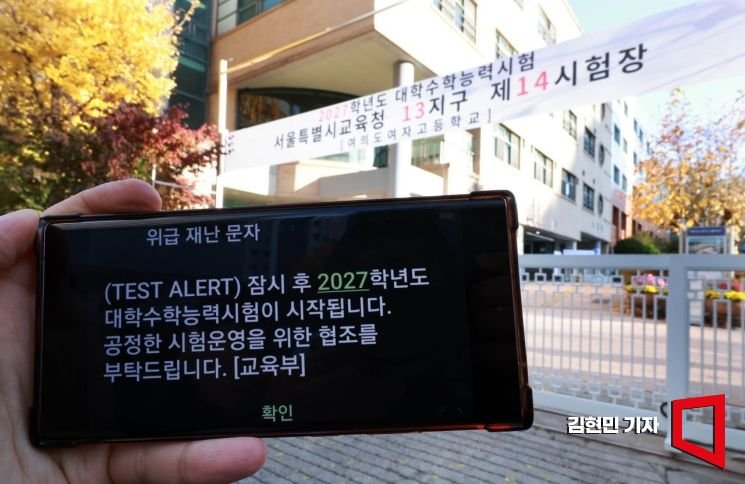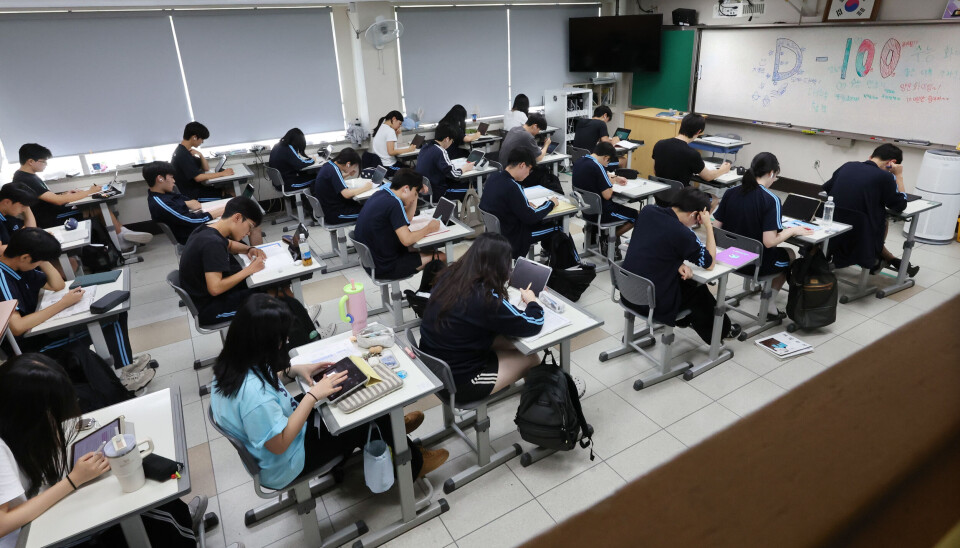
Korea’s first nationwide emergency alerts for the college entrance exam startled residents and foreigners while helping authorities find 22 unauthorized smartphones.
Two Japanese nationals at a cafe in Jung District, central Seoul, looked up in surprise Thursday morning when their phones suddenly blared with an emergency alert. “What is this?” they asked, before translating the Korean message and realizing it had been sent because of the country’s college entrance exam.
The government sent its first-ever nationwide emergency text, along with a 10.5-second alarm, before the first period of the 2027 College Scholastic Ability Test (CSAT) began, after the third period ended and during the fourth period. The aim was to expose test-takers carrying phones that could be used for AI-assisted cheating.
The alert reached foreigners in Korea through the Emergency Ready app, which provides disaster alerts and safety guidelines in 22 languages.
Many Koreans were also caught off guard, asking people around them what was happening. “Oh, that startled me,” one said. “For a second I thought a war had broken out,” said another.
A civil servant who left work around 8 a.m. after an overnight shift complained to the JoongAng Ilbo that he “couldn’t get a wink of sleep because the alert went off three times.” Homeless people sleeping at Hapjeong Station in Mapo District, western Seoul, looked around anxiously when the alarm sounded at 8:30 a.m. At a cafe in Anguk-dong, Jongno District, central Seoul, some customers grumbled, “Is it going to be like this the whole time the exam is going on?”
Posts on online communities claiming that several soldiers had been caught secretly using a second phone in the military and had their phones confiscated also drew attention. Some people online claimed they did not receive the text or that no alarm sounded, but the Ministry of the Interior and Safety said there have been no officially confirmed cases of missed alerts.
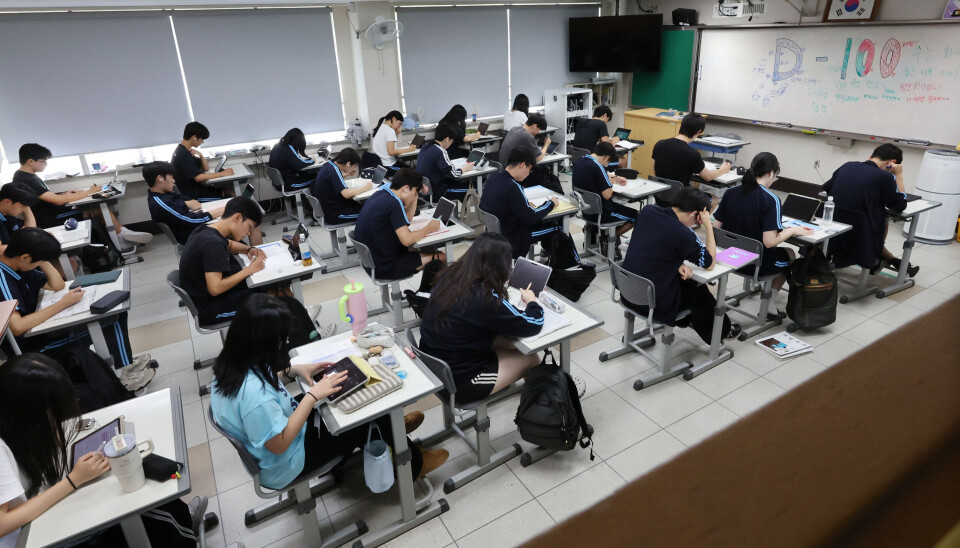
It was the first time an emergency alert had been sent to the entire population since the system was introduced in 2017, but many residents were unfazed because the government had publicized it in advance. A group of older people at a cafe in Jung District said the alerts were “meant to pick out anyone who didn’t turn in their phones, even if it’s later,” adding, “With so many cases of cheating, people need to be made aware.”
“Through the emergency alerts, we caught 22 smartphones in nine cities and provinces nationwide,” said Vice Education Minister Choi Eun-ok. “We will closely check whether [the test-takers] carried advanced devices such as ultrasmall cameras, and if cheating involved such devices, we will take stern measures, including filing complaints for obstruction of official duties by deception.”
BY KIM JEONG-JAE, KWAK JOO-YOUNG, CHOI HYE-RI [lee.jian@joongang.co.kr]