“The United States has an extraordinary measles problem. We’ve had more measles cases in the last 18 months than we’ve had in the previous 25 years combined,” said Noel Brewer, a public health professor at the University of North Carolina at Chapel Hill.
Endemic measles poses a serious risk to people who are unvaccinated, said Dr. Walter Orenstein, former director of the U.S. immunization program at the Centers for Disease Control and Prevention. The risk is especially pronounced for infants, who are not typically eligible for the first dose of the vaccine until they turn 1, as well as those who cannot get the shot because they are immunocompromised.
“People can go into a supermarket and get infected,” he said.
At least four of the measles deaths this year were in babies too young to be vaccinated.
Some health departments in outbreak zones are recommending an early dose for infants as young as 6 months.
Measles is among the most contagious viruses known to humans: One infected person can spread the virus to 9 out of 10 others in close proximity. It can linger in the air for up to two hours. Infections in unvaccinated people can lead to deadly complications such as pneumonia or brain swelling.
Brewer said the U.S. desperately needs a strategy for tackling measles.
“The lack of action to address the growing outbreak is clear negligence,” he said.
Under past presidential administrations, the CDC has responded to measles outbreaks with media briefings and vaccination campaigns, but the agency has not done so this year.

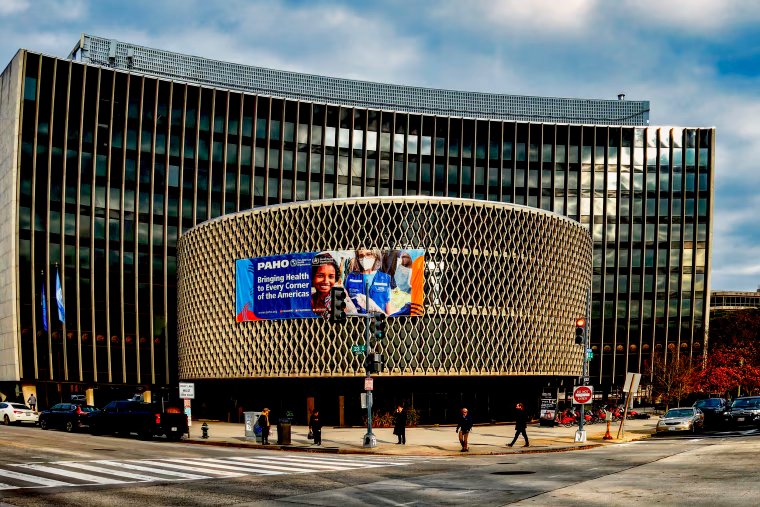
Dr. Daniel Salas, executive manager of PAHO’s Special Program for Comprehensive Immunization, said Tuesday that the U.S. is expected to submit a corrective plan of action in the coming weeks. He added that the country is already taking steps to close immunity gaps in undervaccinated communities.
The CDC and its healthcare partners said Tuesday in a joint statement that they will encourage MMR vaccination, expand access to shots, strengthen data sharing and “hold ourselves accountable for measurable progress.”
A spokesperson for the Department of Health and Human Services said that the CDC has “mounted an aggressive response to measles outbreaks,” including allocating $100 million in additional funding in October and deploying experts to support state responses. Health Secretary Robert F. Kennedy Jr. and CDC Director Dr. Erica Schwartz “continue to recommend MMR vaccination as the most effective way to prevent measles,” the spokesperson said.
“We know where transmission is occurring and we’re working with state and local health departments to reach those communities,” Schwartz said in a separate statement. “Losing a designation doesn’t mean we abandon an evidence-based approach. It means we remain focused on stopping outbreaks.”
Kennedy said on X that HHS will work to regain the country’s measles elimination status.
“We are working to close vaccination gaps and rebuild public trust. We will answer families’ questions honestly about vaccine benefits and risks and work with trusted health care providers and community leaders to prevent measles, limit its spread, and support timely treatment,” he said.
Since taking office, Kennedy has questioned the safety and effectiveness of measles vaccines and touted unproven remedies like inhaled steroids. President Donald Trump, meanwhile, falsely suggested in August that the combined measles shot could be “quite lethal,” despite decades of evidence demonstrating its safety.
“We have seen frequent and damaging public comments that have been shaking the confidence of parents about vaccination,” Brewer said.

The pandemic accelerated the downward vaccination trend. Some parents avoided taking their children to the pediatrician, which meant delaying routine shots. An onslaught of misinformation about the Covid vaccines also reignited debunked theories, including the false notion that measles shots are linked to autism.
Since 2019, 82% of counties and jurisdictions across the U.S. have reported declines in measles vaccination rates. Three small, rural counties — Catron County, New Mexico, and Adams and Custer counties in Idaho — have rates for kindergartners below 50%.
Even before the pandemic, the World Health Organization warned that vaccine hesitancy was contributing to a global resurgence of measles.
“It’s not just a U.S. problem, and it’s not just this administration,” Brewer said.
Last year, Canada’s measles elimination status was revoked following an outbreak that led to more than 5,000 cases.
“It wasn’t for a lack of effort in Canada. There was a political commitment at the highest level to sustain measles elimination and to stop that outbreak,” said Dr. Jon Andrus, a global health professor at George Washington University and the chair of the PAHO commission that determines measles elimination status. “That was for me the sad part of the story, because they really did try.”
Barbosa, PAHO’s director, said Tuesday that Canada has interrupted measles transmission in its outbreak but that the country needs to keep up with vaccinations and surveillance to reclaim its elimination status.
It could take years, experts said, for the U.S. to do the same.