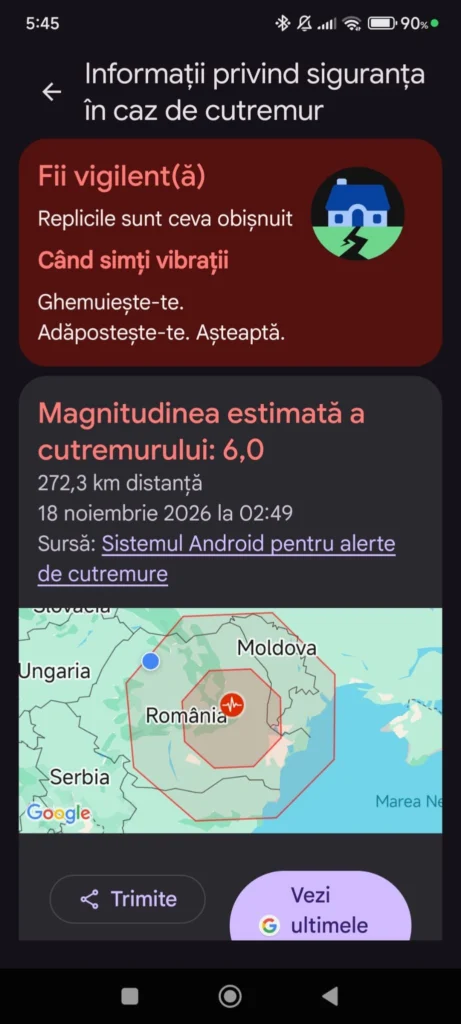
The 5.7 earthquake that occurred Wednesday morning in Vrancea was accompanied, for many Romanians, by a notification on their mobile phones. Google’s earthquake warning system sent alerts to Android users, but the magnitude displayed was not the same on all devices. Some notifications indicated 6.5, others 6.0, while Romanian seismologists established the earthquake’s magnitude at 5.7.
The warnings were automatically generated by the Android Earthquake Alerts System, a technology that uses mobile phones to detect earthquakes and can give users a few seconds to protect themselves.
According to Mediafax, a notification sent around 02:49 announced: “Earthquake at 02:49. You may have felt vibrations. Initial estimated magnitude of 6.5, at a distance of approximately 148.4 km.”
The estimates displayed by Google were not identical on all devices. While the notification presented by Mediafax indicated a magnitude of 6.5, at approximately 148 kilometers distance, a screenshot obtained by Spotmedia.ro from a user in Cluj-Napoca showed an estimated magnitude of 6.0, at 272.3 kilometers distance.
According to the National Institute for Earth Physics Research and Development (INFP), the earthquake occurred at 02:48:55, had a magnitude of 5.7 and a depth of 120.8 kilometers.
Why Google announced different magnitudes
The differences between the values displayed by Google and those communicated by INFP are due to how the estimates are calculated. Google’s system automatically analyzes the information available immediately after an earthquake occurs and quickly estimates its parameters to send warnings.
In contrast, data communicated by seismological institutes are based on instrumental recordings and can be revised as additional information is analyzed.
Google specifies that its estimates regarding magnitude and intensity of seismic movements may be inaccurate and that the displayed information can be updated later. Therefore, the values of 6.5 and 6.0 shown on phones do not represent confirmed earthquake magnitudes but are automatic estimates made by the Android system.
How Google detects an earthquake
The technology developed by Google turns Android phones into a network of seismic sensors. Smartphones are equipped with accelerometers, sensors that detect device movement and can also identify vibrations caused by an earthquake.
When multiple phones in the same region record movements compatible with an earthquake, the data are analyzed by Google’s systems to estimate the earthquake’s location and intensity.
The technology takes advantage of the fact that seismic waves propagate at different speeds. Primary waves, called P waves, arrive first and are followed by S waves, which travel slower and can cause stronger ground movements.
Electronic information travels much faster than seismic waves, allowing warnings to be sent to people in areas where strong movements have not yet arrived.
The system cannot predict earthquakes. It detects earthquakes after they have already started. Also, the warning does not always arrive before seismic movements. Google specifies that users can receive the notification before, during, or even after they have felt the earthquake.
Why the alarm can sound even when the phone is on silent
Google uses several categories of alerts depending on the estimated intensity of seismic movements in the user’s area.
On October 15, 2026, the company announced the expansion of the earthquake warning system and the introduction of a three-level alert structure:
- Be Aware – informational notification for seismic movements estimated to be light.
- Be Ready – a more detailed warning urging users to prepare.
- Take Action – full-screen alert for moderate or strong movements, accompanied by protection instructions.
For high-level alerts, Google’s system can trigger a loud sound even when the phone is set to silent or “Do Not Disturb” mode. However, not all notifications produce such an alarm.
The goal is for the warning to immediately attract the user’s attention, including during the night when they are sleeping.
Why some Romanians received the alert and others did not
Not all Android phones automatically receive the same warning.
Google uses the device’s approximate location and the estimated intensity of seismic movements to decide where to send notifications.
It also matters whether the phone is compatible, if the warning service is active, and if the device has an internet connection.
Therefore, people in the same locality can have different experiences: one may receive a loud alert, another a discreet notification, and a third may receive nothing.
According to Google, the feature is enabled by default on many compatible Android devices.
Why no RO-ALERT message was sent. Raed Arafat’s explanations
Google’s warnings are independent of the national RO-ALERT system, and Romanian authorities have decided not to use this system to alert the population before earthquakes.
The head of the Department for Emergency Situations, Raed Arafat, explained Wednesday morning on Digi24 that the subject has been discussed repeatedly, and authorities consider that a warning transmitted only a few seconds before an earthquake could rather cause panic. “We have said very clearly that through RO-Alert we do not announce an earthquake a few seconds before it happens, because there is neither time for evacuation nor time to take measures, and we rather induce panic,” Arafat stated.
The head of DSU argued that if a RO-ALERT message had been sent during the night, authorities would have been criticized even by people who did not feel the earthquake. “I am convinced that if a RO-Alert message had been sent at night, we would have had comments about why we sent the RO-Alert message, since many did not feel the earthquake and did not wake up,” he said.
Arafat also noted that most phone calls received after the earthquake were related to panic attacks and emphasized the importance of preparing the population for such situations.
Separately, the General Inspectorate for Emergency Situations explained that Google notifications are not sent by Romanian authorities and should not be confused with RO-ALERT messages, as the two systems operate differently.
How to check if earthquake alerts are activated
Android users can check the feature in the phone’s menu:
- Open Settings.
- Go to Safety & Emergency.
- Select Earthquake Alerts.
- Check if the option is enabled.
On some devices, the feature can be found in the Location menu, and the names may vary depending on the manufacturer and Android version. An internet connection via Wi-Fi or mobile data is also required.
The Android Earthquake Alerts system has been available in Romania since 2022, and Google announced in October 2026 that the service is already operational in over 200 countries and regions. The company claims that since the technology’s launch, it has sent over a billion earthquake warnings worldwide.
The English translation of this article was generated with the assistance of AI technology.