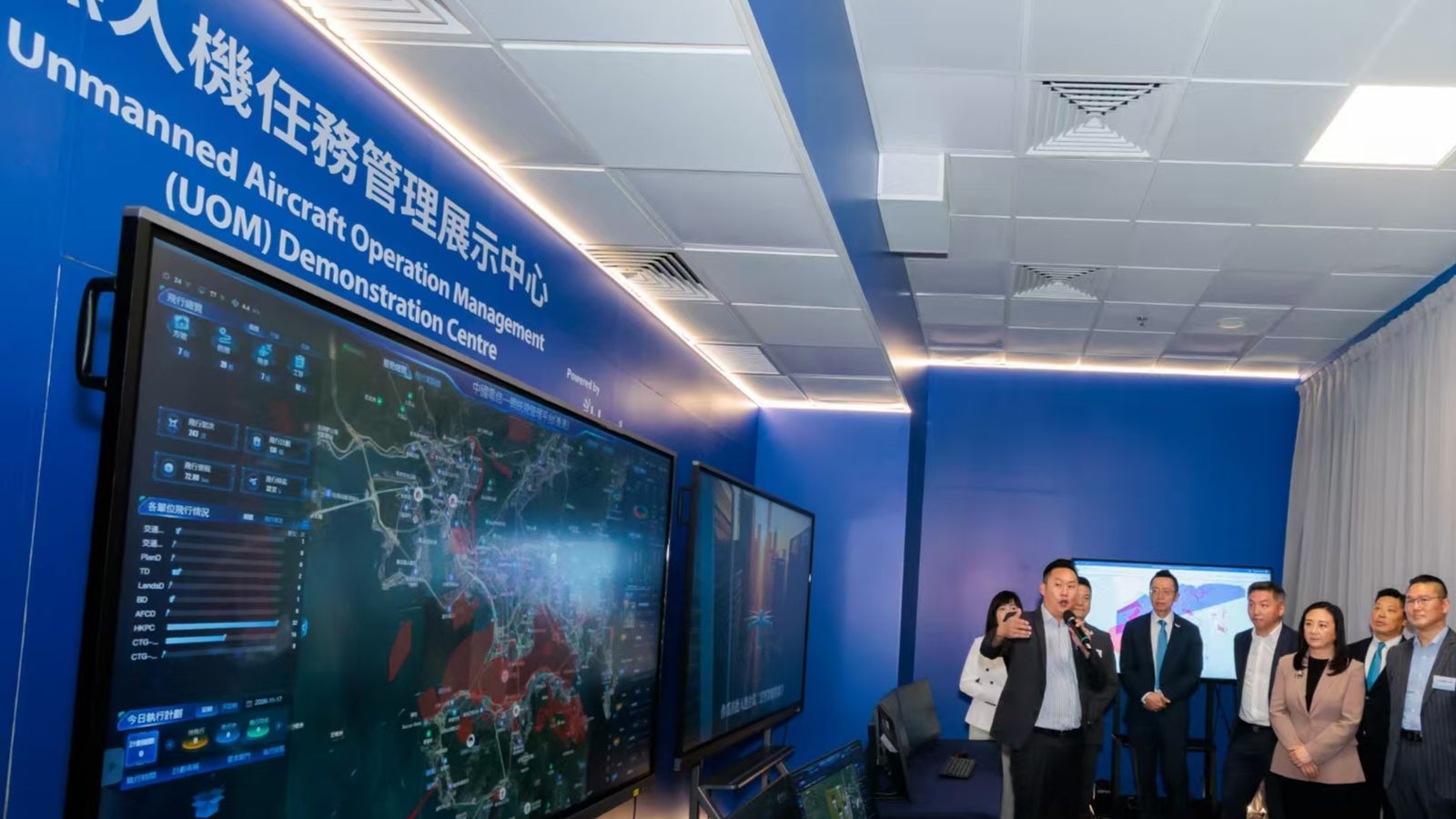
Hong Kong opened a demonstration center on Tuesday where government departments will share drone resources through a single management platform, signaling a shift towards industrialized, large-scale applications in the city’s fledgling low-altitude economy.
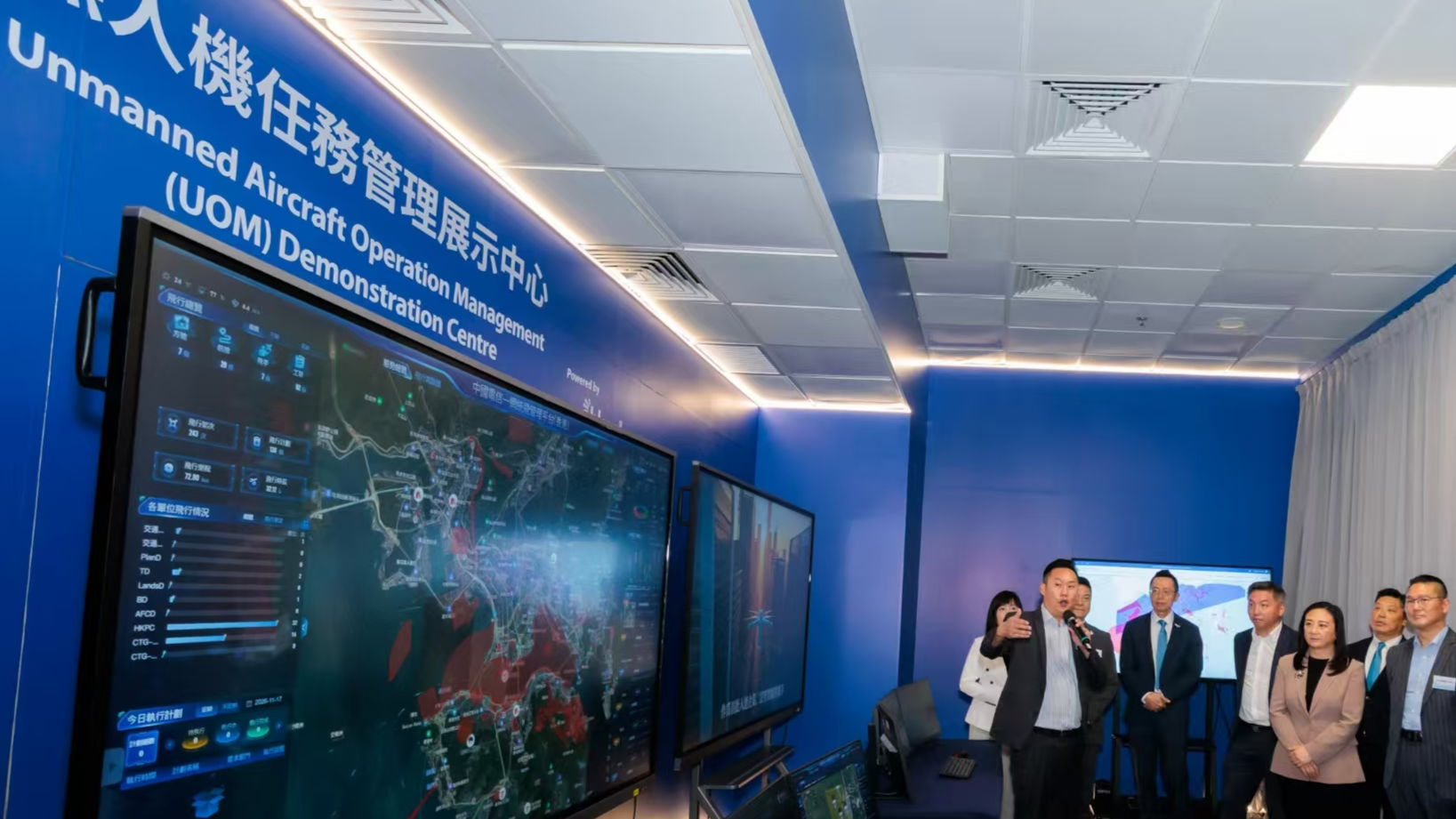
The Hong Kong Productivity Council (HKPC) and the government’s Working Group on Developing Low-altitude Economy jointly opened the Unmanned Aircraft Operation Management Demonstration Centre, which features a centralized operating system designed to serve as a digital foundation for a smart city.
Sunny Tan, chairman of the HKPC, said the center is “more than a technology exhibition platform”. “It represents an important step in advancing drone applications from a single pilot towards shared, platform-based and large-scale development,” he added.
Deputy Financial Secretary Michael Wong Wai-lun, who also heads the working group, reaffirmed the Hong Kong Special Administrative Region government’s commitment to developing the low-altitude economy and positioning the city as a hub for its applications.
He said the government is working closely with stakeholders across society to draw on their expertise and integrate low-altitude technologies into daily life to improve public services.
More than 20 government departments have joined the project, exploring applications including public facilities monitoring, pollution prevention and climate data analysis.
“By closely partnering with various societal stakeholders, the government is pooling collective wisdom to integrate low-altitude tech into daily life for better public service,” he said.
Supported by the Digital Policy Office, the event also showcased interim results from the Multiple Applications/Users Shared-Platform, one of the key testing areas under the government’s Low-altitude Economy Regulatory Sandbox X.
Launched in November 2025, Sandbox X covers applications including cross-boundary operations and has recorded more than 160 pilot projects spanning infrastructure monitoring, surveying, railway inspection and logistics delivery, according to Wong.
Using a “one flight, multiple applications” approach, the platform combines drones, artificial intelligence, automated docking stations and real-time data processing to support public services, including traffic monitoring and landslide risk assessment.
Lawmaker Elizabeth Quat Pui-fan, founding president of the Greater Bay Area Low Altitude Economy Alliance, said the shared-platform model had proved effective in mainland cities. She expressed hope that the platform will be used for commercial services in the near future.
Six technology and AI software providers are participating in the platform, supporting applications including traffic and infrastructure monitoring, land and maritime surveillance, and environmental protection.
China Telecom Global and China Mobile Hong Kong, two major drone service providers participating in the platform, are drawing on their computing and satellite infrastructure to support urban monitoring and planning for the Northern Metropolis.
Yunsheng Intelligent, a startup based in Beijing’s Zhongguancun technology hub, has developed a voice-controlled drone system with onboard computing capabilities designed to process data in real time and support rapid responses in coordination with public-service agencies.
The system features an AI agent named after the Monkey King, designed to make industrial drones easier to operate.
Zhu Shengli, the company’s co-founder and chief marketing officer, told China Daily that its drone system uses world-leading technology for industrial drone services. He said the company also plans to incorporate design elements inspired by Hong Kong’s bauhinia flower into the system, particularly its docking stations.
Cross-boundary applications are the next step, Raymond Shan, HKPC’s general manager of new industrialization division, told China Daily. He said the Hong Kong SAR government is working with mainland authorities on cross-boundary logistics routes, customs arrangements and related infrastructure in the Guangdong-Hong Kong-Macao Greater Bay Area.
The center is expected to “lay a practical foundation” for further cross-boundary applications in future logistic networks in the Greater Bay Area.
Contact the writer at jessicachen@chinadailyhk.com