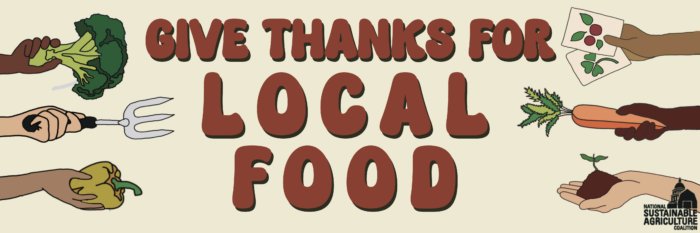
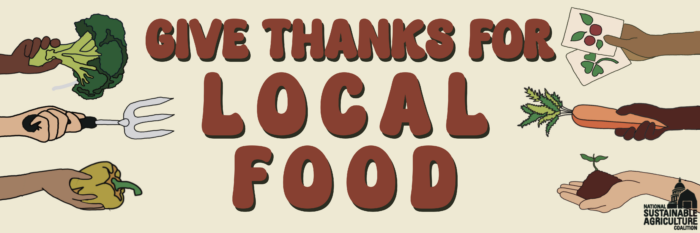
Local food should be for everyone. And the farmers who produce it should be able to earn a living feeding their communities.
This Thanksgiving, the National Sustainable Agriculture Coalition (NSAC) is grateful for policies that connect farmers who need markets to sell their locally grown produce with neighbors who need access to healthy, affordable groceries.
While some farms produce crops for fuel, energy, animal feed, or fiber, 57% of farms produce food that people eat, according to the 2022 Census of Agriculture. This week NSAC celebrates our members and their communities for the work they do every day to grow food that promotes the health of their neighbors and their soil. Too often, the extra work by farmers, cafeteria managers, and farmers market managers to make local food available is underfunded and unnoticed.
One of our members, PASA Sustainable Agriculture, is sharing a local food success story from Twin Maple Farm, a fourth-generation family farm that grows potatoes, vegetables, and grain. It’s one of more than 10,000 farms that benefited from the Local Food Purchasing Program – a program that paid farmers and ranchers to provide their neighbors with healthier, locally grown food. “It is even more rewarding knowing that it is all staying in the local community and helping those who are less fortunate to get a good nutritious meal,” say the folks at Twin Maple Farm in Pennsylvania.
Local Food in Action
Each day this week, an NSAC member will share their own local food story that highlights the strength of local relationships that produce real financial benefit for farms in their networks and provide meaningful access to the healthiest food available. While these stories are personal, they are not unique. Hundreds of NSAC members could share similar experiences of how local food creates new jobs, transforms school meals, eliminates food deserts, and generates sustainable new economic opportunities in communities nationwide.
The week kicks off with The Louisiana Food Policy Council (LA FPC) offering a glimpse into one of the most commonly frequented local food marketplaces – the farmers market. Beyond the market being a reliable revenue source for a farmer, it offers a community gathering space and, thanks to the work of LAFPC, a place where families can pair their SNAP benefits with doubling programs that allow them access to affordable nutritious foods.
But local food doesn’t have to be confined to a weekend market. Advocates like the National Farm to School Network (NFSN) have made daily access to local food and nutrition education in school cafeterias possible around the country, improving children’s health and strengthening family farms. As one food service director shares, it is no easy task: “when we are faced with acquiring a new vendor, there are a whole lot of steps that come with that ahead of actually getting the product in the kitchen.”
Farmer-focused member stories shared by our members, Community Alliance with Family Farmers (CAFF) and Pasa Sustainable Agriculture, show how diligent work pays off. Both provide programs and training offering hands-on assistance to farmers or food service buyers. These services help farmers build the capacity and skills to navigate food safety certifications, open bidding, and processes to sell to institutions and other wholesalers. This diversifies farm revenue, and forward contracting allows farmers to invest confidently in resources and labor for the season.
NSAC members work to ensure all farmers have access to reliable and profitable market opportunities. For example, Cultivate Kansas City pairs land, training, and market opportunities at Juniper Gardens Training Farm to help New Americans develop and maintain their small businesses. Participating farmers can sell to any market of their choosing, but they can also sell to the Dotte Mobile Grocer, handling pickup and delivery throughout Wyandotte County.
Without the support of the dedicated nutrition officials, technical assistance providers, incubator farms, and committed buyers that make up local food systems, these lucrative relationships may not exist.
How Congress Can Show Their Appreciation
NSAC thanks the thousands of people across its member organizations who manage the tedious and complex processes to ensure local food makes it to the cafeteria tray and table. NSAC calls for meaningful federal investments that institutionalize these relationships and build robust supply chains that make local food success stories like these permeate the nation.
Bipartisan leaders in the House and the Senate have laid the groundwork in the Farm, Food, and National Security Act of 2026 (H.R.7567) and the Agricultural Act of 2026 by including the Strengthening Local Food Security Act and the Local Farmers Feeding our Communities Act. The Senate’s Strengthening Local Food Security Program takes the House version of the program one step further by ensuring local food purchases can reach both food pantries and schools and provides $400 million in mandatory funding. To adequately serve the needs of food insecure communities and schools, the program needs $200 million each year, totaling $1 billion for the five-year farm bill.
Beyond building market demand, Congress must invest in regional food supply chain capacity. The lack of local processing options for ranchers is a consistent and significant bottleneck that impacts the production, pricing, and availability of local meat. Schools often require minimally processed produce, such as carrot sticks, to easily incorporate farm fresh products. Congress can address discrete issues, combat corporate consolidation, and build the long-term capacity of states to manage regional supply chains by including the bipartisan American Food Supply Chain Resiliency Act.
As Congress wraps up its work for the year, lawmakers should set the table for a local food feast by prioritizing and funding programs that build closer connections between farmers and their communities.