The pain in AI stocks may stretch on for a while, one longtime strategist is warning.
Jim Paulsen, the former chief investment strategist at The Leuthold Group, says he sees a deeper stock correction looming, even as the market aims to regain its footing after a brutal sell-off in Nvidia jolted investors this week.
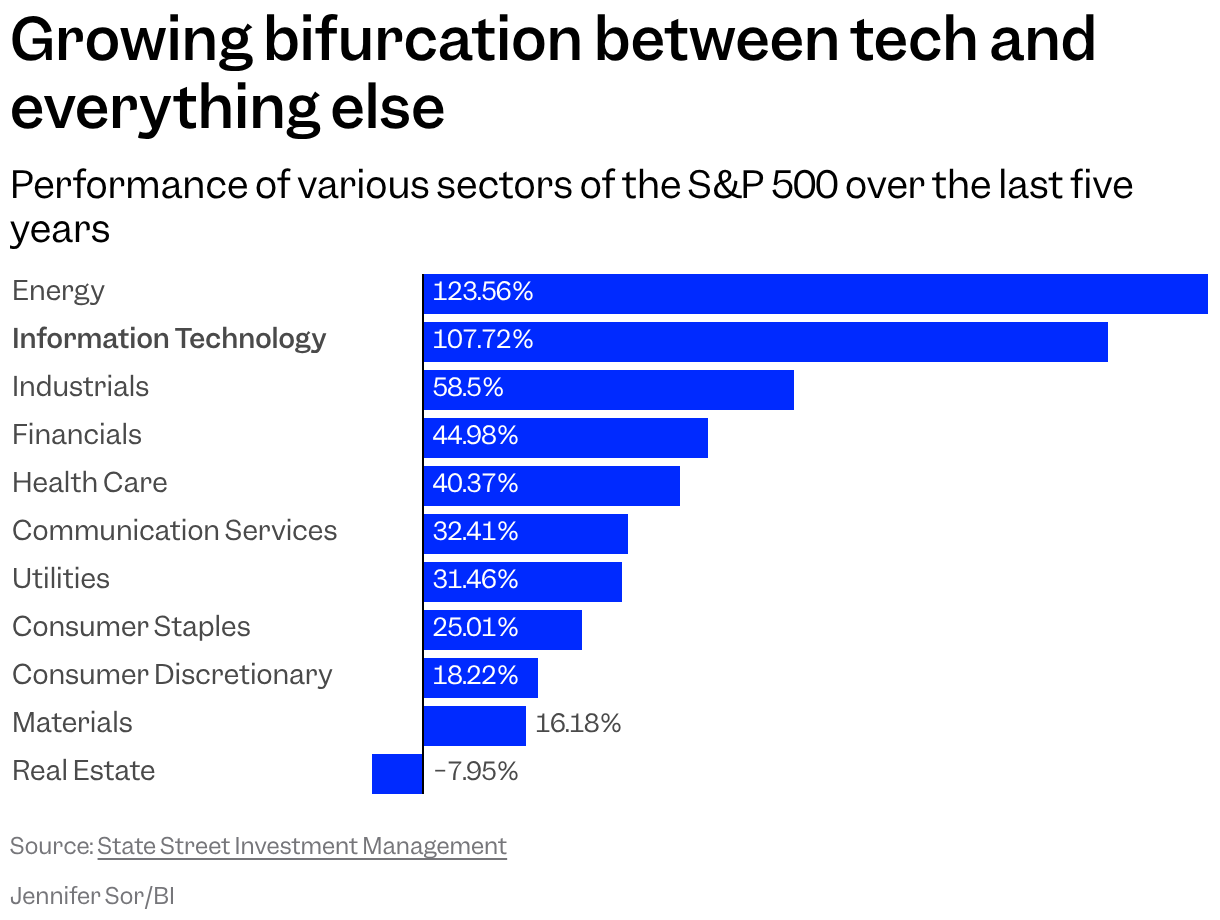
Paulsen is worried about a stark bifurcation between tech stocks and those in other sectors, with tech vastly outperforming most other areas of the market over the past several years. That gap will need to narrow before the bull market can be considered on solid footing, Paulsen told Business Insider in an interview, speculating there could be a reset that involves tech stocks tanking more than 20% as investors reset their expectations.
A tech sell-off of that magnitude could drag the broader S&P 500 down by around 10% to 15%, he estimated, pointing to tech’s outsize importance in the benchmark index. The upper end of Paulsen’s forecast implies the S&P 500 dropping as low as 6,400, a level that hasn’t been seen since stocks swooned in the first months of the US-Iran war.
“We’ve had truly tech and telecom go up, and everything else is sort of debatable whether there’s really been a bull market,” Paulsen said. “My point is that the growth rate there is so phenomenal that even if it doesn’t fall apart, it probably can’t sustain those levels,” he later added.
Paulsen pointed to the growing gap between what he called the “new era” stocks in the market, his shorthand for the information technology sector, and “old era” stocks, a label that encompasses everything else.
Over the last five years, growth in the S&P 500’s tech sector has outpaced most other areas of the index, soaring 107% since November 2021. The one exception is energy, thanks largely to the spike in oil prices that followed the start of the Iran war.
Paulsen said the split looks even more extreme than the bifurcation between tech stocks and other sectors at the peak of the dot-com bubble, and is unsustainable for a few reasons.
- The boom in the AI sector is squeezing other areas of the economy. Immense growth in tech is contributing to hotter inflation and higher rates, but tighter financial conditions don’t appear to be slowing investment in the new-era portion of the economy. Amazon, Alphabet, Meta, Microsoft, and SpaceX, four of the largest spenders in the AI trade, are on track to drop around $800 billion in capex this year.
However, tighter financial conditions are impacting the old-era portion of the economy, where growth has fallen to levels consistent with past recessions. Paulsen estimated that areas outside of tech are growing at around a 1% annualized pace.
“If the new era economy keeps booming, probably the Fed and other officials are going to keep tightening,” he said, adding that growth in the old-era economy could eventually be choked off.
- Stock prices look vulnerable to even a mild slowdown in the AI sector. Expectations for rapid growth in the tech sector have already been baked into stock prices. That suggests even a mild slowdown of AI investment has potential to create an outsized effect on tech stock prices, Paulsen said.
Strategists, meanwhile, have been eyeing an earnings slowdown in 2027 as hyperscalers pull back on capex spending. Goldman Sachs estimated that S&P 500 earnings per share growth could drop from a pace of around 36% a year to 11%, falling below the historic average of around 15% annual EPS growth.
If growth were to slow, the tech sector would likely be repriced rapidly, Paulsen said, pointing to how concentrated investors have been in tech.
“If tech really hits the air pocket, it goes down radically,” he said.
The silver lining is that once the heat gets taken out of the tech sector, Paulsen sees the AI trade thriving again. The idea is that the US needs to let some steam out of the new-era economy in order for the Fed to lower rates, boosting the old-era side and allowing those stocks to recover.
“Maybe the older economy does better for a while while the new era grows, but at a slower, more refreshing pace,” he said of the market’s long-term path.
Stocks appear to be at a critical juncture, with the indexes whipsawing in recent weeks as investors panic about future data center construction and the crisis surrounding Nvidia’s CEO. The two prominent fears spreading among investors have been that, 1), tighter regulation will put an end to new data centers in the US, and 2), that the AI trade will stumble without Nvidia founder Jensen Huang cheerleading the movement.
