Key Points
-
Geely agreed to contribute its commercial battery-swap business and some cash to acquire a 30% stake in Nio Power.
-
Investors have long questioned Nio’s battery-swap network and its ability to contribute to profitability.
-
Nio’s “other sales” have turned the corner and remain in positive territory.
- 10 stocks we like better than Nio ›
Tesla (NASDAQ: TSLA) and Nio (NYSE: NIO) have one very important thing in common. Both believe that the true battleground for electric vehicle (EV) dominance is not only in designing and developing advanced EVs, but also in the underlying infrastructure itself. Nio’s battery-swap network is playing an entirely different game from Tesla’s charging infrastructure and its North American Charging Standard (NACS).
But if Nio wants to become the next stock to make investors rich, it needs to steal a page from Tesla’s playbook — because it’s brilliant.
Missed AI’s “Act 1”? Act 2 Could Be 15x Bigger. Most investors think they missed the AI boat because they didn’t buy Nvidia in 2005. But according to our analysts, we’re only at the end of “Act 1″—the R&D phase. “Act 2” is the global rollout. Continue »
Image source: Nio.
What’s going on?
Both Nio and Tesla embarked on the same fight: to offer proprietary systems to solve the problems of range anxiety and charging convenience. Tesla realized early in the transition to EVs that charging infrastructure had to come first, and so the automaker built its own network of superchargers and then made the brilliant strategic decision to open up its proprietary charging plug as NACS. Then Tesla distributed adapters to legacy automakers Ford Motor Company and General Motors, and even young EV maker Rivian, and drove a successful shift from individual charging specifications to a universal standard in North America.
For Tesla, this strategic move essentially opened up the door for every non-Tesla vehicle using an adapter to plug into the automaker’s Supercharger network to become a paying customer. By being early to the game and recognizing the importance of charging infrastructure, Tesla turned a loose set of standards into a competitive advantage and then monetized it. That’s exactly what Nio needs to do with its battery swap network.
Be first, or you’re last
Analysts and many investors have remained skeptical and anxious about Nio’s battery-swap network, which is capital-intensive up front and doesn’t yet have a large enough Nio-vehicle user base to generate enough battery-swap demand to break even. However, by watching gross margin growth in Nio’s “other sales,” which includes its battery-swap business, you can see that the growing user base is becoming more profitable with each additional Nio vehicle delivered.
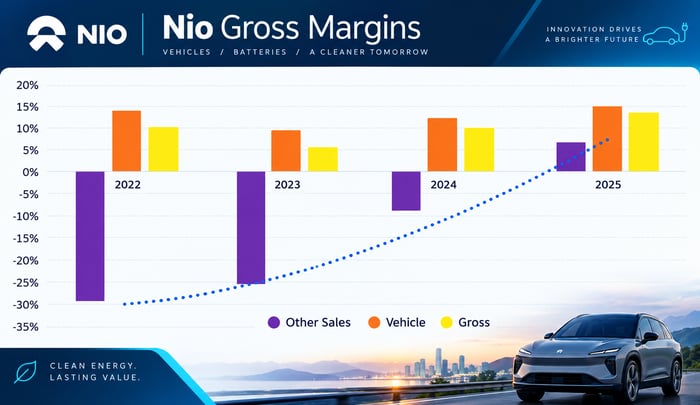
Chart data source: Nio SEC filings. Chart generated by ChatGPT by author.
What investors are also overlooking is that Nio’s battery-swap network could literally change the game for how Wall Street values the company. Nio already operates the largest battery-swap network in China, with over 125 million battery swaps tallied, over 4,100 battery-swap stations, and a 2026 goal of reaching 4,700, along with a continuous stream of partners coming into the fold.
In fact, just this week, Geely and Nio announced that the former would put up its commercial battery-swap business, along with $95 million in cash for a 30% stake in Nio Power, Nio’s entity that runs its battery-swap network. In a second transaction, Nio agreed to purchase a 10% stake in Haohan Energy, a Geely subsidiary that operates its fast-charger network. The two plan to fully integrate their charging infrastructure ecosystems, a critical step toward Nio becoming the “gold standard” for battery swaps in China.
What it all means
Investors and analysts still seem to be valuing Nio as if its battery-swap network is a major drag — and, to be fair, it will remain a significant up-front cost until the network is fully built. But in reality, Nio’s “other sales” growth in gross margin shows how close its riskiest asset is to becoming a driving force not only for higher margins in a notoriously low-margin industry, but also for a fatter bottom line and a more appealing valuation ratio.
Further, Nio’s deliveries are poised to continue growing with the recent launches of the subbrands Onvo and Firefly. While Onvo and Firefly continue to push more affordable sales volume, Nio’s premium namesake brand recently launched premium SUVs that are selling well and helping offset margin pressure amid China’s well-known EV price war. Nio’s likely to break even on adjusted earnings in 2026, and it’s time Wall Street started valuing the company as if it’s going to be bottom-line profitable as soon as next year.
Should you buy stock in Nio right now?
Before you buy stock in Nio, consider this:
The Motley Fool Stock Advisor analyst team just identified what they believe are the 10 best stocks for investors to buy now… and Nio wasn’t one of them. The 10 stocks that made the cut could produce monster returns in the coming years.
Consider when Netflix made this list on December 17, 2004… if you invested $1,000 at the time of our recommendation, you’d have $361,650!* Or when Nvidia made this list on April 15, 2005… if you invested $1,000 at the time of our recommendation, you’d have $1,437,517!*
Now, it’s worth noting Stock Advisor’s total average return is 936% — a market-crushing outperformance compared to 213% for the S&P 500. Don’t miss the latest top 10 list, available with Stock Advisor, and join an investing community built by individual investors for individual investors.
*Stock Advisor returns as of October 6, 2026.
Daniel Miller has positions in Ford Motor Company and General Motors. The Motley Fool has positions in and recommends Tesla. The Motley Fool recommends General Motors. The Motley Fool has a disclosure policy.