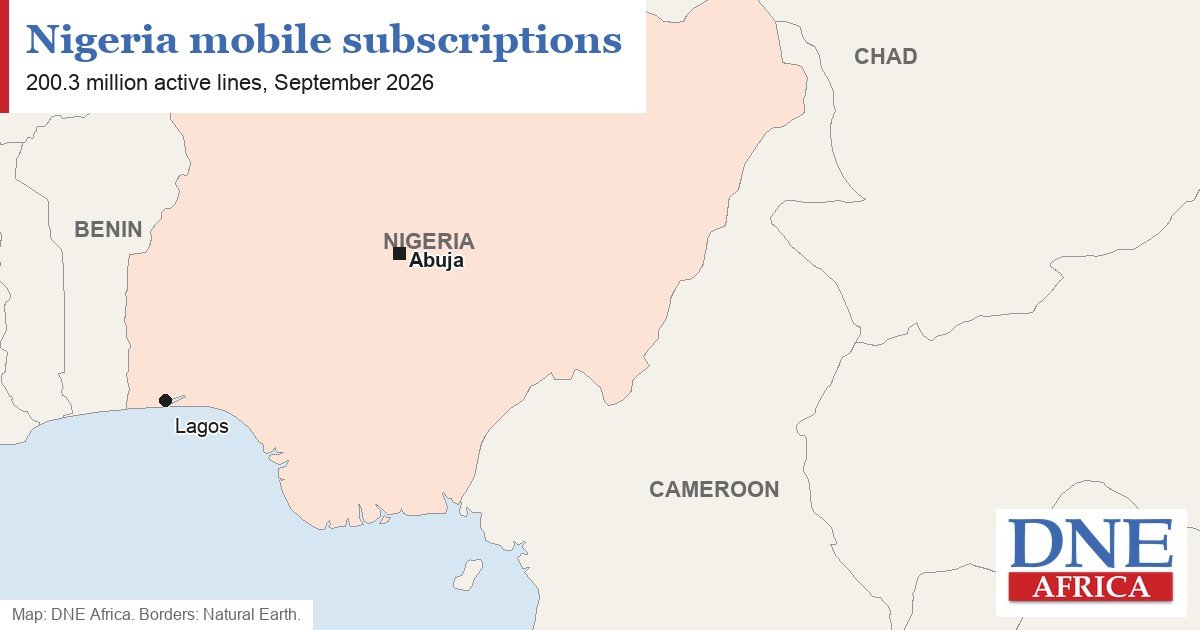
Nigeria mobile subscriptions rose 29% in two years to 200.3 million in September 2026, recovering from the fall that followed the NIN-SIM purge, according to Nigerian Communications Commission (NCC) data.
The figures were reported by TechCabal. The recovery in Nigeria mobile subscriptions is concentrated in two operators. MTN and Airtel account for about 86% of active connections, leaving Globacom and T2 Mobile with a much smaller share of Africa’s largest mobile market by population.
How big are Nigeria mobile subscriptions now?
MTN had 104.6 million active subscriptions in September and Airtel had 68 million, together about 172.7 million of the 200.1 million recorded across the four operators, the NCC data show. Globacom had 23.5 million and T2 Mobile 3.6 million.
The figure counts active lines, not people. One person can hold several SIM cards, and active connections also include SIMs used in routers and other devices, TechCabal noted.
What caused the earlier fall in Nigeria mobile subscriptions?
The NIN-SIM policy required subscribers to link their phone lines to verified national identity numbers. It was introduced in 2020, but enforcement intensified in 2024 as operators completed verification and disconnected lines without valid NIN records.
In its 2024 year-end performance report, the NCC said active subscriptions fell from 224.7 million in 2023 to 164.9 million in 2024, a loss of 59.8 million connections, or 26.6%. The commission attributed the decline to removing SIM cards not linked to verifiable NINs and to correcting a major discrepancy in one operator’s subscriber figures.
By August 2024, the regulator said more than 153 million SIM cards had been linked to NINs, representing 96% compliance. It then set 14 September 2024 as the final deadline for operators to complete the exercise.
What do the data show about use and network quality?
Data consumption grew by about 51% year on year in September to 1.73 million terabytes, the NCC figures show. The shift to faster networks remains uneven: 4G accounted for 54.37% of mobile connections and 5G for just 5.05%, while 2G and 3G still made up 36.42% and 4.16%.
Fixed broadband is also expanding. Fibre-to-the-X subscriptions, which cover connections to homes, offices, streets and hubs, rose about 67% between the first and third quarters of 2026. Telecoms contributed 9.72% to gross domestic product in the second quarter of 2026, up from 9.20% a year earlier, the NCC said. It noted that figures for late 2024 and early 2025 were affected by the National Bureau of Statistics’ rebasing of GDP.
Service quality remains a live political issue. MTN, Airtel, Globacom and T2 Mobile have taken the House of Representatives to court over summonses issued to their chief executives in a committee inquiry into network quality, according to Nigerian press reports.
What happens next?
The NCC publishes its subscriber statistics monthly, so the October figures will show whether Nigeria mobile subscriptions keep growing or settle around 200 million. Wider African trends are covered in DNE Africa’s look at the countries leading the 2026 tech boom, and in its report on Nigeria’s place among the world’s largest economies.
FAQ
How many Nigeria mobile subscriptions are active?
The NCC data show 200.3 million active mobile subscriptions in September 2026, up 29% in two years.
Does 200 million mean 200 million Nigerians have phones?
No. The figure counts active lines. One person can have several SIM cards, and some lines are used in routers and other devices.
Why did Nigeria mobile subscriptions fall in 2024?
Operators disconnected lines not linked to verified national identity numbers under the NIN-SIM policy. The NCC also corrected a discrepancy in one operator’s figures.
Which operators lead Nigeria mobile subscriptions?
MTN, with 104.6 million active subscriptions, and Airtel, with 68 million, hold about 86% of active connections.
