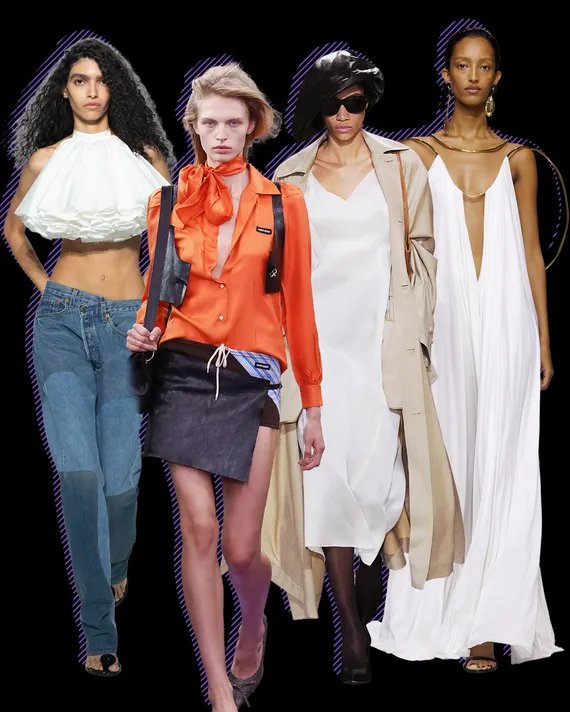

Photo-Illustration: by The Cut; Photos: Getty Images, Courtesy of Jean Paul Gaultier, Celine, Givenchy
Listen to fashion critic-at-large Cathy Horyn read her review.
In October 2021, as the world was in a pandemic, Miu Miu caused a riot with a collection of cut-off school-uniform skirts, cropped sweaters, and loafers with socks. It was all drawn from Miuccia Prada’s personal style but made new in its proportions and energy, and it propelled Miu Miu to the top of the charts in terms of sales and online activity. Six months later, Prada followed with a country-club version of the look with white polo shirts and double-belted micro shorts.
She extended the riot in the fall of 2023 with tailored gym shorts with exposed underwear, navy school blazers, flouncy minis, wide belts, and polos layered over checked shirts, their sleeves rolled high. The proportions were new, too.
On Sunday, Miu Miu’s spring 2027 show was a dusty jukebox of those hits. Prada sent out 75 looks in all, among them tiny shorts in a rounded micromini style, jeans laced erratically with shoestring, and black leather wrap skirts over jersey bottoms. That’s 25 more looks than she showed in the first cutoff collection in 2021, and presumably, the difference is due in part to the men in the show. Still, the collection felt stale. And it didn’t help matters to throw in some skirts that reminded us of Prada’s smart main-line show in Milan recently.
Miu Miu needs another riot, and it starts with better design.


From left: Photo: Estrop/Getty ImagesPhoto: Giovanni Giannoni/WWD via Getty Images
From top: Photo: Estrop/Getty ImagesPhoto: Giovanni Giannoni/WWD via Getty Images
There’s not a lot that feels new or challenging on the Paris runways. I had a great time at Junya Watanabe’s show. For one thing, he played Chaka Khan’s “Like Sugar” and Michael Jackson’s “I Just Can’t Stop Loving You,” and how bad can that be on a Saturday morning in Paris?


From left: Photo: Peter White/Getty ImagesPhoto: Dominique Maitre/WWD via Getty Images
From top: Photo: Peter White/Getty ImagesPhoto: Dominique Maitre/WWD via Getty Images
But for another, Watanabe had the genius to build the entire collection, which he called Funky, on long-sleeve bodysuits and tights in two-tone color combinations and graphic patterns. He threw on tulle princess skirts, beaded evening frocks, portions of deconstructed coats, and for your boobs, bras with spikes of the sort you might find in a sex club. Instead of hammering female sexuality — as many designers have done this season — and the connection between sex and performance, he tickled you. I got up feeling stoked.


From left: Photo: Dominique Maitre/WWD via Getty ImagesPhoto: Dominique Maitre/WWD via Getty Images
From top: Photo: Dominique Maitre/WWD via Getty ImagesPhoto: Dominique Maitre/WWD via Getty Images
But Watanabe’s is a relatively small brand with an avant-garde history. Where are the big ideas from the well-known luxury brands? And who is capable of creating not just weird and wonderful clothes but a universe you actually want to enter?
Alessandro Michele did all that at Gucci, but either Valentino — his gig since 2024 — is too small for his expansive ideas, his intellectual sense of funk and glamour, or he can’t adapt those ideas to contemporary reality. Though another possibility, as I suspect, is that it bedevils Michele to even think of adapting.
What we got on a Sunday, then, was a dramatic location — a historic library that is part of the Sorbonne, located opposite the Pantheon — and a milquetoast collection of casualwear and party separates and gowns, saved only by Michele’s Baroque colors: those deep blues, reds, earthy browns, and golden yellows. When you see a burgundy plaid cotton shirt layered over a lilac lace camisole and tucked into a fringed pencil skirt in an ochre knit with fuchsia boots or a lavender lace bustier with an embroidered sheer cardigan and bright-green rolled-up jeans, you can’t help feeling that Michele’s talents are being wasted.


From left: Photo: Victor VIRGILE/Gamma-Rapho via Getty ImagesPhoto: Victor VIRGILE/Gamma-Rapho via Getty Images
From top: Photo: Victor VIRGILE/Gamma-Rapho via Getty ImagesPhoto: Victor VIRGILE/Gamma-Rapho via Getty Images
And despite the fact that he equated the collection with the notion of an anti-library — that is, unread books in our homes that are tangible proof of stuff we still don’t know — most of his ideas for dressing up are really well known.
Michael Rider’s collection for Celine also wasn’t new, but it immediately hooked the audience, just like his men’s show in June. Sarah Burton attempted to do some daring new things at Givenchy, such as suspending a pair of silk gowns, one in white, the other in royal blue, on looping gold metal frames and creating draped trousers from extra-large men’s pants that, by clever patternmaking, were brought in at the waist for a side drape.


From left: Photo: Givenchy by Sarah BurtonPhoto: Givenchy by Sarah Burton
From top: Photo: Givenchy by Sarah BurtonPhoto: Givenchy by Sarah Burton
And like Rider, Burton had a strong cast of individual-looking women, and she offered a range of tailored looks with a tough edge, including fitted leather dresses and skirts with side zips you can open and close at will. She also offered a fitted black dress with an asymmetrical hem that was more of a skirt suspended on a single long strap and worn with a white cotton shirt. I thought it looked great — and new. Yet, in the main, her collection left me cold.


From left: Photo: Givenchy by Sarah BurtonPhoto: Givenchy by Sarah Burton
From top: Photo: Givenchy by Sarah BurtonPhoto: Givenchy by Sarah Burton
So what’s the difference between the work of these two designers? The answer is that Rider’s clothes looked effortless and Burton’s, though more novel, felt forced. I wanted to say to Burton, Stop trying so hard. Do less and cut out the pom-poms on shoes and a lot of these techniques, like the Japanese-style pants. It’s not you.
In the 18 months since he became Celine’s creative director, Rider has loosened up the fit and bourgeois attitude of the brand, beginning with his men’s show, in which he offered dozens of individual looks, waking up the audience to the obvious. On Saturday, there was a long black silk sack on a woman with Penelope Tree hair and yellow tinted granny glasses; blazers in a camel or cornflower blue over gray crewnecks and tan pleated trousers; an unlined light beige raincoat thrown over a long and loose slip dress in white silk with low heels; a golden-yellow maxi dress with a diamond-pattern detail that vaguely suggested Marrakech; and a small, fitted black leather blazer with soft balloon pants in a mostly blue patchwork that made me think of 1970s vernacular design, like the kind that came out of San Francisco.


From left: Photo: Alessandro Lucioni/ Courtesy of CelinePhoto: Alessandro Lucioni/ Courtesy of Celine
From top: Photo: Alessandro Lucioni/ Courtesy of CelinePhoto: Alessandro Lucioni/ Courtesy of Celine


From left: Photo: Alessandro Lucioni/ Courtesy of CelinePhoto: Alessandro Lucioni/ Courtesy of Celine
From top: Photo: Alessandro Lucioni/ Courtesy of CelinePhoto: Alessandro Lucioni/ Courtesy of Celine
It was a lot. But despite the variety, it made for a coherent collection, and I think the telling difference was that the fabrics were generally lightweight, the clothes not overly constructed, and the styling intuitive. Rider said, speaking of his team, “We had this sense that there was a way to get dressed up and still feel lightness and live in a hotter world. We were definitely talking a lot about that.”
At Hermès, Nadège Vanhée was also thinking of ways to look and feel cooler in the summer. Recalling a trip to Shanghai, she told me, “The hot air was actually perceptible, and I came back to the studio and said, ‘I want featherweight fabrics.’” The show opened with slim T-shirt knit dresses, cotton parkas, and wide-leg pants in shades of off-white and “haze blue,” all meant to evoke the color of air. The cotton shapes were airy with side zips in the pants to create both airflow and volume.


From left: Photo: Filippo Fior / Gorunway.com / Courtesy of HermesPhoto: Filippo Fior / Gorunway.com / Courtesy of Hermes
From top: Photo: Filippo Fior / Gorunway.com / Courtesy of HermesPhoto: Filippo Fior / Gorunway.com / Courtesy of Hermes
Vanhée’s ideas were also effortless with semi-sheer knit pieces made with tiny strips of leather or suede, slim chiffon tube skirts in neutrals or orange that could change shape by virtue of tiny zippers, leather jackets with knit insets under the arms for easier movement, and a roomy orange parachute coat with a drawstring to catch the breeze.


From left: Photo: Filippo Fior / Gorunway.com / Courtesy of HermesPhoto: Filippo Fior / Gorunway.com / Courtesy of Hermes
From top: Photo: Filippo Fior / Gorunway.com / Courtesy of HermesPhoto: Filippo Fior / Gorunway.com / Courtesy of Hermes
Of all the collections over the weekend, maybe my favorite was Duran Lantink’s for Jean Paul Gaultier. The Dutch designer is already at home in Gaultier’s world judging by a pair of sublimely tailored coats in stark white that opened the show (and closed it in black) and with Gaultier’s famous play of innerwear and outerwear — say, a white semi-sheer catsuit with a cropped, keyhole sweater over a white bra.


From left: Photo: Courtesy of Jean Paul GaultierPhoto: Courtesy of Jean Paul Gaultier
From top: Photo: Courtesy of Jean Paul GaultierPhoto: Courtesy of Jean Paul Gaultier
But Lantink is the rare young talent who knows how to create a world of his own. He does that by drawing on the layers of his personality. Most of the patterns and colors in the collection — a red-and-cream plaid for a very Gaultier-like kilt, the tiny red flowers on the keyhole cardigan, the blue checks and red trim on a stiff, squared-off miniskirt — are based on vintage Dutch textiles. The mini’s shape comes from a traditional Dutch shoulder piece called a kraplap.


From left: Photo: Courtesy of Jean Paul GaultierPhoto: Courtesy of Jean Paul Gaultier
From top: Photo: Courtesy of Jean Paul GaultierPhoto: Courtesy of Jean Paul Gaultier
Watching the models whisk around the room in densely gathered white cotton dresses and a similar cotton top with faded jeans, I whispered to my seatmate, “I like this collection a lot.”
He nodded. “It’s good-natured,” he said. It’s a world, indeed, where many of us would like to live.