TL;DR: Brent fell 5.85% to settle at USD 92.57 on Monday as Trump’s signals against renewed Iran strikes pushed the market to discount escalation risk, breaking the 93.80 Fibonacci level. The US naval blockade remains in place, so the decline is a repricing of strike risk rather than a restoration of supply, and 88.21 is the next test.
Why Is Brent Breaking Lower While the Iran Blockade Remains?
Brent crude oil’s selloff resumed through last week’s low on Monday as US President Donald Trump’s repeated signals against renewed military strikes on Iran reinforced expectations of de-escalation, while signs of a softer physical oil market added to downward pressure. As weakness continued into Tuesday’s Asian session, Brent is approaching a critical test of 88.21 Fibonacci support. Meanwhile, Washington’s conditional restraint does not amount to a peace agreement, and the US naval blockade remains in place. That distinction could determine whether the decline develops into a broader bearish reversal or encounters renewed geopolitical support.
Brent Falls Nearly 6% as Markets Discount Renewed Iran Strikes
Brent futures settled at USD 92.57 on Monday, November 9, down 5.85%, before extending losses after settlement. The selloff reflects a growing willingness to discount the immediate risk of renewed US military escalation, rather than confirmation that the underlying conflict is approaching resolution.
Trump said on Sunday that further strikes against Iran were highly unlikely if negotiations progressed toward a sufficiently strong agreement. Following Monday’s meeting with Qatari Prime Minister Sheikh Mohammed bin Abdulrahman Al Thani, he indicated that Washington would hold off on renewed attacks “for the time being”, following appeals from regional governments.
Nevertheless, Trump preserved the possibility of military action, telling Reuters that US forces were “ready to go anytime we want”. The naval blockade would also continue.
These statements reinforced an existing shift in market expectations. Brent had already fallen sharply during the preceding week, and Monday’s decline reflected both the diminishing perceived likelihood of immediate escalation and technical selling as prices broke through previous support.
The market’s response is notable because attacks on shipping around the Strait of Hormuz have continued without generating a fresh, sustained geopolitical premium. However, the speed of the decline may also have been amplified by stop-loss selling and reduced liquidity after the regular settlement.
Fundamental conditions provided additional downward pressure. JPMorgan has previously pointed to a surplus in the physical oil market, while a Reuters survey showed OPEC production increasing in October. These developments reinforce the bearish backdrop, although the immediate repricing of geopolitical risk appears to be the more prominent feature of the latest selloff.
Follow Brent’s 88.21 test and the Iran diplomacy headlines on the ActionForex Telegram channel.
Qatar Mediation Keeps Diplomacy Alive, but a Breakthrough Is Not Imminent
Qatar has emerged as an important intermediary in efforts to restart negotiations between Washington and Tehran. Monday’s White House meeting demonstrated that diplomatic channels remain active, with Gulf governments seeking to prevent another round of military escalation.
However, a decision to delay military strikes is materially different from an agreement to remove the restrictions affecting regional oil supplies.
The US naval blockade remains in force, while Iran continues to link progress in negotiations to sanctions relief and other conditions. The Strait of Hormuz has not returned to normal operations, and the competing positions over Iran’s nuclear programme remain unresolved.
Senior US and Gulf officials have also cautioned against expecting an imminent breakthrough. Their assessments suggest that the diplomatic process remains at an exploratory stage, despite the more conciliatory tone from Washington.
For oil markets, the distinction is crucial.
Trump’s decision to hold off on additional strikes reduces the immediate danger of further supply disruption. Yet the blockade and continuing maritime security threats mean that the underlying constraints on oil flows have not been lifted.
The market is therefore pricing a lower probability of renewed escalation, not necessarily a near-term restoration of disrupted supply.
That leaves an important question for the next stage of Brent’s decline: whether diplomatic discussions will produce concrete changes capable of reinforcing the reduction in geopolitical risk.
What Could Push Brent Below USD 90?
For the bearish momentum to extend sustainably, markets will look beyond reassuring diplomatic statements.
A credible commitment to easing the blockade, progress on sanctions or frozen assets, an agreed inspection process, or a timetable for reopening Hormuz would provide stronger evidence that negotiations are beginning to change the supply outlook.
Without such developments, the decline could become more dependent on the physical-market surplus and technical selling.
A prolonged period without renewed strikes would keep the immediate escalation premium subdued, but continuing restrictions on oil flows could also limit the scope for further declines.
Conversely, a breakdown in negotiations, renewed military attacks or a serious escalation involving tankers could quickly challenge the market’s increasingly optimistic interpretation.
Brent’s next major move may depend less on whether negotiations continue than on whether they begin producing tangible results.
ActionForex’s Technical View: Brent, Break Below 93.80 Opens the Way Toward 88.21
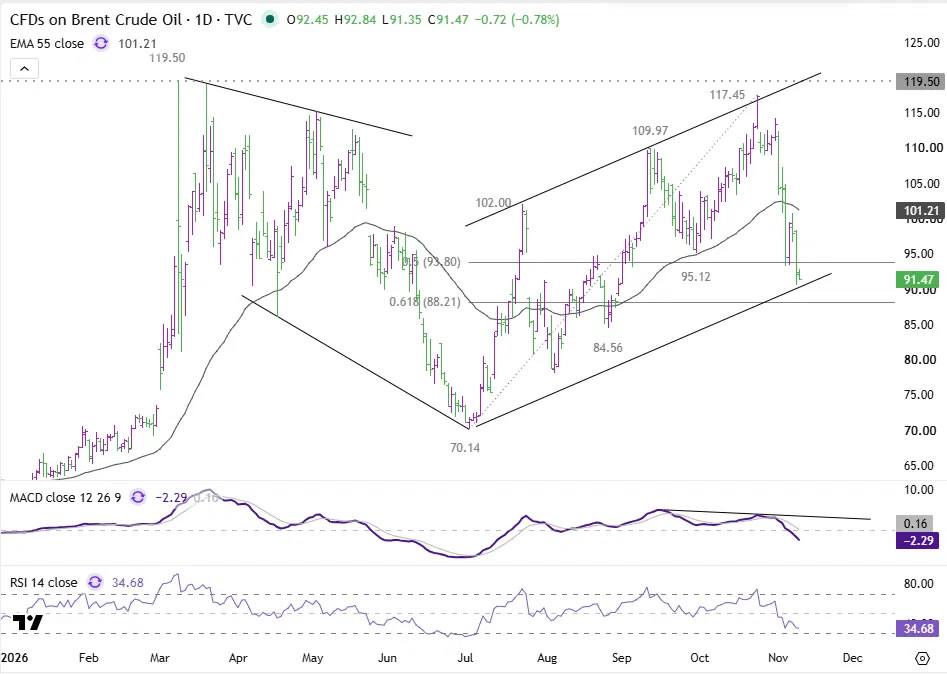
The daily technical outlook has deteriorated significantly following Brent’s reversal from 117.45.
The latest decline has carried prices below 93.80, the 50% retracement of the advance from 70.14 to 117.45, while the break below the previous support area around 93.22 reinforces the bearish structure.
The rejection beneath the 55-day EMA, currently around 101.21, also suggests that the recent rebound failed to restore upward momentum.
The next important downside level is 88.21, the 61.8% retracement of the entire 70.14–117.45 advance.
A sustained break below 88.21 would strengthen the case that the decline from 117.45 is developing into a reversal of the broader advance, rather than merely another correction within it.
Conversely, support around 88.21 could attract buying, particularly given the increasingly stretched short-term momentum indicators. The daily RSI around 34.68 indicates weakening momentum, although it has not entered oversold territory.
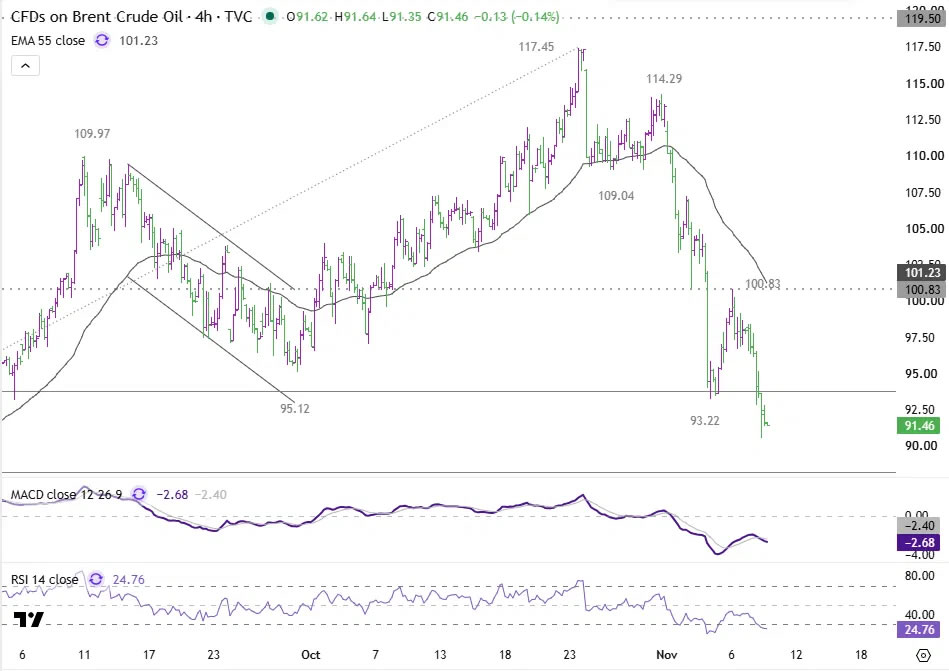
The four-hour chart offers a more detailed bearish interpretation. The decline from 117.45 may be developing into a five-wave impulsive structure, with an initial fall to 109.04, a rebound to 114.29, a subsequent decline to 93.22, and another recovery to 100.83 before the current selloff.
This potential sequence supports the possibility that the decline is becoming more than a routine pullback. However, the wave count is not yet confirmed, and momentum indicators do not provide decisive evidence of a completed bearish pattern.
With four-hour RSI around 24.76, an oversold rebound is possible even if the broader downside bias remains intact.
For now, risks remain tilted lower while 100.83 resistance holds. A sustained recovery above that level, followed by a move through the 55-period EMAs around 101.2, would weaken the near-term bearish case and raise the possibility of a more substantial rebound.
De-escalation Is Not Yet Peace
Brent’s sharp decline suggests that traders are increasingly prepared to look beyond the immediate threat of renewed US strikes against Iran. The break below important technical support reinforces that shift, bringing the 88.21 retracement into focus.
However, the continuing blockade, unresolved diplomatic differences and persistent maritime risks leave substantial uncertainty over the eventual restoration of regional oil flows.
A decisive break below 88.21 would strengthen the case for a broader bearish reversal, but a sustained extension of the selloff may require more concrete diplomatic progress. Until then, declining geopolitical risk and unresolved supply disruptions will continue pulling oil prices in opposing directions.
Key Takeaways
- Brent settled at USD 92.57 on Monday, down 5.85%, as markets discounted the near-term risk of renewed US strikes on Iran.
- Trump is holding off on attacks “for the time being”, but the US naval blockade remains and Hormuz has not returned to normal operations.
- The market is pricing lower escalation risk, not a near-term restoration of disrupted supply.
- Brent broke below 93.80, the 50% retracement of the 70.14–117.45 advance, bringing the 88.21 (61.8%) level into focus.
- Four-hour RSI near 24.76 leaves room for an oversold rebound, with 100.83 the key resistance for the bearish case.
Stay ahead of Brent’s 88.21 test and the Iran diplomacy that could decide it—join the ActionForex Telegram channel for regular market updates and analysis.