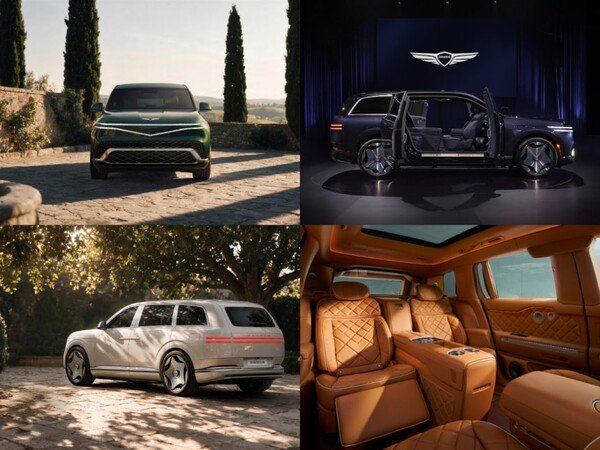

Genesis has opened orders for the GV90, its first full-size flagship electric SUV, as the luxury brand seeks to strengthen its position in the ultra-premium market. On Nov. 10, Genesis announced that it had begun accepting orders for the GV90 and its higher-end variant, the GV90 Neolun. The new models are built on Hyundai Motor Group’s dedicated electric vehicle platform, eMP, and feature a 123.5-kilowatt-hour battery, the largest capacity in the group’s EV lineup. Following their global premiere in San Francisco in August, South Korea is the first market where sales are officially getting underway.
Prices start at 139.5 million won, or approximately $103,679, for the base model and reach 270 million won for the top-tier limited edition, the Neolun First Edition. Specifically, the GV90 Standard is priced at 139.5 million won, the Individual Lounge Seat at 145.5 million won, the Neolun Standard at 189.9 million won and the Neolun Executive Suite at 239.5 million won. The GV90 is available in seven- and six-seat configurations, while the Neolun comes in six- and four-seat versions. The Neolun First Edition is limited to 222 units worldwide. The GV90 prices include a 5% individual consumption tax and eco-friendly vehicle tax benefits, while the Neolun prices reflect the 5% individual consumption tax. The pricing positions the models against ultra-luxury SUVs from established brands such as Mercedes-Maybach and Land Rover’s Range Rover.
The GV90 Neolun features the world’s first Neolun Arch Gate, a design that eliminates the B-pillar — the structural column between the front and rear doors — and allows the doors to open in opposite directions. Despite the pillarless design, Genesis says it has achieved crash safety performance equivalent to that of vehicles with a B-pillar by incorporating ultra-high-strength dual steel beams inside the doors and a hidden roll-cage structure. The exterior design draws on the curved form of traditional Korean moon jars, emphasizing restrained sculptural elegance.
The interior introduces the Wood Floor, a radiant heating system inspired by Korea’s traditional ondol floor-heating culture, for the first time in the Hyundai Motor Group. Electrically powered front seats that swivel 180 degrees allow the cabin to be converted into a lounge-like space when the vehicle is stationary. The top-tier four-seat Executive Suite also features a refrigerator and table for rear passengers, as well as a comfort partition to divide the cabin. Other convenience features include a pop-up OLED display, a 25-inch head-up display and a Bang & Olufsen sound system. The vehicle also adopts a buttonless power system that eliminates the need for a separate start button, a first for the Hyundai Motor Group.
The GV90 is equipped with front and rear electric motors producing a combined maximum output of 490 kilowatts and peak torque of 800 newton-meters. Dual electronic limited-slip differentials, multi-chamber air suspension and active rear-wheel steering are designed to improve handling stability and ride comfort. The driving range on a single charge is approximately 500 kilometers for the standard GV90 and 460 kilometers for the six-seat Neolun equipped with 24-inch wheels. Using a 350-kilowatt ultra-fast charger, the battery can be charged from 10% to 80% in about 22 minutes. The vehicle also supports Plug and Charge (PnC) 2.0, which enables authentication, charging and payment simply by connecting the charging cable. With a two-channel E-pit charger, charging can begin about two seconds after connection using standard authentication or about seven seconds using Plug and Charge.
Safety features include 12 airbags, among them what Genesis describes as the world’s first roof airbag. In the event of a rollover, the airbag deploys to cover the roof glass and help prevent occupants from being ejected from the vehicle. The models also feature thermal propagation prevention technology, known as TRP, designed to limit heat transfer between battery cells and reduce the risk of battery fires. All windows are fitted with sound-insulating glass more than 5 millimeters thick to improve cabin quietness.
The launch comes as Genesis seeks to reverse a decline in domestic sales. Through October, the brand sold 68,683 vehicles in South Korea, down 29.4% from a year earlier and its lowest January-October total since 2019. Sales of its key G80 and GV70 models fell 28.6% and 25.9%, respectively. An aging core lineup and the lack of hybrid models have been cited as factors behind the decline. Genesis plans to use the GV90 to strengthen its brand positioning and support a sales recovery.
However, recently introduced hybrid models have shown signs of improving sales. The GV80 Hybrid, launched last month, sold 959 units in its first month, accounting for 52.9% of total GV80 sales during the same period. Genesis plans to add hybrid versions of the G80 and GV70 in the future.
A Genesis official said the GV90 is a symbolic model that embodies the brand’s electrification technology and differentiated customer experience, adding that the company aims to set a new standard for luxury through its product features and dedicated financial offerings such as The 90. Genesis has also introduced an exclusive membership program offering vehicle-care services and lifestyle benefits. The GV90 is set to become the first model produced at Hyundai Motor’s dedicated electric vehicle plant in Ulsan, which was completed following an investment of approximately 2 trillion won.