Key highlights
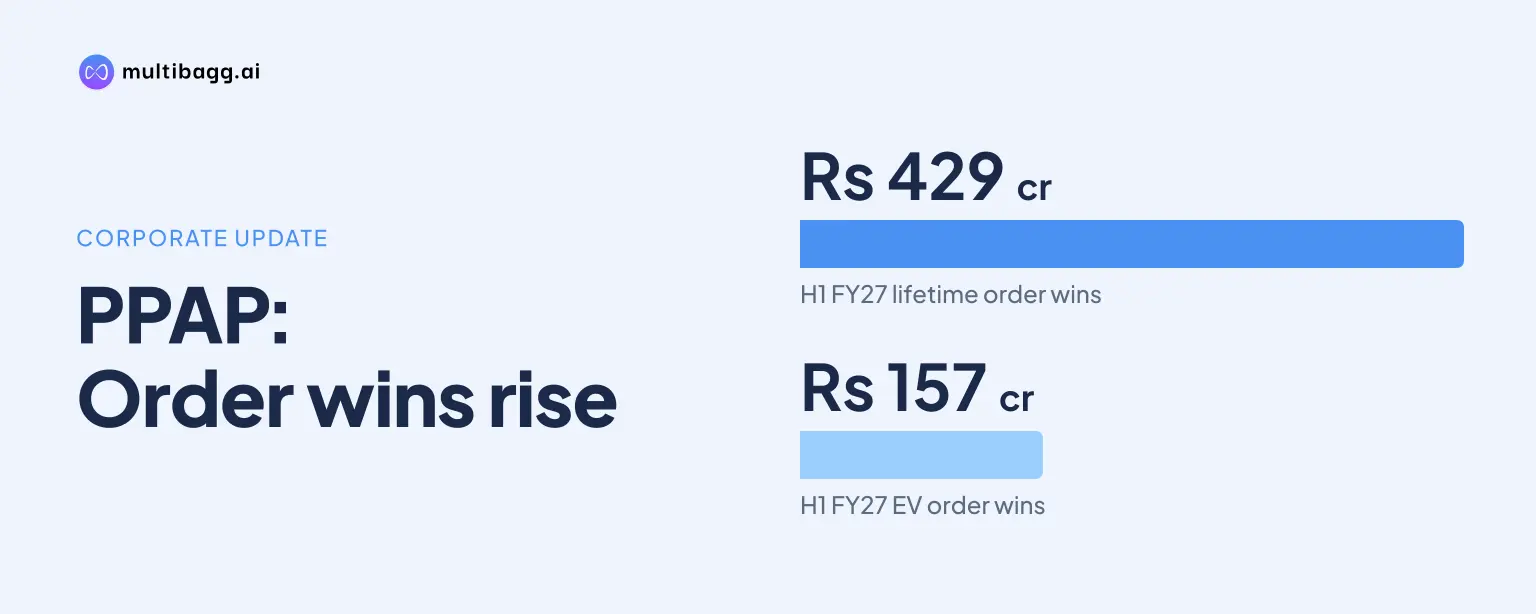
- PPAP secured approximately ₹429 crore of lifetime order wins in H1FY27.
- PPAP’s EV order wins rose about 5.8 times year-on-year to approximately ₹157 crore in H1FY27.
- PPAP recorded approximately ₹298 crore of order wins in Q2FY27, up 127.6% sequentially.
- PPAP’s consolidated H1FY27 revenue rose 31.8% year-on-year to ₹334.2 crore.
powered by IRIS
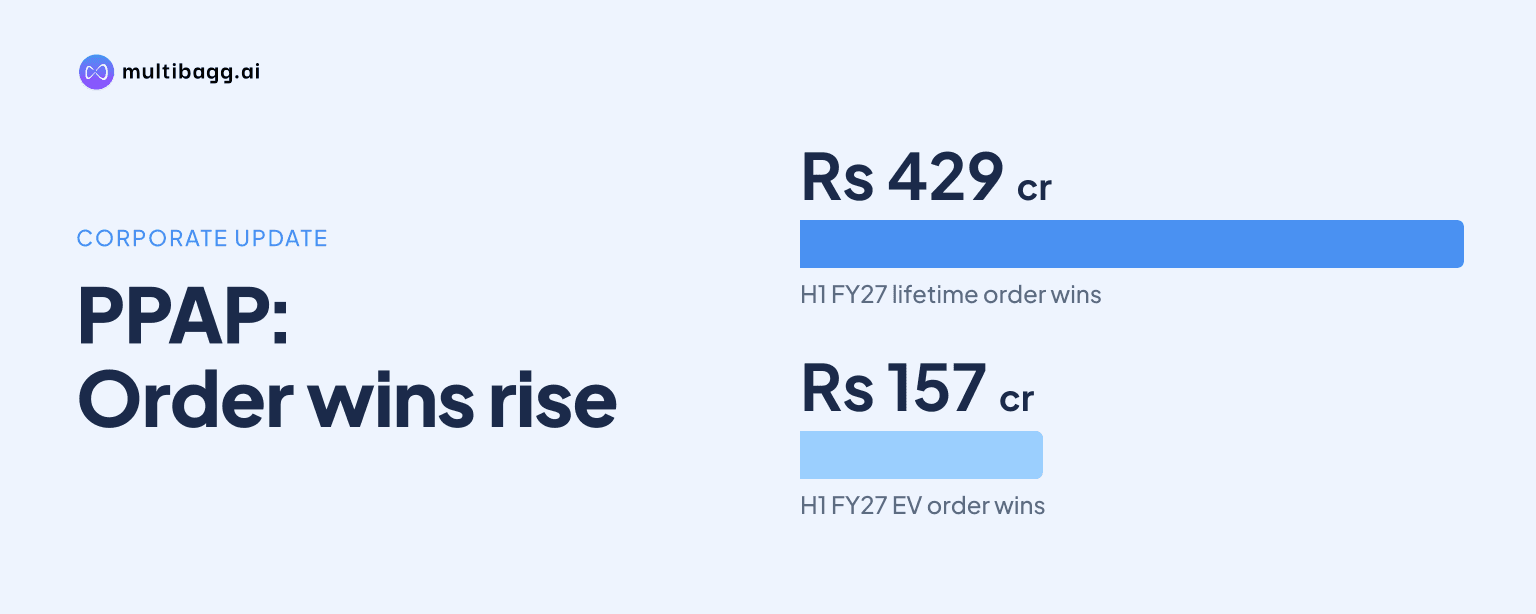
PPAP Automotive Ltd secured approximately ₹429 crore of lifetime order wins in H1FY27, including approximately ₹157 crore in electric-vehicle, or EV, awards, up about 5.8 times from approximately ₹27 crore in H1FY26. The second quarter contributed approximately ₹298 crore, while non-EV awards remained the larger H1 category at approximately ₹272 crore.
Know PPAP Automotive inside out
Results, valuation, peers and who’s buying, in one view.
How large were PPAP’s H1FY27 order wins?
PPAP’s cumulative lifetime order wins were approximately ₹429 crore in H1FY27, of which approximately ₹298 crore were secured in Q2FY27. The company said Q2FY27 wins rose 127.6% sequentially from approximately ₹131 crore in Q1FY27, indicating that the second quarter accounted for most of the first-half order intake.
The ₹429 crore figure represents lifetime order wins rather than revenue reported during H1FY27. PPAP reported consolidated revenue of ₹334.2 crore for the six months, up 31.8% from ₹253.6 crore in H1FY26. Order wins therefore describe awarded business over programme lifetimes, while revenue is the amount recorded in the reported period.
Non-EV programmes accounted for approximately ₹206 crore of Q2FY27 wins and approximately ₹272 crore for H1FY27. EV programmes supplied approximately ₹92 crore in Q2FY27 and approximately ₹157 crore in H1FY27. The disclosed mix shows that conventional-vehicle programmes remained the larger source of awarded value despite the faster growth in EV orders.
Why did PPAP’s EV order wins increase in H1FY27?
PPAP’s EV lifetime order wins increased to approximately ₹157 crore in H1FY27 from approximately ₹27 crore in H1FY26, which the company described as growth of about 5.8 times year-on-year. The approximately ₹92 crore won in Q2FY27 accounted for more than half of the first-half EV total, although PPAP did not disclose Q1FY27 EV wins separately.
Management said EV order traction reflected PPAP’s strengthening presence in the electric-mobility ecosystem. The presentation does not provide a product-level, vehicle-platform or customer-level allocation for the approximately ₹157 crore of EV awards, so it does not identify which EV programmes or components produced the increase.
PPAP also said order inflows were diversified across EV and non-EV segments through relationships with original equipment manufacturers, or OEMs, including Maruti Suzuki, Tata Motors, Toyota, Honda, Renault, Mahindra and SMG. It said it received new orders from JSW and MG, but did not disclose the value, timing or production start date of those awards.
Got a follow-up? Ask IRIS
How did PPAP’s financial performance change in H1FY27?
PPAP reported consolidated revenue of ₹334.2 crore in H1FY27, up 31.8% from ₹253.6 crore a year earlier, while earnings before interest, tax, depreciation and amortisation, or EBITDA, increased 27.4% to ₹28.1 crore from ₹22.0 crore. Consolidated profit after tax changed to a profit of ₹3.3 crore from a loss of ₹2.3 crore in H1FY26.
The standalone business reported revenue of ₹309.3 crore in H1FY27, an increase of 26.7% from ₹244.2 crore, and EBITDA of ₹27.0 crore, up 16.8% from ₹23.1 crore. Standalone profit after tax rose to ₹5.8 crore from ₹1.6 crore, while EBITDA margin declined to 8.7% from 9.5% and gross profit margin declined to 40.6% from 45.6%.
In Q2FY27, PPAP’s consolidated revenue increased 29.8% year-on-year to ₹177.8 crore and consolidated EBITDA increased 23.0% to ₹15.7 crore, according to management. Chairman and Managing Director Ajay Kumar Jain attributed the quarterly performance to favourable industry dynamics, higher vehicle production and demand across key customer platforms; the board also declared an interim dividend of Rs 1.50 per equity share.
What does PPAP’s revenue mix show?
PPAP’s H1FY27 revenue was led by Maruti plus SMG at 46.4%, followed by Tata at 17.5% and Honda at 12.2%. Others represented 9.7%, Nissan 6.5%, MG Motors 4.8%, Hyundai 2.5% and Toyota 0.5%. The presentation does not allocate the approximately ₹429 crore of H1FY27 order wins among these customers.
Parts represented 92.3% of H1FY27 revenue, down from 94.4% in H1FY26, while Tools and Others rose to 7.7% from 5.6%. This was a 2.1-percentage-point increase in the Tools and Others share. PPAP did not state whether this revenue-mix movement was connected to EV or non-EV order wins.
The presentation’s industry data showed passenger-vehicle sales rose 30.7% year-on-year to 13.60 lakh units in Q2FY27, commercial-vehicle sales increased 28.7% to 3.09 lakh units and three-wheeler sales grew 23.6% to 2.85 lakh units. It cited higher L5 EV adoption, cargo demand and last-mile mobility as support for three-wheeler sales, without linking those market trends to a specific PPAP order.
Conclusion
PPAP’s H1FY27 order-win data combines a substantial increase in EV awards, to approximately ₹157 crore from approximately ₹27 crore a year earlier, with a larger non-EV pipeline of approximately ₹272 crore. The approximately ₹298 crore of wins in Q2FY27, following approximately ₹131 crore in Q1FY27, accompanied 31.8% growth in consolidated H1 revenue to ₹334.2 crore.
The next disclosure to watch is whether PPAP’s stated healthy non-EV opportunity pipeline produces further awards and whether EV wins continue after the approximately ₹92 crore secured in Q2FY27. Investors can also monitor conversion of lifetime awards into revenue and whether the standalone gross profit margin, which was 40.6% in H1FY27 versus 45.6% in H1FY26, changes in subsequent results.
Frequently Asked Questions
PPAP recorded approximately ₹157 crore of EV lifetime order wins in H1FY27. That was about 5.8 times the approximately ₹27 crore disclosed for H1FY26, and Q2FY27 contributed approximately ₹92 crore.
PPAP reported approximately ₹272 crore of non-EV lifetime order wins in H1FY27. This exceeded the approximately ₹157 crore of EV awards, making non-EV the larger disclosed order category.
PPAP secured approximately ₹298 crore of lifetime order wins in Q2FY27, compared with approximately ₹131 crore in Q1FY27. The company reported the quarter-on-quarter increase as 127.6%.
PPAP’s consolidated profit after tax was ₹3.3 crore in H1FY27, compared with a ₹2.3 crore loss in H1FY26. Consolidated EBITDA also increased 27.4% year-on-year to ₹28.1 crore.
Maruti plus SMG accounted for 46.4% of PPAP’s H1FY27 revenue, followed by Tata at 17.5% and Honda at 12.2%. PPAP did not disclose how its H1FY27 order wins were split among customers.