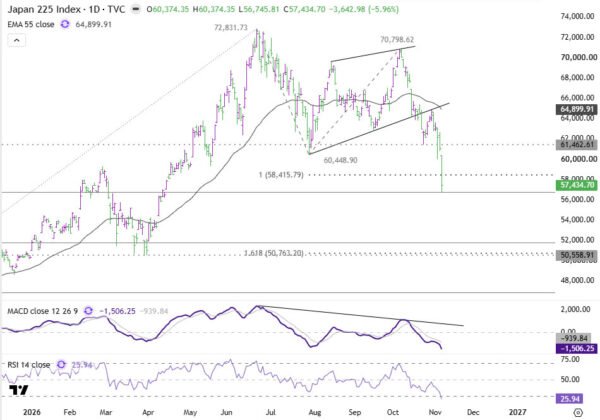
TL;DR: The Nikkei closed down 5.96% at 57,434.77, entering a bear market, while KOSPI fell 6.02% and TAIEX 4.51%. AUD/JPY and AUD/USD broke key support as the Aussie and Kiwi took the heaviest currency losses, yet the Yen and Won stayed comparatively stable, suggesting the shock is still concentrated in equities and risk-sensitive currencies.
Why Are Asian Equities and the Aussie Selling Off Together?
The Asian equity rout intensified on Friday, pushing Japan’s Nikkei into bear-market territory and driving another round of heavy losses across South Korea and Taiwan. The technology-led selloff has also spread into currency markets, with the Australian and New Zealand Dollars suffering some of the steepest declines among major currencies. AUD/JPY and AUD/USD have both broken important technical support, suggesting that regional risk aversion is increasingly affecting Asia-Pacific currencies.
Yet the currency response has been far less uniform than the equity collapse. The Korean Won strengthened modestly despite KOSPI’s 6% plunge, while USD/JPY remained within its established trading range. The contrast suggests that the shock is still concentrated in equities and risk-sensitive currencies, rather than developing into a broad episode of disorderly capital withdrawal from the region. The key question is whether that distinction can hold as the selloff deepens.
Follow the Asian rout and its impact on the Nikkei and the Aussie on the ActionForex Telegram channel.
Nikkei Enters Bear Market as Regional Equity Losses Accelerate
Japan’s Nikkei opened with a downside gap and plunged more than 7% intraday before closing at 57,434.77, down 5.96%. The index entered bear-market territory and recorded its sharpest one-day decline since April 2025. Friday’s losses brought its weekly fall to approximately 9.25%, reflecting the speed at which sentiment has deteriorated.
South Korea’s KOSPI dropped 6.02% to 5,059.69, having fallen as much as 8% earlier in the session and triggered circuit breakers. Kosdaq declined another 5.03%. Taiwan’s TAIEX also suffered heavy selling, closing 4.51% lower at 39,701.64.
Elsewhere in the region, losses were comparatively moderate. The Hang Seng fell approximately 1.2%, CSI 300 declined 1.44%, and Australia’s ASX 200 slipped 0.49%. The contrast highlights the particularly severe pressure facing Japan, South Korea and Taiwan, where semiconductor and AI-related companies account for substantial market exposure.
- Nikkei: −5.96% to 57,434.77 (weekly fall about 9.25%).
- KOSPI: −6.02% to 5,059.69; Kosdaq: −5.03%.
- TAIEX: −4.51% to 39,701.64.
- Hang Seng: about −1.2%; CSI 300: −1.44%; ASX 200: −0.49%.
The regional rout followed Thursday’s Wall Street collapse, when the Nasdaq Composite plunged 5.52% and the Philadelphia Semiconductor Index lost 12.2%. Concerns over tighter US data-center regulation following the Democratic midterm victory have added to existing pressure on AI valuations and infrastructure financing. Positioning adjustments, stop-loss selling and margin calls amplified the decline, while Japan also faced renewed concerns about energy costs as oil prices recovered.
However, the Japanese selloff was not limited to technology shares. Selling broadened across the market, suggesting that the initial pressure on AI-related stocks was developing into a wider reduction in equity risk exposure.
The immediate concern is no longer simply whether semiconductor valuations have adjusted sufficiently, but whether the accelerating equity losses will begin to affect regional currencies and financial conditions more broadly.
Equity Rout Has Yet to Produce Broad Currency-Market Stress
Despite the severity of the equity declines, there has been little corresponding evidence of disorderly depreciation across major North Asian currencies.
USD/KRW traded around 1,355.28, down 0.19%, indicating modest Won strength even as KOSPI lost more than 6%. Meanwhile, USD/JPY held around 157.95, remaining within the approximate 156.06–159.02 range that has prevailed since mid-September.
The Yen has not displayed a particularly strong safe-haven response to the Japanese equity collapse. However, neither has it weakened sharply in a manner that would suggest widespread pressure to withdraw capital from Japan.
Regional authorities have also focused on stabilizing equity trading rather than defending exchange rates. South Korean authorities eased retail leverage requirements, while Taiwan’s finance ministry reportedly instructed state banks to support its stock market.
These developments suggest that the immediate stress is concentrated in equities, without a comparable disruption in regional exchange rates.
That distinction should not be overstated. Foreign net-flow figures for the session are not available, so currency movements alone cannot establish whether international investors are withdrawing capital. Nor does the relative stability of the Won and Yen guarantee that broader financial pressure will not develop.
Nevertheless, the absence of synchronized currency depreciation is an important contrast with the scale of the equity-market collapse.
Aussie Becomes a Clearer Expression of Regional Risk Aversion
The Australian and New Zealand Dollars have shown a much more pronounced response to deteriorating regional sentiment.
By late Asian trading, AUD/USD had fallen approximately 0.75% to 0.6878, while NZD/USD declined 0.64% to around 0.5558. Both currencies substantially underperformed other major currencies against the Dollar.
The weakness extended to Yen crosses, with AUD/JPY down approximately 0.60% to 108.64 and NZD/JPY falling 0.47% to around 87.80. AUD/CAD also declined 0.45%, while AUD/NZD was only modestly lower, indicating that the selling pressure was broadly shared by the two Antipodean currencies.
- AUD/USD: −0.75% to 0.6878.
- NZD/USD: −0.64% to around 0.5558.
- AUD/JPY: about −0.60% to 108.64; NZD/JPY: −0.47% to around 87.80.
- AUD/CAD: −0.45%; AUD/NZD only modestly lower.
The cross-rate performance is particularly revealing.
With USD/JPY rising approximately 0.16%, AUD/USD’s 0.75% decline mathematically accounts for almost the entire 0.60% fall in AUD/JPY. The move in AUD/JPY has therefore been driven predominantly by Australian Dollar weakness rather than an independent surge in demand for Yen.
That makes AUD/JPY a useful measure of how regional risk aversion is affecting the Australian currency without relying exclusively on Dollar movements.
The timing also argues against a simple mechanical relationship between the Nikkei and the Aussie. AUD/USD was only modestly lower earlier in the Asian session, when the Nikkei had already suffered most of its decline. The larger currency move developed later as selling pressure intensified across regional equity markets.
Commodity prices offered little direct explanation for the scale of AUD weakness. Iron ore was broadly unchanged and copper slightly higher, although the general Dollar bid and renewed oil-price pressures may also have contributed.
The combined performance is consistent with a deterioration in regional risk sentiment increasingly weighing on AUD and NZD, even while the Yen and Won remain comparatively stable.
The technical developments in the Nikkei, AUD/JPY and AUD/USD suggest that this pressure could extend further.
ActionForex’s Technical View: Nikkei, Weekly Breakdown Raises Deeper Correction Risk
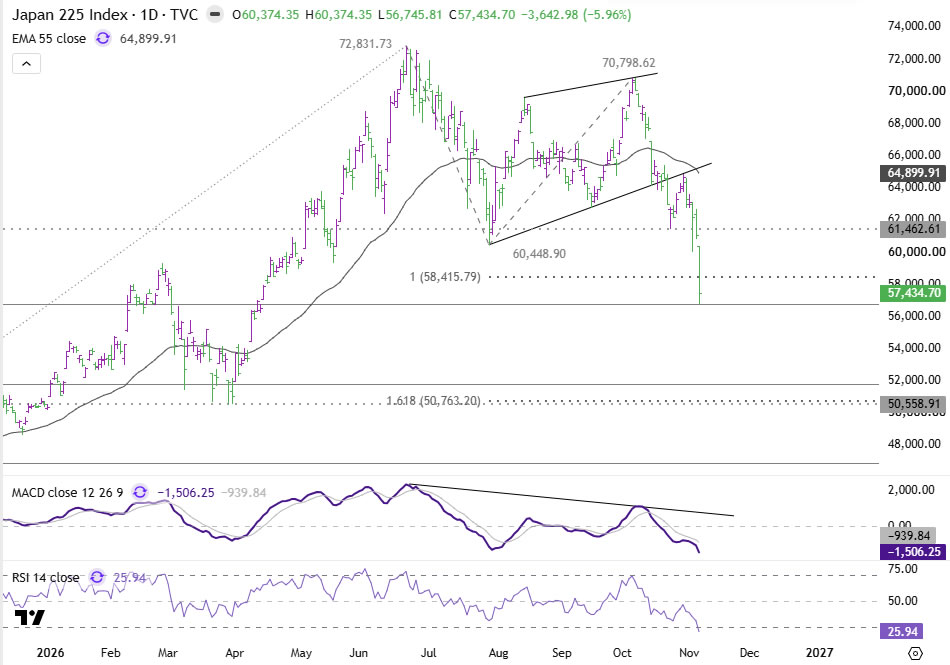
The Nikkei’s decline intensified on Friday after opening with a downside gap.
The break of the 100% projection of 72,831.73 to 60,448.90 from 70,798.62 at 58,415.79 indicates downside acceleration.
Together with the close below the weekly 55 EMA, currently around 59,332, the decline from 72,831.73 could be correcting the entire uptrend from 30,792.74, the 2025 low.
For the near term, deeply oversold conditions on the daily chart, with RSI around 25.94, could help establish a temporary floor around the 38.2% retracement of 30,792.74 to 72,831.73 at 56,772.84.
Friday’s intraday low of 56,745.81 briefly penetrated this level before the index recovered to close above it.
That leaves room for a technical rebound. However, the near-term outlook will remain bearish as long as 61,462.61 support-turned-resistance holds.
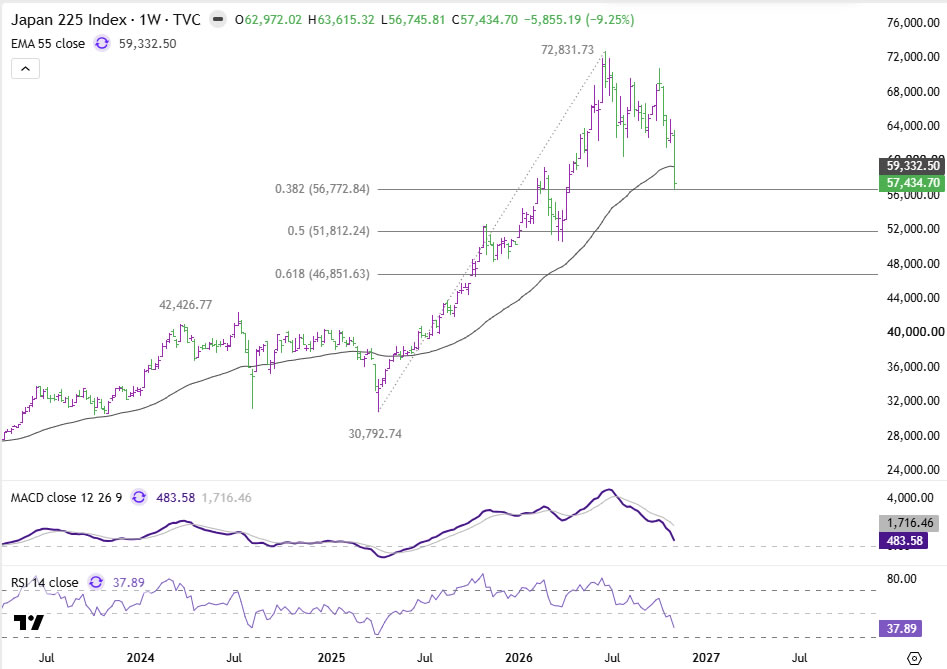
The correction could eventually extend toward a key confluence zone around 50,000 before finding a more durable bottom.
This region includes 50,763.20, which represents structural support as well as the 161.8% projection of 72,831.73 to 60,448.90 from 70,798.62.
The 50% retracement of the rise from 30,792.74 to 72,831.73 at 51,812.24 provides another important reference.
Together with the psychological 50,000 level, these projections define a broader potential support region if downside momentum persists. Prices could also briefly extend below the Fibonacci levels toward the round-number area.
While oversold conditions may produce a near-term rebound, the weekly technical deterioration suggests that the decline could develop into a deeper correction rather than end with the latest selloff.
ActionForex’s Technical View: AUD/JPY, Break of 108.62 Resumes Decline From 114.95
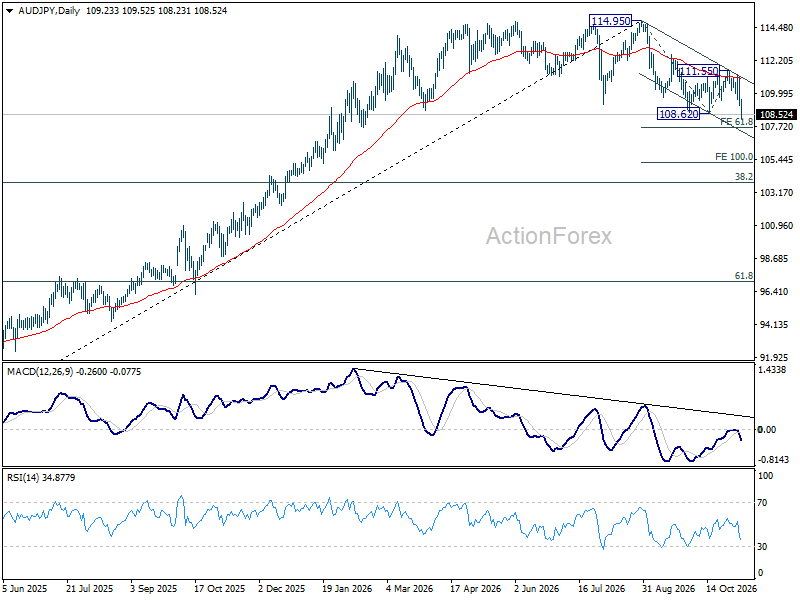
AUD/JPY’s decline from the 114.950 medium-term top resumed with the break of 108.620 support.
The prior rejection by the daily 55 EMA was a bearish signal, and the latest support break indicates renewed downside momentum.
The near-term outlook will remain bearish as long as 111.550 resistance holds, even in the event of recovery.
The next target is the 61.8% projection of 114.950 to 108.620 from 111.550 at 107.638.
A decisive break there could trigger downside acceleration toward the 100% projection at 105.220.
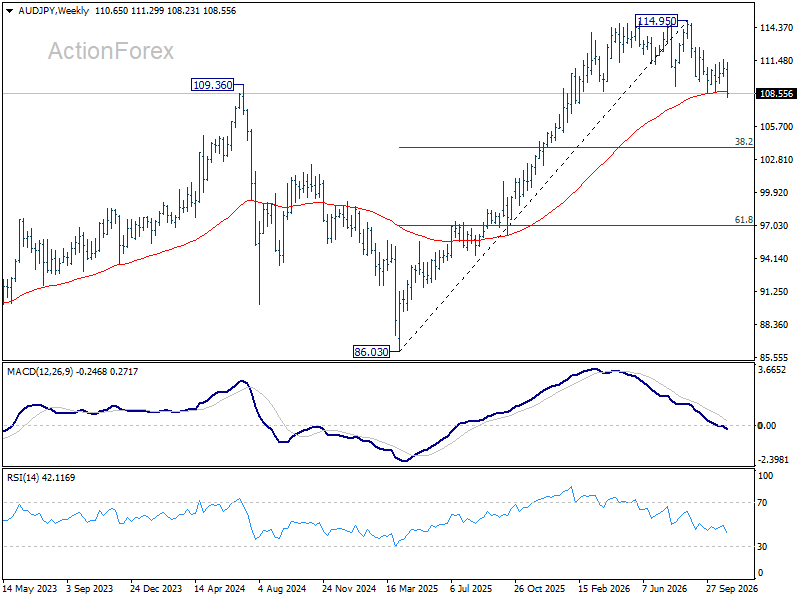
On the weekly chart, the break of the 55 EMA raises the possibility that AUD/JPY is correcting the broader rise from 86.030, the 2025 low.
However, a firm break of 107.638 accompanied by downside acceleration would provide stronger confirmation of this medium-term bearish scenario.
A deeper decline could then extend toward the 38.2% retracement of 86.030 to 114.950 at 103.903 before the correction completes.
The immediate focus is 107.638. A decisive break would reinforce the case that the weakness from 114.950 is developing into a more substantial correction.
ActionForex’s Technical View: AUD/USD, 0.6854 Becomes Immediate Downside Focus
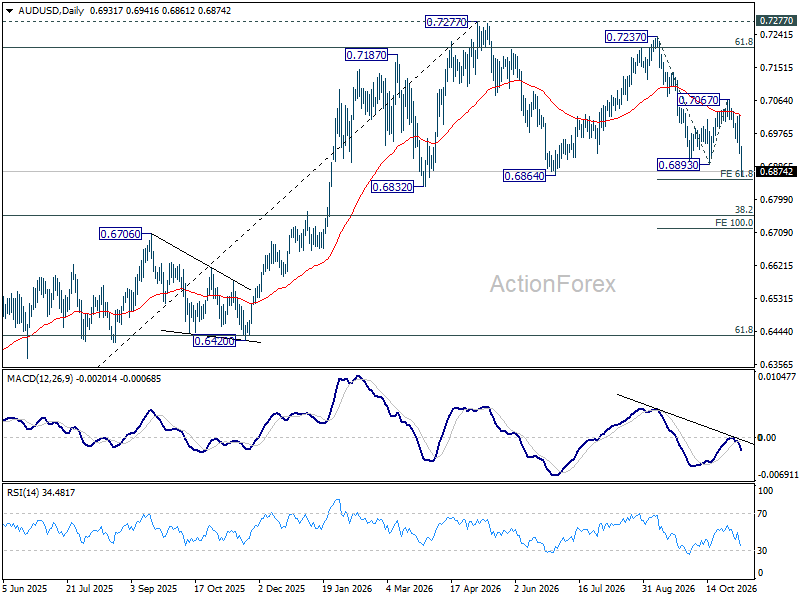
AUD/USD’s decline from 0.7237 also resumed after breaking through 0.6893 support.
The prior rejection by the daily 55 EMA was a bearish signal, followed by renewed selling pressure as regional risk sentiment deteriorated.
The immediate focus is now on the 61.8% projection of 0.7237 to 0.6893 from 0.7067 at 0.6854.
A firm break there could prompt downside acceleration toward the 100% projection at 0.6723.
The near-term outlook will remain bearish as long as 0.7067 resistance holds, even if a recovery develops.
Further down, the next important test is the 38.2% retracement of the rise from 0.5913 to 0.7277 at 0.6756.
Strong support around that level would favour treating the price action from 0.7277 as a correction within the larger uptrend.
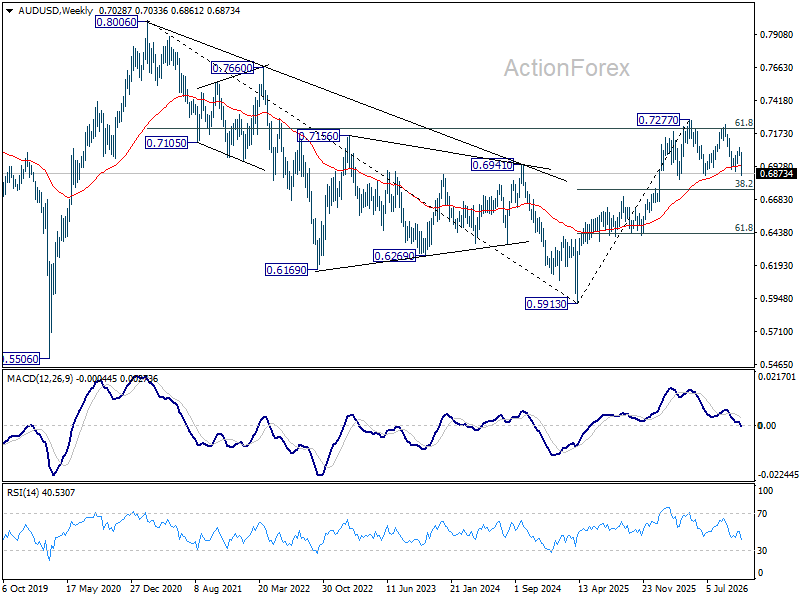
However, a decisive break would raise the possibility that AUD/USD is already reversing the entire advance from 0.5913, the 2025 low.
The immediate trigger is 0.6854, while 0.6756 is the more important level for distinguishing a corrective decline from a potentially broader reversal.
Regional Risk-Off Faces Further Tests
The Asian equity rout has now become severe enough to push the Nikkei into bear-market territory and drive substantial losses across South Korea and Taiwan.
The Australian and New Zealand Dollars are also weakening sharply, suggesting that the deterioration in regional sentiment is increasingly affecting risk-sensitive currencies.
Yet the absence of comparable pressure on the Yen and Won indicates that the equity shock has not translated into uniform currency-market stress.
The next tests will come from Friday’s US employment report and the reopening of Asian markets on Monday.
Payrolls could influence Dollar direction and broader risk appetite, while the Nikkei’s ability to stabilize around 56,772.84 will help determine whether its deeply oversold condition produces a meaningful rebound.
USD/KRW and USD/JPY will also be important indicators of whether equity weakness begins spreading more broadly into regional exchange rates.
Meanwhile, renewed Middle East uncertainty and Brent trading near $100 add another potential source of pressure for energy-importing economies.
Technically, the Nikkei’s break below its weekly 55 EMA has raised the possibility of a deeper correction toward the 50,000 region, while AUD/JPY and AUD/USD face immediate downside tests at 107.638 and 0.6854 respectively.
For now, the regional selloff remains technology-led but increasingly broad within equity markets, with AUD and NZD providing the clearest currency expression of deteriorating sentiment.
Whether the shock remains concentrated in equities and risk-sensitive currencies, or develops into a more widespread deterioration in regional financial conditions, will be a central question for the next trading sessions.
Key Takeaways
- The Nikkei closed down 5.96% at 57,434.77 and entered a bear market; KOSPI fell 6.02% to 5,059.69 and TAIEX 4.51% to 39,701.64.
- Currency stress is uneven: USD/KRW slipped 0.19% to 1,355.28 and USD/JPY held at 157.95 within its 156.06–159.02 range, while AUD/USD fell 0.75% to 0.6878 and NZD/USD 0.64% to 0.5558.
- AUD/JPY’s 0.60% fall is almost entirely explained by AUD weakness, as USD/JPY rose only about 0.16%.
- The Nikkei has a near-term floor at 56,772.84 with resistance at 61,462.61, while a deeper correction could reach the 50,000 region (50,763.20 and 51,812.24).
- AUD/JPY faces its next test at 107.638 (then 105.220), and AUD/USD at 0.6854 (then 0.6723), with 0.6756 the key level for a broader reversal.
Stay ahead of the Asian equity rout and its impact on the Nikkei, AUD/JPY and AUD/USD—join the ActionForex Telegram channel for regular market updates and analysis.