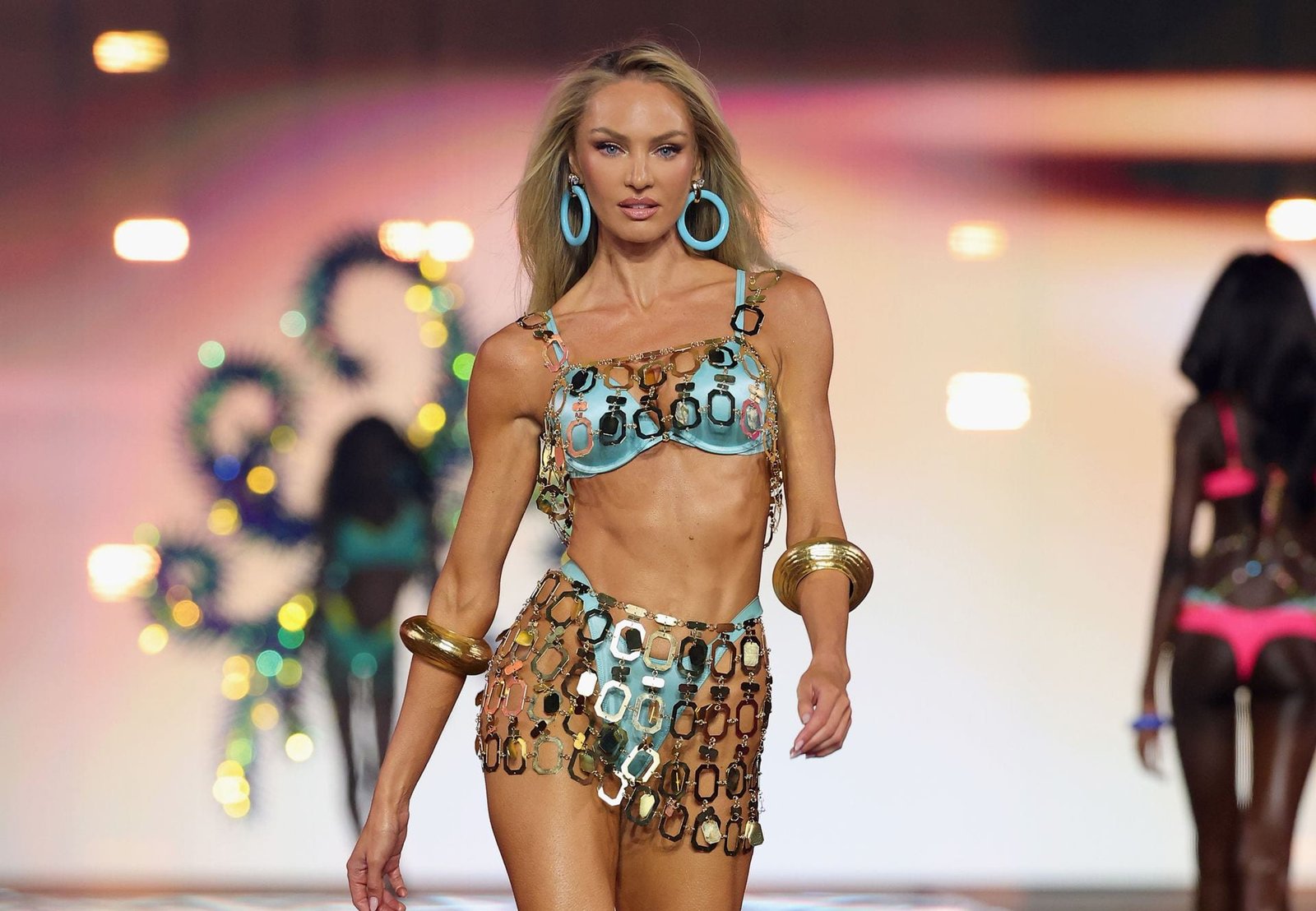

Candice Swanepoel walks the runway for the Victoria’s Secret Fashion Show 2026 on Oct. 18, 2026, in Los Angeles. (Dimitrios Kambouris/Getty Images for Victoria’s Secret/TNS)
The most recent Victoria’s Secret Fashion Show, which took place on Oct. 18, has reignited online debate over beauty standards within the fashion industry, raising questions about whether its models should adhere to the traditional beauty standards the brand follows or if it should embrace inclusivity.
Ohio State professors have different perspectives on the industry’s progress when it comes to representation and the limits that remain. Victoria’s Secret did not provide a comment in time for publication.
“Certainly the fashion industry has, in certain ways, become more, quote-unquote, inclusive,” said Elizabeth Sheehan, an associate professor of English. “But there are profound limitations to that.”
Sheehan said Victoria’s Secret is primarily profit-driven and benefits from exploiting female labor, including not just the work of the models, but the labor involved in producing garments.
Sheehan said she has reservations about looking at the industry and its practices of representation, calling it compromised.
The fashion show continues to spark online debate, Sheehan said, mainly due to the power of branding.
“It makes sense that when Victoria’s Secret does something, and when there’s a fashion show, the whole point of a fashion show is to draw attention to itself,” Sheehan said. “Sure enough, it shows it’s been really successful at drawing attention to itself, even if that attention is criticism.”
The industry’s economy is built on attention to spectacle and representation, Sheehan said. Name recognition alone can lead audiences to pay attention to what a brand is doing.
Sheehan said modeling has also transformed from a small profession to a celebrity engine over the last century, giving the modeling industry and the behavior of models a celebrity presence and an impact on culture.
Sheehan said the word “model” alone tells audiences that the women in the fashion show are supposed to be imitated. Models set an unreachable standard, she said, and the culture and industry have done a lot of work to make people think of models as figures to imitate.
However, Sheehan said she thinks there is a limit to the idea that simply changing the appearance of the models will make the industry less restrictive. She said introducing a new type of model could create further restrictions rather than transform beauty standards.
“A mode that, say, doesn’t require people to starve themselves to imitate might seem better, but there can be other problems with other models that may require other kinds of modifications,” Sheehan said.
Sheehan said Victoria’s Secret has consistently emphasized larger bust sizes at a time when high fashion has not. The fashion industry itself has also placed greater emphasis on including transgender and disabled models.
At a recent conference, Sheehan said she learned about interviews with transgender and disabled models who had made an impact on the industry. However, even those models felt their opportunities to enter the industry were becoming more limited.
Sheehan said she believes audiences sometimes prefer to see a traditional Victoria’s Secret aesthetic rather than greater diversity in the models featured in the fashion show because of an attachment to existing order and a fear of transformative change.
“There’s a lot of money and power invested in keeping things the way they are, and so people feel, I think often, easily threatened, and we’ve been encouraged to be threatened by change, that any change and expansion of opportunity is actually a loss for those in power, which is not true,” Sheehan said. “I think that’s a widely held sentiment or sense, so that just carries across, I think, all sorts of different platforms, from politics to fashion.”
However, Sheehan said, despite believing industries could be structured to allow for meaningful change by being less profit-driven, that the potential for change depends on a brand’s size and who funds it. Small brands may consist of only a few people and may not become widely known. These brands might make expensive garments for a limited number of people, allowing them to respond more directly to the vision of the designer or artist, she said.
Tasha Lewis, a clinical associate professor in the Department of Human Sciences, said beauty standards in the fashion industry have changed over recent decades, but not across the board.
Lewis said inclusivity is driven by a brand’s recognition of its customers and whether they see themselves in the image of beauty that the brand presents.
Victoria’s Secret has been around for more than 40 years, Lewis said, and the debate reflects changing societal views about beauty and how the brand can respond to those changes and remain relevant.
Lewis believes models play a significant role in how a brand establishes its image.
“The models are a part of the branding and they should be,” Lewis said. “It is also meaningful if consumers see models that look like them in the brand’s marketing.”
Lewis said a brand can evolve to reflect changing attitudes toward beauty while maintaining an identity that consumers recognize. Typically, a brand has a core product or value that remains familiar to consumers over time.
“For example, Victoria’s Secret has leaned more into their pink and white stripes as a way to identify the brand that is familiar to consumers” Lewis said.
Lewis said there have been external pushes for Victoria’s Secret to become more inclusive in its representation of beauty. She said she thinks this could be a reason Victoria’s Secret brought back the traditional fashion-show format.
“They realized that there were some things that needed to change with the brand’s image but at the core, they are a beauty and lingerie brand and the fashion show was part of presenting that image,” Lewis said.
Lewis said she believes consumer expectations, particularly among younger generations, have an important influence on brands, as social media allows companies to hear directly from consumers. Victoria’s Secret has discussed incorporating consumer comments about what they want to see in the show through its social media platforms.
Lewis said fashion brands risk losing market share to competitors that present a more inclusive aesthetic when balancing an established image with calls for greater inclusivity.
When deciding how to represent beauty and body diversity, brands should consider their current customers and the customers they want to attract, Lewis said. Brands typically want to grow their clientele, and a narrow beauty standard could limit their ability to attract or retain customers.
“A global brand like Victoria’s Secret serves a lot of different customer segments and it is to their benefit to consider the diverse representation of beauty,” Lewis said.