China’s fifth plenum offered few clues about succession, but its low attendance, continuing military vacancies and conspicuous omission of familiar political slogans reveal much about the state of Xi Jinping’s party and the challenges ahead of the 21st Party Congress in 2027. EAI researcher Zhou Na gives her analysis.

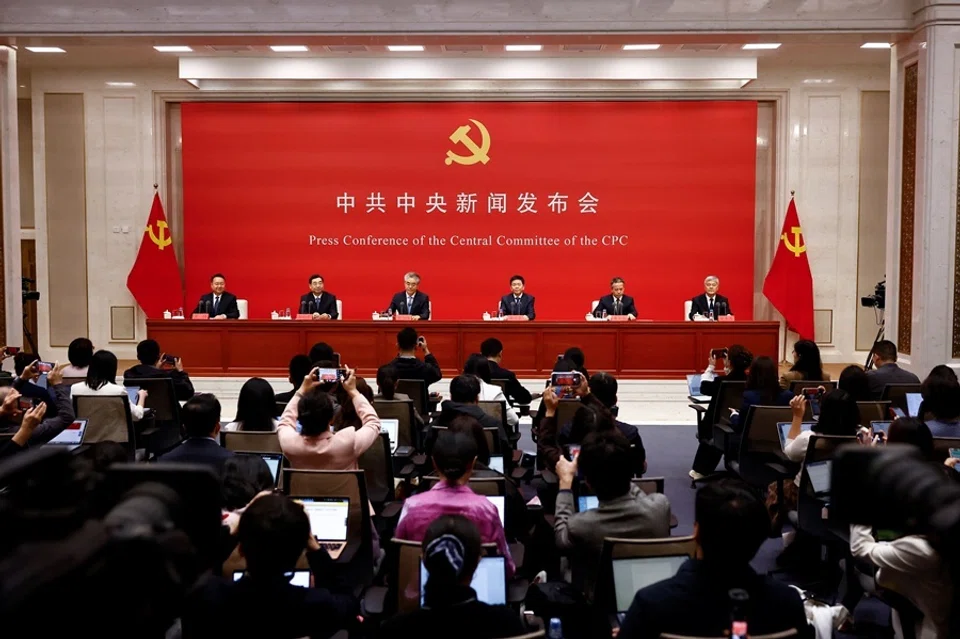
The Fifth Plenary Session of the 20th Central Committee of the Communist Party of China (CPC) concluded in Beijing on 29 October, adopting a decision on major issues concerning the sustained advancement of full and rigorous party self-governance. The meeting placed cadre management, discipline enforcement and anti-corruption work at the centre of the party’s agenda ahead of the 21st Party Congress, which is scheduled for the second half of 2027.
The four-day plenum heard a work report delivered by Xi Jinping on behalf of the Politburo and approved the Decision of the CPC Central Committee on Major Issues Concerning the Sustained Advancement of Full and Rigorous Party Self-Governance.
The plenum stated that the key to full and rigorous party self-governance is “strict governance of officials”, calling for tighter standards in cadre education, selection, appointment and supervision.
Two aspects of the communique are particularly notable. First, it called for improving the quality of the selection and training of younger officials, while strengthening the management and supervision of cadres. The formulation suggests that personnel work before the next party congress will combine leadership renewal with closer scrutiny of political conduct, performance and discipline.

Second, the communique called for the strict implementation of decision-making rules within party leadership groups and for the regulation of how “top leaders” exercise their authority. It also pledged to improve the party and state oversight system, strengthen comprehensive supervision by party committees and enhance the dual-leadership system governing disciplinary inspection and supervision bodies.
The communique reaffirmed the centrality of anti-corruption work, calling for the continued maintenance of high pressure in punishing corruption and for a coordinated approach combining severe punishment, targeted treatment, prevention and institutional reform.
In 2025, disciplinary and supervisory bodies nationwide opened over one million cases and disciplined 983,000 people. In the first nine months of 2026, they opened 800,000 cases and disciplined 680,000 people. Since the last party congress, the number of centrally managed officials placed under investigation has risen each year, from more than 20 annually to over 60 in 2025 and likely more than 70 this year. The policy direction and recent data indicate that additional cases involving senior officials and high-risk sectors are likely before the 21st Party Congress, although the timing and targets of individual investigations cannot be predicted.
The plenum was attended by 162 full Central Committee members and 117 alternate members, or 279 people in total. That figure equals 74.2 % of the 205 full members and alternate members elected at the 20th Party Congress in 2022. Compared with the fourth plenum in October 2025, attendance by full members declined by six and attendance by alternate members fell by 30. The published figures are attendance figures rather than an exact measure of the number of serving members, but they nevertheless mark an unusually low level by recent standards.
The meeting approved disciplinary reports involving 18 officials from party, state, financial and state-sector institutions and 16 military officials. It confirmed the expulsion of 33 people from the party and imposed the lesser penalty of removal from party posts on one.

The low attendance rate was closely linked to continuing disciplinary purges, vacancies among full and alternate Central Committee members, and the large-scale cleanup of the military system. It also represents a direct organisational consequence of the party’s campaign for full and rigorous self-governance.

This meeting added Zhang Shengmin, vice-chairman of the Central Military Commission (CMC), to the Politburo. It did not announce a broader round of CMC appointments or fill other visible vacancies in the military leadership structure.
The communique provided no explicit succession signal ahead of the 21st Party Congress. This meeting suggests that the military leadership is still in a period of adjustment and repair, without a clear and complete personnel arrangement. It may also be seen as a signal that Xi Jinping continues to hold the leading role in military personnel reshuffles. In addition, the meeting did not bring new leaders into the CMC or promote a new CMC vice-chairman, suggesting that Xi’s successor remains unclear and making it more likely that he will remain in office after the 21st Party Congress.
After confirming disciplinary action against 24 full members of the Central Committee, this plenum promoted only ten alternate members to full membership, in accordance with their order of votes received at the 2022 Party Congress. Of the ten individuals, three — Lu Dongliang, Bao Gang, and Liu Jie — have risen to provincial-level leadership positions within the past two years. No military representative was included among those promoted.
In particular, five alternate members in the relevant promotion sequence were bypassed, with no reason provided, including two military officials and a deputy governor of the People’s Bank of China. The omissions do not by itself mean that the authorities have confirmed disciplinary problems involving all five individuals.

However, the fact that no military figures were elevated this time and that two military alternate members were passed over, further suggests that personnel uncertainty in the military system remains greater than in the party-state system. For the 21st Party Congress, this plenum’s central message is that the anti-corruption campaign will not be wound down, cadre supervision will become further institutionalised, and appointments to fill vacancies and succession arrangements in the military leadership remain unsettled.
A further textual change is politically significant. In the previous second, third and fourth plenum communiques of the 20th Central Committee, the Party called on cadres to understand the decisive significance of the “Two Establishes”, strengthen the “Four Consciousnesses”, remain confident in the “Four Confidences”, and uphold the “Two Safeguards” — a combined formula that affirms Xi Jinping’s core status in the party and the guiding position of Xi Jinping Thought. None of those expressions appears in the fifth plenum communique itself.
Given the highly controlled and closely reviewed nature of a Central Committee communique, this is unlikely to be a routine stylistic omission. It represents a deliberate lowering of the formula’s prominence in the party’s highest-level statement on full and rigorous Party self-governance, replacing it with an emphasis on Party-building doctrine, discipline, cadre oversight and institutional supervision. Post-plenum authoritative publicity materials continued to use the formula, indicating that it has not been abandoned. But that contrast itself reinforces the conclusion that its exclusion from the communique was a purposeful recalibration of the document’s political emphasis. The omission does not prove a formal reversal of Xi’s standing, but it is a meaningful signal that should be watched closely in subsequent authoritative texts.
Last but not least, the communique described Xi Jinping Thought on Party Building as an important component of Xi Jinping Thought on Socialism with Chinese Characteristics for a New Era and as a fundamental guide for advancing Party building. The language provides a basis for a possible further elevation of its formal theoretical status at the 21st Party Congress. Whether it will be incorporated into the party constitution, and in what form, remains undecided.