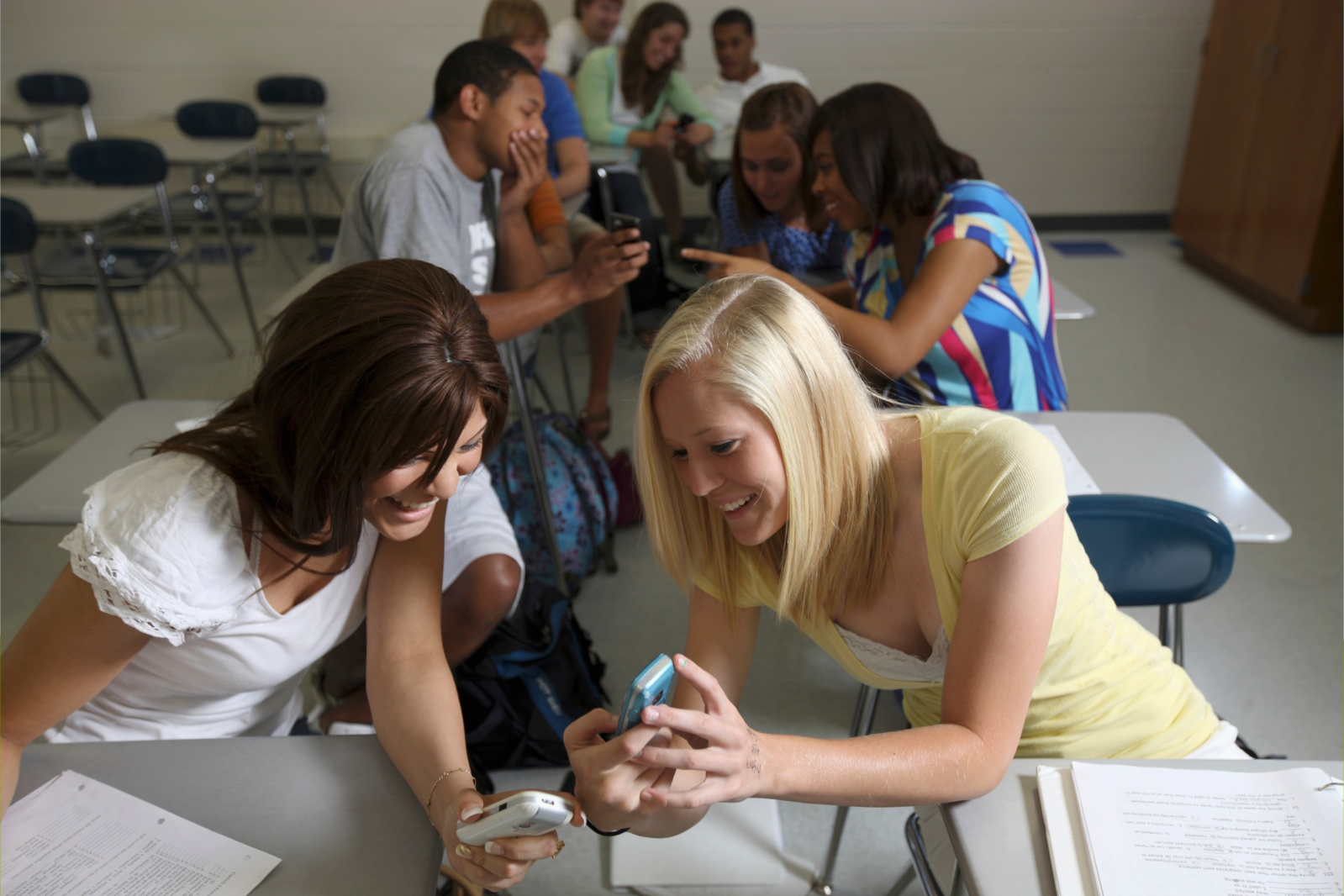
Pennsylvania has become the latest state to restrict students’ cellphone use at school, joining a rapidly growing nationwide push to remove smartphones and other personal devices from classrooms.
Federal data based on responses from 1,490 public schools found that more than half of school leaders believed cellphone use had hurt academic performance, and nearly three-quarters reported a negative effect on mental health as well as attention-span. The U.S. Department of Education said in August that “cellphones and algorithm-driven social media” can distract students from learning, but said states and local communities should decide how technology is used in schools.
Governor Josh Shapiro signed Senate Bill 1014 into law on Monday, requiring schools across Pennsylvania to adopt “bell-to-bell” policies prohibiting students from possessing and using personal mobile devices throughout the school day.
“Technology is a powerful tool, but it’s also a powerful distraction,” Shapiro said, adding that parents and teachers had raised concerns about children being distracted by their devices and spending less time building relationships in person.
The restrictions cover not only lessons but also lunch, recess and periods between classes. Schools must adopt and implement compliant policies by the beginning of the 2027-28 school year.
The legislation applies broadly to school districts, intermediate units, career and technical schools, charter and regional charter schools, cyber charter schools and private and nonpublic schools.
Exceptions are permitted for documented medical, disability or special education needs, and also for English-language learning devices and certain pre-approved instructional purposes.
Which Other States Have Banned Cellphones in Schools?
Pennsylvania is part of a much broader nationwide shift, although states differ significantly in how far their restrictions go.
The Education Commission of the States nonprofit reported in July that at least 40 states had “enacted policies related to cell phone use in schools,” ranging from requirements that districts develop their own policies to prohibitions covering the full school day.
Bell-to-Bell Restrictions
These states have rules extending beyond classroom instruction across essentially the full school day, although there are differences in grades covered and implementation dates:
- Alabama enacted HB166 in 2025, known as Freeing Our Classrooms of Unnecessary Screens for Safety (FOCUS) Act, which restricts students’ use and possession of wireless communication devices throughout the “instructional day,” including lunch, class transitions and other non-instructional periods.
- Arkansas enacted SB 142, known as the Bell to Bell, No Cell Act, in 2025, requiring public school districts and open-enrollment charter schools to restrict possession and prohibit use of devices throughout the “school day,” which refers to “from the time students are required to be at school until the time students are dismissed from school.”
- Florida expanded its existing cellphone restrictions through HB 1105 in 2025, prohibiting cellphone use throughout the school day for elementary and middle school students, while high school students remain subject to an instructional-time restriction.
- Georgia enacted HB 340, the Distraction-Free Education Act, prohibiting students from kindergarten through to grade 8 from accessing personal electronic devices “bell-to-bell,” including during breaks and transitions; HB 1009 subsequently extended the requirement to students in grades 9-12.
- Illinois enacted SB 2427 in 2026, requiring school districts to adopt policies by the beginning of the 2027-28 school year prohibiting students from using wireless communication devices during “school time.”
- Indiana enacted SB 78, expanding the state’s existing wireless-device policy requirements for school corporations and charter schools, including restrictions governing students’ devices throughout the school day and requirements concerning storage.
- Kansas enacted HB 2299, requiring school districts and state-accredited nonpublic schools to prohibit students from accessing or using devices during the school day and requiring devices to be switched off and securely stored away from students.
- Louisiana enacted SB 207 in 2024, prohibiting public-school students from having electronic telecommunications devices on their person throughout the instructional day and requiring any device brought to school to be switched off and stowed away for the duration of the day.
- Maine enacted its statewide bell-to-bell requirement through LD 2212, which includes a requirement for schools to prohibit students’ personal electronic-device use.
- Maryland enacted HB 525, the Joanne C. Benson Maryland Phone-Free Schools Act, requiring county boards to prohibit students from using electronic communication devices during the “academic school day,” defined as first bell to dismissal and including classes, lunch, recess, passing periods and transitions, beginning no later than the 2027-28 school year.
- Missouri enacted SB 68 in 2025, which contains a requirement for school districts and charter schools to prohibit students from displaying or using devices during the school day.
- New Hampshire enacted in HB 2 in 2025, requiring school boards and charter schools to establish policies restricting personal communication-device use from the beginning of the school day through to dismissal.
- New Jersey enacted S3695, which requires public schools to restrict students’ non-academic use of internet-connected devices during the school day, with exceptions for education, health needs and emergencies.
- New York enacted its Distraction-Free Schools law requiring K-12 public schools, charter schools and Boards of Cooperative Educational Services (BOCES) to prohibit “unsanctioned use of smartphones and other internet-enabled personal devices” for the entire school day, including lunch and study halls.
- North Dakota enacted HB 1160 in 2025, requiring schools to establish an all-school-day approach under which covered devices are silenced or switched off and stored away.
- Ohio strengthened its school cellphone rules through HB 96, requiring school districts to adopt policies prohibiting student cellphone use during the instructional day.
- Oklahoma enacted SB 139 in 2025, requiring every public school district to impose a “bell-to-bell” cellphone restriction during the 2025-26 school year.
- Rhode Island enacted S 0771/H 5598 in 2025, requiring every public school to establish a policy prohibiting students from having access to personal electronic devices during the school day, subject to exceptions for specified educational, disability, medical and emergency needs.
- South Carolina introduced a statewide school cellphone ban through its state budget, prohibiting students from accessing personal electronic devices throughout the school day from January 2025.
- Texas enacted HB 1481 in 2025, requiring public school districts and open-enrollment charter schools to adopt policies prohibiting students from using devices while on school property “during the school day.”
- Utah enacted SB 69, School Device Revisions, in 2026, changing the statewide default from an instructional-time restriction to a school-day restriction on cellphones and emerging technologies, with “school hours” including instruction, lunch, recess and transitions between classes.
- Vermont enacted H.480 in 2025, requiring school boards and approved independent schools beginning in the 2026-27 school year to enforce policies which prohibit students use of cellphones and other covered personal electronic devices “from arrival to dismissal.”
- Virginia enacted SB 108 in 2026, requiring public schools to restrict possession and prohibit use of cellphones and smart devices on school property “bell to bell,” including “lunch and time in between class periods.”
- Washington D.C. enacted the Disconnect Act of 2025, which bans K-12 students from having personal wireless devices on them during the school day from the 2026-27 school year.
- Pennsylvania enacted SB 1014 on October 26, 2026, requiring public, charter, cyber charter, private and other covered schools to establish policies prohibiting students from possessing and using personal mobile devices for the entire school day, including lunch, recess and between classes, with implementation required by the beginning of the 2027-28 school year.
Massachusetts could also impose a statewide restriction. If passed, S.2581 would require policies prohibiting students from using personal electronic devices on school grounds during the school day.
Classroom Restrictions / Specific District Policies
While the states above have enacted stricter bell-to-bell restrictions, other states have statewide requirements that take a different approach, either restricting cellphone use primarily during classroom time, or requiring individual school districts to develop their own policies.
Those states are Alaska, Arizona, California, Colorado, Delaware, Hawaii, Idaho, Iowa, Kentucky, Michigan, Minnesota, Nebraska, Nevada, New Mexico, North Carolina, Tennessee, West Virginia, Wisconsin and Wyoming.
The rules vary between states. For example, Michigan’s HB 4141 requires school districts and public school academies to prohibit students from using wireless communication devices during class, but allows districts to impose additional restrictions if they choose.
California takes a more locally controlled approach. AB 3216 requires school districts, county education boards and charter schools to develop and adopt policies that limit or prohibit smartphone use, rather than imposing one uniform statewide bell-to-bell ban.
Why Are States Restricting Cellphones?

The proliferation of state restrictions follows concerns over classroom distraction, academic performance and student well-being.
Federal data released by the National Center for Education Statistics in February 2025 found 77 percent of public schools prohibited students from using cellphones during classes, while 30 percent prohibited their use during classes and at other times outside of class, such as free periods or between lessons.
Based on responses from 1,490 public schools, it also found that 53 percent of school leaders believed cellphone use had hurt academic performance, 72 percent reported a negative effect on mental health and 73 percent cited attention-span effects
Newsweek’s reporters and editors used Martyn, our AI assistant, to produce this story. Learn more about Martyn here.