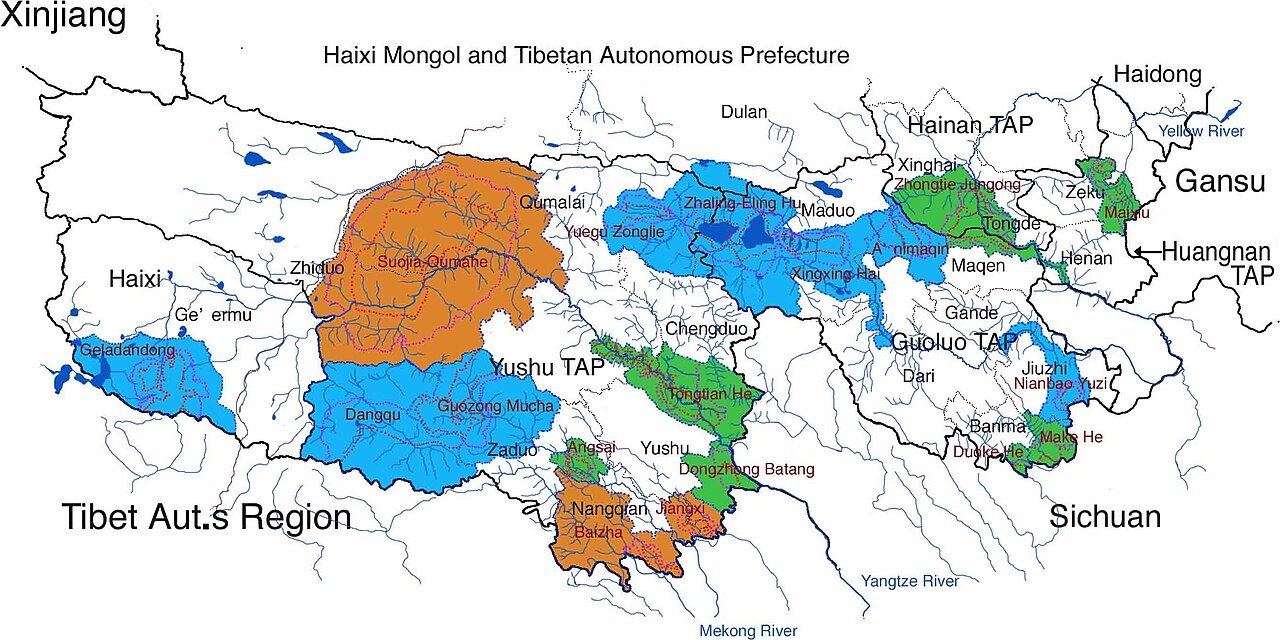
In 2015 the Chinese government announced an ambitious plan to build the world’s largest national park system. China started with Sanjiangyuan, a massive park 13,000 square miles larger than Germany and 14 times the size of Yellowstone National Park in the United States, located in what the government called the Qinghai-Tibet plateau. State media recently described the region as containing “vast, unspoiled alpine ecosystems” and “pristine rivers and mountains.”
To many environmentalists, this was big news. Over the next few years, groups like Conservation International, The Nature Conservancy, WWF, and others eagerly signed up to play a role in helping China build this system. Reports and articles from then focused on how this would protect wildlife like snow leopards, giant pandas, yaks, Tibetan antelopes, and provide opportunities for China to learn from America’s long experience with conservation and national parks management.
But for Tibetans like Kyinzom Dhongdue, there was a big problem. Of the 10 initially planned parks, four — including Sanjiangyuan — were in areas that had been part of the then-independent nation of Tibet prior to the 1950 invasion by China’s People’s Liberation Army.

By Quigley – Own work, CC0, Link
“In Tibet, you have an authoritarian colonial power presenting to be some kind of a green hero,” says Dhongdue, former member of the Tibetan Parliament in exile who is now an Australia-based human rights activist. “The environmental movement is in danger of normalizing what China is doing and without really looking at the darker side of these programs.”
She and others fear that history is repeating in Tibet and other regions under Chinese control, such as Xinjiang, homeland of Turkic Uyghurs and Kazakhs, and Inner Mongolia.
In each of these locations, the designation of new national park and land protections systems and increased efforts to promote ecotourism have resulted in the ongoing displacement of locals from the land they’ve lived on for generations. In their place, Chinese park officials or tourism interests have taken control.
“These parks are displacing the very same people who have lived on and looked after those lands for generations,” Dhongdue says. “A colonial, foreign government is coming in and protecting a landscape by removing the traditional custodians. And that is a huge problem.”
Nonprofit conservation groups, meanwhile, have mostly remained silent, their messaging focusing more on snow leopards, argali, and other endemic and endangered species over the communities who have lived alongside them for generations.
According to the East West Center at the University of Hawai‘i, The Nature Conservancy introduced the idea of national parks to the Chinese government as early as 1997 and has played an active role in knowledge sharing and exchanges between the U.S. and China. Conservation International claims to have helped conserve 4.9 million acres of land in China, and one of their first projects was in Southeastern Tibet. To them China’s 2015 national parks announcement was a major achievement.
While the imagery of parks like Sanjiangyuan evokes an empty landscape untouched by humans, the reality is quite different. According to an article in National Geographic, there were an estimated 652,600 people living inside the boundaries of China’s initial 10 parks.
While comprehensive data is lacking, so far these national parks have resulted in the displacement of tens of thousands Tibetan nomads and villagers from their land — and likely many Uyghurs and Mongols, too — often to newly constructed urban villages in less desirable locations.
It’s a similar story to what happened with America’s first national park, Yosemite, often glorified as the origin of the global conservation movement. There the park’s formation led to the expulsion of the Miwok and Ahwahneechee peoples and eventually their erasure from the landscape, which was promoted to wealthy tourists as an unspoiled wilderness, not a longtime home of thriving cultures.
The same happened to at least 26 Indigenous groups at other well-known national parks or monuments in the United States — including Glacier, Yellowstone, and Shenandoah. For decades this history was erased and nearly forgotten.
Today it’s recognized that in the push to protect landscapes and forests in the late 19th and early 20th centuries, environmentalists turned a blind eye to the sometimes-violent displacement of native peoples. In recent years groups like the Sierra Club, the National Parks Conservation Organization, and even — at least prior to January 2025 — the National Park Service have begun to reckon with their role in erasing native peoples from landscapes.
The Nature Conservancy also acknowledges the harms of colonialism and the need to involve including local communities and Indigenous peoples in land conservation, as do Conservation International and WWF.
In the United States, it was mostly white settlers who displaced Natives from their land — and it was mostly white rangers and officials who managed national parks. Positions of power, and often voting rights, were withheld from native peoples. At the time millions of Native Americans and other oppressed groups lacked voting rights or representation.
For many nonprofits, understanding this harmful past didn’t stop them from actively working with China, despite its ranking as one of the world’s most repressive countries. China’s authoritarian single-party government has criminalized most protests, especially for so-called ethnic minorities like Tibetans and Uyghurs, who face collective punishment and far more surveillance and censorship than the Han Chinese majority.
“Protest has become a very sparse and dangerous thing in Tibet and Xinjiang,” says Dawa Lokyitsang, a Tibetan anthropologist currently doing a postdoctoral fellowship at the International Institute for Asian Studies in the Netherlands.
Removing communities from landscapes isn’t just bad for people. It can be bad for the landscapes themselves.
In the same ways that European colonialism and America’s westward expansion were disastrous for iconic species like bison and passenger pigeons, many point to the invasion of Tibet as when deforestation, mining, and river damming began to transform landscapes.
“Extraction has been happening for a long time, [starting] right after Tibet’s invasion,” says Lokyitsang. “Deforestation and mining, since the 1950s, it’s been classic industrial, colonial, resource development, and extraction.”
Today science is finally starting to recognize the many ways that Native Americans molded the ecological landscape of much of North America. Other published science has found that in seemingly wild places like the Amazon rainforest, humans are often part of the ecosystem and removing them can have adverse impacts.
In Tibet, too, the role of traditional nomads and other communities should be valued, not displaced, by national parks, says Dhongdue.
“It’s also very important to understand that Tibetans are environmental actors,” Dhongdue says. “We have lived on and conserved this land for generations, and that traditional knowledge is not being taken into account by China.”
A report published last year by the Institute for Security & Development Policy presented evidence that removing Tibetans from these seemingly harsh landscapes has led to increased erosion, biodiversity loss, and land degradation.
Not too long ago, global conversation groups were happy to speak about their work in China, which was highlighted in annual reports. Journalists were welcomed on tours of parks like Sanjiangyuan or Giant Panda National Park, where, sometimes, they saw showcase projects where some Tibetans had been provided housing or low-level jobs at parks.
But critics say these organizations failed to see past propaganda or ask difficult questions about what was really happening.
“The danger is if you’re not addressing both the environmental aspect and people’s rights, these organizations risk legitimizing a colonial system that is in place,” Dhongdue says.
WWF China, The Nature Conservancy, and Conservation International all declined to be interviewed for this story, while Snow Leopard Trust, the Paulson Institute (a sustainability think tank), and Chinese nonprofits like Shan Shui didn’t respond to interview requests. This echoes Dhongdue’s experience when she was working on a report about Tibetan nomads and land displacement in 2019.
“I’m not surprised, but, yes, quite saddened by that,” she says. “I had the same response: people not willing to engage on issues relating to Tibet.”
Gabriel Lafitte, an independent researcher focused on Tibet, fears that these organizations have self-censored due to policies that limit their space to operate in China.
“They have to operate within Beijing’s constraints,” says Lafitte. “Beijing has learned how to co-opt, control, and manage international nonprofit engagement across the entire spectrum of environmental issues.”
An NGO law passed in 2016 requires anyone operating in China to have their yearly plans approved by a branch of Chinese government, limiting direct criticism. Even actions taken by overseas offices staff are risky, as statements that anger or upset China could lead to Chinese staff being threatened or even arrested or detained. It’s one reason that human rights and labor nonprofits like Amnesty International, Human Rights Watch, and Transparency International have no presence in China.
Worryingly, some of this is now repeating in the United States, where Donald Trump has also backtracked on quite recent efforts to recognize the erasure of the Miwok, Ahwahneechee, and others from national parks, returning the government, after a brief window, back to silence about the treatment of Native Americans.
The good news? So far U.S. conservationists are mostly fighting back against these changes and refusing to forget the dark history. But Lafitte doubts they’ll be willing to speak about the same injustices happening today in China.
“At this particular moment, it’s hard to imagine who might speak up for Tibetans or Uyghurs.”

Tear Down the Walls: The Racist Roots of ‘Fortress Conservation’