Key Points
Analysts at Cantor Fitzgerald reiterated their “neutral” rating on Rivian (NASDAQ: RIVN) stock on Sept. 28. Curiously, however, the firm also reiterated its $19 price target, which implies more than 20% upside.
In many ways, Cantor Fitzgerald’s seemingly contradictory stance makes a lot of sense. Rivian does have plenty of growth potential. But there is also plenty of risk.
Missed Nvidia in 2009? This Rare Signal Is Flashing Again. In 2009, a “Double Down” signal flashed for a little-known chipmaker called Nvidia. For the first time in years, that same “Total Conviction” signal is flashing for a company 1/100th the size of Nvidia. Continue »
Even if you’re not traditionally interested in EV stocks, it looks wise to take a deeper dive into Rivian as an investment opportunity. Share price upside for Rivian could easily surpass Cantor Fitzgerald’s price target in the years to come.
Here’s why Rivian stock could easily surpass $19 per share
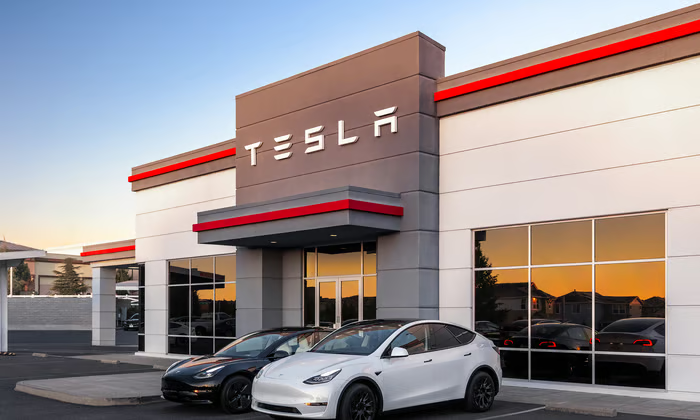
At today’s stock price of around $15, Rivian is valued at roughly $22 billion. At $19 per share, Rivian would be valued at nearly $28 billion. To put that into perspective, fellow EV maker Tesla is valued at more than $1.4 trillion.
Rivian, of course, is no Tesla. Last quarter, Rivian generated just 5.9% of Tesla’s sales. From a deliveries perspective, Rivian totaled just 2.5% of Tesla’s deliveries last quarter. That mostly reflects an average higher price point for Rivian’s vehicles.
Yet Rivian’s valuation is just 1.5% of Tesla’s market cap. Even at $19 per share, Rivian would be just 1.9% the size of Tesla. That’s strange considering Rivian arguably has several growth runways that could allow it to ramp sales and gross profits aggressively in the years to come.
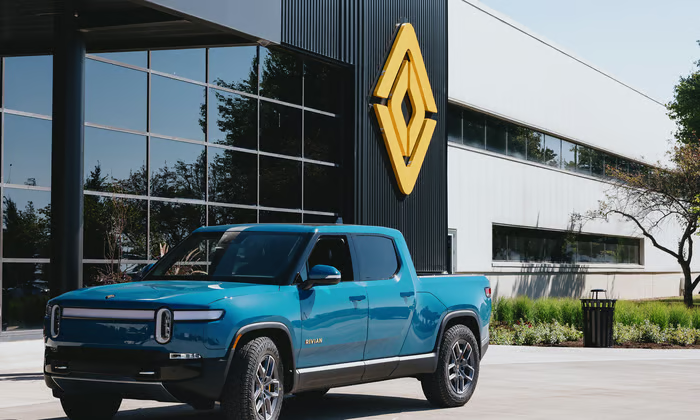
Tesla’s gross margins, for example, currently hover around 19%. Rivian’s gross margins, meanwhile, remain around 2%, only recently turning positive. A big reason for Tesla’s superior margins is its production capabilities. In other words, Tesla has benefited from economies of scale, mostly stemming from the mass success of low-price models, including the Model Y and Model 3. Rivian began deliveries of its first low-priced model — its R2 SUV, with a base price of $48,000 — earlier this year. The launch not only has the potential to accelerate Rivian’s sales growth, but also to narrow its gross margin gap with Tesla as economies of scale take root.
Image source: Rivian.
Rivian’s biggest long-term growth driver, however, is the same as Tesla’s: robotaxis. Morgan Stanley sees robotaxis becoming a $1 trillion market by 2040. Other analysts are even more bullish. Cathie Wood — the CEO of Ark Invest, a longtime Tesla shareholder — sees robotaxis eventually becoming an $8 trillion to $10 trillion market.
Tesla plans to benefit from this market by producing its own EVs, selling or leasing them to independent robotaxi fleet operators, and taking a cut of every ride booked through its Tesla ridesharing app.
Rivian is taking a different approach, opting to sell its vehicles to robotaxi fleet operators regardless of which ridesharing platforms they intend to use. Uber Technologies, for instance, recently agreed to buy up to 50,000 Rivian R2 SUVs to help scale its robotaxi efforts.
These two different approaches will generate different sales potential and margins. But both could ultimately succeed. Tesla can compete aggressively as a vertically integrated platform. Rivian, meanwhile, is positioning itself as a core supplier to robotaxi operators that lack internal manufacturing capabilities.
The market seems very bullish on Tesla’s approach, yet strangely dismissive of Rivian’s opportunity. Given Rivian’s potential to scale vehicle sales, improve margins, and sell into the robotaxi market, a long-term market cap well above $30 billion certainly seems possible.
Should you buy stock in Rivian Automotive right now?
Before you buy stock in Rivian Automotive, consider this:
The Motley Fool Stock Advisor analyst team just identified what they believe are the 10 best stocks for investors to buy now… and Rivian Automotive wasn’t one of them. The 10 stocks that made the cut could produce monster returns in the coming years.
Consider when Netflix made this list on December 17, 2004… if you invested $1,000 at the time of our recommendation, you’d have $379,123!* Or when Nvidia made this list on April 15, 2005… if you invested $1,000 at the time of our recommendation, you’d have $1,396,103!*
Now, it’s worth noting Stock Advisor’s total average return is 933% — a market-crushing outperformance compared to 212% for the S&P 500. Don’t miss the latest top 10 list, available with Stock Advisor, and join an investing community built by individual investors for individual investors.
*Stock Advisor returns as of September 30, 2026.
Ryan Vanzo has no position in any of the stocks mentioned. The Motley Fool has positions in and recommends Tesla. The Motley Fool has a disclosure policy.