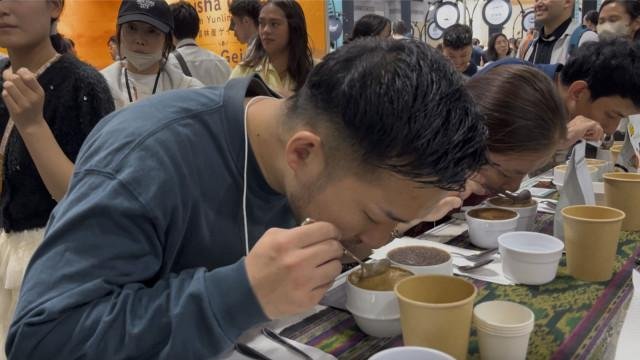
TOKYO — On a table lined with cups at Tokyo Big Sight, the sprawling convention center on the waterfront of Tokyo Bay, Philippine coffee was being asked to do something it rarely gets the chance to do in Japan: introduce itself.
Names like Ethiopia, Brazil, and Colombia are familiar to Japanese coffee drinkers, appearing on coffee bags and café menus. Philippine coffee origins such as Benguet, Mt. Apo, Sagada, Bukidnon, and Sultan Kudarat, however, remain less familiar.
At the Philippine booth during the Specialty Coffee Association of Japan’s (SCAJ) 2026 World Specialty Coffee Exhibition, visitors gathered around a cupping table to sample beans from different parts of the country. They first took in the aroma, then broke the crust—the layer of coffee grounds, oils, and foam that forms on the surface after steeping—before tasting the coffee as it cooled.
Facilitated by the Philippine Embassy in Japan, the booth showcased Arabica, Robusta, Excelsa, and Liberica varieties, including Barako, Mt. Apo coffee, and single-origin beans from Benguet and Mindanao.
For Japanese chocolate maker Kyoko Masuda, who has been drinking coffee for more than two decades, what stood out was what remained after the sip.
“I think the most impressive thing in Philippine coffee is the sweetness and the clear aftertaste. The fragrance is also beautiful. That’s my favorite point,” Masuda said.
Another participant, Manami Naito, was just as taken by the sweetness.
“It’s so rare that we can taste a lot of types of coffee from the Philippines. It was so delicious. All of them were delicious,” she said.
The tasting was part of the Philippines’ participation in the SCAJ held from October 14 to 17.
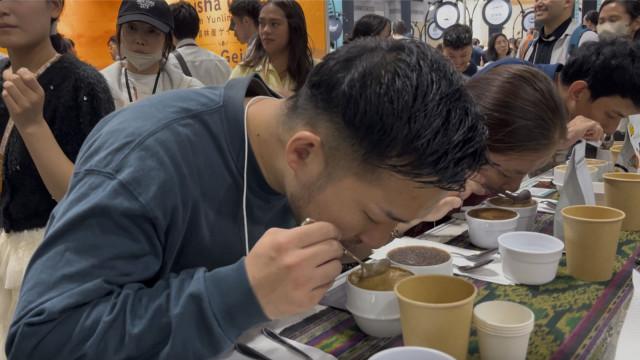
Visitors sample Philippine coffee during a cupping session at SCAJ 2026. Photo: Jay-vee Marasigan Pangan
Ahead of the event, organizers expected around 95,000 visitors, with more than 500 exhibitors from Japan and overseas representing 35 countries and regions, and attendees coming from around 80 countries and regions over the four-day exhibition.
Three Philippine companies participated onsite: Verra Coffee, which brought premium Barako, Mt. Apo Liberica and Amadeo coffee; The Coffee Heritage Project, with hand-sorted and single-origin beans from Sagada, Bukidnon and Maguindanao; and Pistacia Mindanao Coffee Export Inc. (PMCEI), which showcased dried green coffee beans from Mindanao.
Products from other Philippine companies and cooperatives were also displayed. JPC Golden Alliance Trading Corporation featured civet coffee beans and grounds; Merlo Agricultural Corp. brought Cafe Barako de Lipa, Batangas Brew and Mercado Coffee Drip; Pinagdanlayan Multipurpose Cooperative showcased Robusta beans, ground coffee and drip coffee; and D’ Aroma Coffee featured an air-roasted blend of Excelsa and Robusta.
The booth also included cacao products from Crave Cacao Orchard, which brought pure tablea, and MS3 Agri-Ventures Corp., which showcased 100% cacao tablets.
The Philippine presence at SCAJ also extended beyond the official booth. Cappo Coffee Lab & Roastery joined the exhibition independently, which the company described as its first international coffee expo.
In a social media post ahead of the event, Cappo said it was bringing Philippine coffee to Tokyo to introduce more people to what the local coffee community has to offer.
Agriculture Attaché Maria Alilia Maghirang from the Philippine Embassy in Tokyo said Barako appeared to have a particular pull among visitors.
“Most of the customers who came here, they are really looking for Barako coffee,” Maghirang said.
But Barako was only part of the pitch. Coffees from places such as Mt. Apo, Benguet, Bukidnon, and Sultan Kudarat were also part of the effort to broaden how Japanese consumers see Philippine coffee.
Rare enough to make people curious
In Japan, Philippine coffee is still unusual enough to invite a second look.
About a 20-minute train ride from Tokyo Station, Cafe Lubna in Arakawa opened only this year with a focus on Philippine coffee. Nobuyuki Harada of the café said customers are already familiar with origins such as Ethiopia, Brazil, and Colombia, while Philippine coffee still prompts curiosity.
“Actually, in Japan, Philippine coffee is very rare, very unique,” he said.
Customers, he added, sometimes react: “Oh wow, you sell the Philippine coffee, I want to taste.”
The café began after its operators met Vanessa Velasco of VerraCoffee during SCAJ 2025 and sampled Philippine beans. Within months, they had selected coffees including those from Mt. Apo and opened their own shop in April.
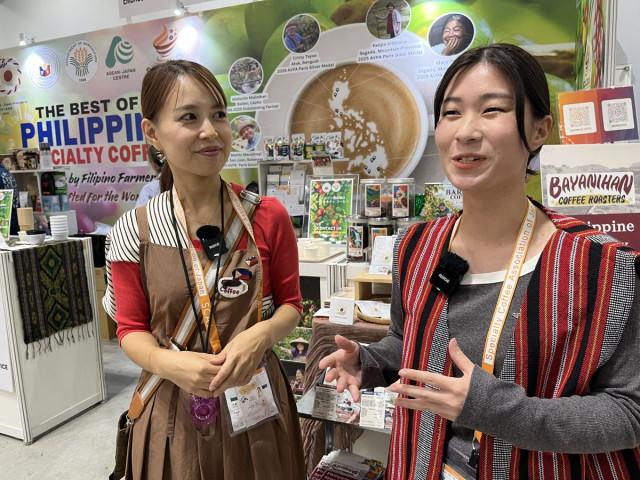
Sachiko Sata (left) of ST Lala, which imports Philippine coffee, and Kurumi, a Japanese student of Philippine studies, join activities at the Philippine booth during SCAJ 2026, where Japanese participants were introduced to Philippine coffee origins, varieties and different ways of appreciating the beans. Photo: Jay-vee Marasigan Pangan
Meanwhile, Kurumi, a Japanese student of Philippine Studies at Tokyo University of Foreign Studies, said she had not been much of a coffee drinker before. Her time in the Cordillera, however, introduced her to local coffee and changed her impression of it.
“Nagulat din ako sa lasa. Masarap ang coffee dito sa Pilipinas,” she said.
(I was also surprised by the taste. The coffee here in the Philippines is delicious.)
Sachiko Sata of ST Lala, recalled discovering Barako while ordering coffees from different countries during the pandemic.
“When I drank it, I was shocked. I thought, ‘What is this interesting coffee?’” Sachiko said in Japanese. “There are many delicious coffees, but it was the first time I had encountered a coffee that I found interesting.”
Sachiko said most customers do not arrive already looking for Barako. More often, they come in for coffee, realize the shop serves Philippine beans, and decide to try them.
Some later buy beans to take home or give as gifts, wanting others to experience the coffee they had just discovered.
ST Lala directly imports, roasts, and sells Philippine origin coffee beans.
That progression, from tasting beans to putting them on a Japanese café menu, is the kind of connection Philippine participants hope to recreate.
Maghirang said Japanese visitors were also buying dried green beans rather than only finished roasted coffee, allowing them to roast, grind and brew the beans themselves.
She noted that despite the fast pace of everyday life in Japan, some coffee drinkers were taking the time to roast, grind, and brew the beans themselves.
“With coffee, I think it’s more special that they’re taking time to prepare it,” she said.
The Philippine Embassy lists on its Facebook page Japanese coffee brewers and businesses that also joined the country’s participation, among them Aoyama Tsusho Co., Ltd., Door to C, Norry’s Coffee, Bayanihan Coffee, ST-lala, Tetsu Coffee, Cordillera Green Network, Panay Dream Coffee Project, A.C.C. LLC, Cocomas Chocolate and Fresh Roaster Coffee Tonya
For Maghirang, SCAJ is different from trade events built primarily around moving large quantities of products.
“The target is really the volume, but here it’s more on the quality and the taste of the coffee that we wish for our consumers, for the customers to experience,” she said.
Several coffees displayed at the booth came from farmers who had placed in Philippine coffee competitions, while some have also received international recognition.
A coffee-producing country that still imports coffee
There is an irony behind the push.
The Philippines grows coffee, but the industry itself acknowledges that domestic production remains limited.
Brenda Claver of the Philippine Coffee Guild said the country is still not widely perceived as a coffee-producing nation partly because it produces relatively little and consumes more coffee than it grows.
“[The] Philippines is not seen as a coffee-producing country. Why? Because the quantity that we produce is not that much,” she said. “But we consume more than we produce.”
For the industry, introducing specialty coffee abroad is therefore also about giving farmers a reason to keep improving what they grow.
Brenda said exhibitions can help draw attention to coffee producers and encourage both current and potential farmers to consider high-quality coffee production as a viable source of livelihood.
Farmers, she said, are “the heart and soul of the Philippine coffee industry.”
That effort can start with something as simple as the color of a coffee cherry.
Katsuhisa Ota from Pistacia Mindanao Coffee Export (PMCE, Inc.) recalled teaching Filipino farmers to harvest only fully red cherries, improve sorting and processing, and taste their own coffee so they could understand the quality they were producing.
He would also bring a small roaster to farming communities so farmers could taste their own harvests instead of simply selling beans without knowing how the finished coffee turned out.
“Many buyers just buy, and farmers do not know if their coffee is delicious or not,” he said.
His view of the economics behind coffee was equally straightforward.
“Coffee price high, quality should be high,” he said.
Brenda added that government agencies and private-sector specialists have also been conducting training for farmers, particularly on production and processing, as the industry tries to raise both output and quality.
Getting Philippine coffee into more cups
For now, Philippine specialty coffee remains a discovery for many Japanese coffee drinkers.
That unfamiliarity may also be part of its appeal.
And the promotion will not end at Tokyo Big Sight.
Maghirang said Philippine specialty coffee is also expected to be featured at the International Horticultural Expo, which will take place in Yokohama, Japan. The Philippines will have its own garden and pavilion and a café component as part of a six-month participation beginning in March 2027.
“So, this is just the start,” she said.
At the cupping table in Tokyo, however, the case for Philippine coffee was made one aroma, one sip, and one spoonful at a time. — VBL, GMA News