New York
Down a dim, crooked hallway inside the Jay Street Lofts, a hulking brick relic of Brooklyn’s industrial past, Naomi Mishkin is conducting a radical fashion experiment.
She’s making shirts. In New York City. Using cotton and wool. They are not cheap, and they never go on sale. That counts as a rebellious act in the sprawling $1.9 trillion global fashion industry, a business that over the past three decades has mastered the art of cutting production costs to the bone.
Mishkin owes some of the success of her label, Naomi Nomi, to a growing backlash against companies – from the luxury tier on down to mall brands and fast fashion – that have tried to pull the synthetic poly-blend wool over our eyes. The middle tier of the market has been hollowed out, with prices inching higher even as brands downgrade quality.

Big mall brands aren’t seeing sales drop off a cliff, but customers have become “more interested in buying less, but buying right,” Neil Saunders, managing director of retail at GlobalData, said.
“There is a bit of a disconnect between what consumers are looking for and what’s being delivered,” he added. Shoppers may feel constrained by higher inflation, but they aren’t trading down to cheaper brands. “Consumers are looking at value more closely and part of that involves assessing how long garments will last and how much wear consumers will get out of them.”
Mishkin, who launched Naomi Nomi in 2018, says her average customer starts with one shirt, then comes back for three more within six months.
“I don’t f**k with my quality… That is the reason I’m still kicking. And I want to be a business that’s around for the next 50 years.”
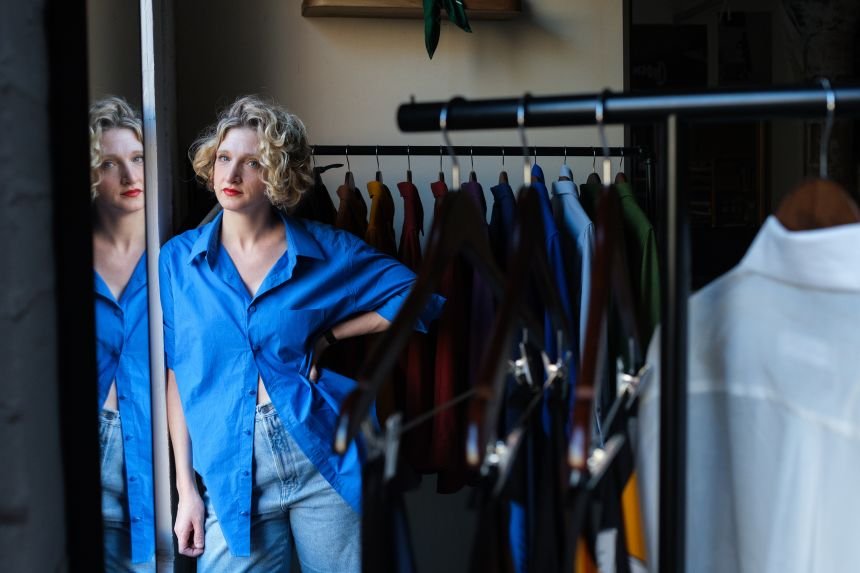
Inside Mishkin’s sunlit studio, spools of thread, scissors and power tools hang on a peg board above a worktable. There are three racks of shirts and a mirror by the window, with a curtain that can create a makeshift dressing room.
It is not a typical retail experience. There’s no storefront. No sale racks or cash registers or crowds. Try-ons are by appointment. And if you decide to buy a shirt, you won’t get to walk out with it the same day. The shirts are made to order, so no fabric is cut until the money clears. And the money is no joke: Naomi Nomi’s signature white cotton Oxford button-down, sewn in a factory a few miles north in Queens, costs $268 before tax.


That is nearly four times what I paid for the white Gap button-down that I wore when I met Mishkin at her studio in September. Browsing a rack of her latest merino wool Oxfords ($338 a piece), I’m not even holding a coffee but I am nonetheless anxious about spilling coffee on them. They remind me, favorably, of the elegant-but-sturdy garments that once filled my grandmother’s closet.
That is part of Mishkin’s pitch. While she describes her base as “millennials and their mentors” — folks well into their 30s and beyond — there is a younger cohort finding Naomi Nomi because they’d rather have one good $300 shirt than five $60 shirts. They’re increasingly shopping secondhand, she said.
And when they buy new, they’re reaching for brands like hers that exist in a kind of obscure fashion middle ground that some in the industry refer to as “advanced contemporary” — cheaper than luxury but well above mass market prices.
“They’re sick and tired of the planned obsolescence of it… I think that’s the biggest selling point in my clothing. I’m telling you, ‘Yes, it is going to be pricier than an Anthropologie shirt. We’re pricier than Banana Republic, but we’re going to last.”

For me, it started with one crooked seam.
Two years ago, I ordered a seemingly identical replacement of a simple cotton dress that I practically lived in. When the replacement arrived, the new cotton felt stiff, less breathable, and one side seam veered off at an angle, pulling the fabric awkwardly around my body. I chalked it up to a rare miss from an otherwise reliable brand. But subsequent purchases were similarly disappointing. Sweaters quickly pilled after a few wears. Sizing was all over the place. Everything, it seemed, was too delicate for the washing machine.
None of what I was buying could be categorized as fast fashion. But there was no denying something had changed.
It wasn’t all in my head.
A confluence of forces has upended the economics of retail over the past several decades.


Fast fashion’s ascendence alongside social media in this century is certainly one well-documented culprit. But the decline of American textile manufacturing since the 1970s played a role, too, as brands went overseas for cheap labor. When I asked fashion podcaster Avery Trufelman where the trouble began, she pointed to, among other things, LVMH CEO Bernard Arnault, whose aggressive overhaul of European fashion houses in the 1980s pushed designers to churn out double or even triple the number of seasonal collections they produced.
The result today is that we expect clothes to be cheap, and we expect to buy a lot of them. But that is a relatively new reality.
In 1980, the average American bought 12-14 clothing items a year. By 2018, that figure was 68, Dana Thomas, author of the book “Fashionopolis,” which exposes the labor abuses and environmental tolls of fast fashion, told me.

And while the price of just about everything Americans buy has gone up since 1980, clothing is a notable exception.
Apparel prices in the United States in 2024 were essentially the same as in 1994, according to the Bureau of Labor Statistics.
“We’ve been conditioned to think that clothes should be cheap, but they shouldn’t be cheap,” Thomas said. “Labor costs money… they’re only cheap because nobody along the supply chain is paid what they’re worth.”
For a growing cohort of style influencers, we’ve reached a tipping point.
Rachael Brownfield, a Tampa-based advertising executive who moonlights as a retail sleuth, documents on TikTok her dismay over the fast-fashion-ification of brands such as Madewell and Anthroplogie that she once loved.
Two key themes emerge in Brownfield’s videos:
-
There are a lot of polyester and other synthetic blends, a sign the brand has cut production costs by using cheaper materials. “If you’re not paying attention, you can spend $200 on something that’s not made well, and made out of plastic,” Brownfield said in an interview.
-
There is so much clothing. New styles drop every few weeks, creating a perpetual supply of sale rack fodder — much of which will end up in landfills (where their synthetic fibers don’t biodegrade); incinerators (where their synthetic fibers create toxic smoke); or “recycling” centers in developing nations, where, as CNN documented earlier this year, workers face relentless health hazards.
Brownfield captures a frustration that’s palpable across the internet: Clothes have never been more abundant. Yet it’s never been harder to shop for them.
Global clothing production doubled between 2000 and 2014, according to McKinsey research, and the number of garments purchased per person in that time grew 60%.
Today, the fashion industry produces 100 billion garments and accessories every year. That is only a best guess, though, because companies aren’t required to disclose how much they produce, or how much of it ends up in a landfill, Thomas said.
About 60% of new clothes now contain some form of plastic, which can include polyester, acrylic and nylon – all of which are cheaper than cotton or linen, but none of which break down naturally.

To be sure, a bit of polyester here and there is not inherently bad, especially in outdoor or athletic gear. But it feeds into a consumption loop: Introducing plastic makes an item cheaper to produce, spurring more demand for low-cost items. Shoppers get excited by new trends and brands move quickly to cater to them. Those clothes then cycle through our closets to the thrift store to the landfill as we move on to the next trend.
“This is capitalism 101,” Thomas said. “‘Now that we’ve got everybody hooked on the product, let’s see how we can cut the corners on the product to raise our profits, and maybe no one will notice.”
But at some point, consumers do notice, she said.
“We’re getting to the endgame… There’s only so much you can cut until it really starts showing.”
That’s one of the main reasons a Naomi Nomi shirt costs what it costs: Mishkin’s not using cheaper poly blends or shipping her designs overseas to be sewn in bulk.
“My seamstresses live in the same city as my customers,” she said. “If a customer is going from a $3 coffee to a $5 coffee, my seamstresses are going from a $3 coffee to a $5 coffee.”