
Photo: South China Morning Post
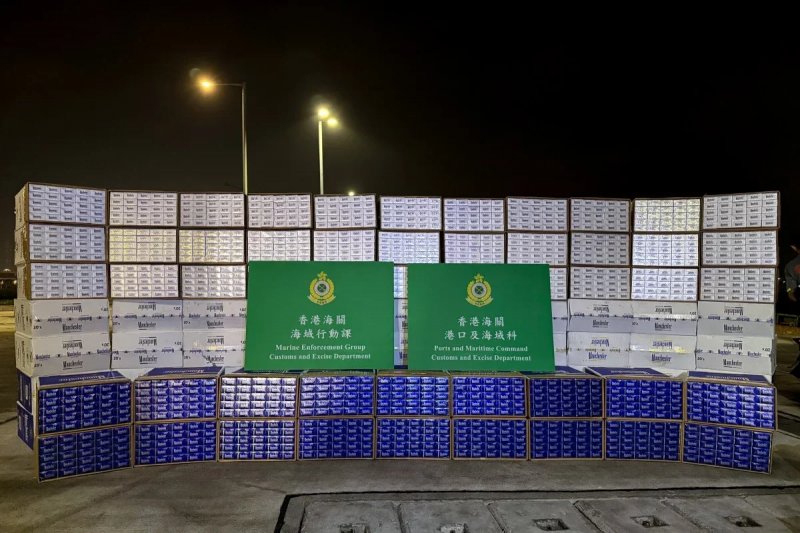
Hong Kong customs officers seized 600 million illicit cigarette sticks in the first three quarters of this year, the department chief has said, as he revealed plans to roll out more advanced contraband detection equipment.
Commissioner of Customs and Excise Chan Tsz-tat told a radio programme on Saturday that the seizures in the first nine months this year nearly matched the 2025 total, according to South China Morning Post.
He said that of the 600 million sticks seized, 200 million were destined for other locations but were intercepted in Hong Kong after customs received intelligence.
“We have around 16,000 cases of illicit cigarette seizures that involved passengers who did not declare they were carrying over 19 sticks of cigarettes,” Chan said.
The cases were among 18,000 involving illicit cigarettes that customs detected from January to September.
No serious drug offences occurred at the revamped Huanggang Port since it opened last Monday, the commissioner added.
When asked whether customs operations at the border crossing were smooth following long queues amid crowd surges over the Chung Yeung Festival long weekend, the customs chief said both passenger and cargo clearances were steady.
“The bottleneck was not at customs checks. Customs clearance hall operations were quite smooth,” Chan said.
At the revamped checkpoint, vehicle clearance is handled through a “joint one-stop” lane. Drivers first pass through a customs front kiosk before supplying their identity and biometric data at a machine that shares the information with five government departments, including customs.
Should customs checks be deemed necessary, drivers are notified at the customs front kiosk to drive to a separate clearance hall for checks.
The department has reassigned workers from other border checkpoints, cancelled employee leave and hired a small number of retired staff to help man the newly opened land boundary checkpoint.
“As more people cross the border, our workload will only increase. Adding manpower may not be the only way to cope,” Chan said.
The customs chief said the department would turn to technology to introduce more advanced equipment to alleviate manpower pressure.
This would include introducing active millimetre wave detectors, a device to scan for contraband items hidden on a person’s body, at more land checkpoints in the future.
The detector uses a wave that is not invasive to the body and may reduce the need for body searches on passengers, according to Chan.
With the unprecedented “joint clearance” system, officials earlier said processing time at the revamped Huanggang crossing could be cut to five minutes from about 30 minutes.
Hong Kong residents who hold a valid mainland Chinese travel permit can use their Hong Kong ID cards interchangeably at the joint clearance channel for both outbound and inbound trips.
The crossing is expected to be able to handle up to 300,000 travellers a day. The Immigration Department said it expected about 100,000 people to use Huanggang Port daily during initial operations. It can also handle 15,000 vehicles a day.