In 1990, the Hispanic Designers Inc. organization held its sixth annual gala and fashion show, recognizing Luis Estévez with its Lifetime Achievement Award and Fernando Sánchez with the MODA award, for their contributions to fashion. By then, both couture-trained designers had already left their marks, building legacies in New York and Los Angeles that helped define American fashion.
Luis Estévez: From Havana to Hollywood
A Havana, Cuba, native, Estévez, (1930-2014) the grandson of sugar tycoon Santiago Estévez, arrived in New York in the late 1950s. A student of architecture, Estévez’s turn to fashion came when he took a summer job in the display department at Lord & Taylor, then a beacon of progress in retail.
More from WWD
Connections to the social set took him to Paris, where he worked and trained under French couturier Jean Patou, known for his luxury ready-to-wear, knitwear and perfumes. But New York kept calling and he returned. In the mid-1960s, he set up the fashion label Grenelle-Estévez, a partnership with Fred and Robert Greenberg and Ben Papell. Understanding that location matters, he opened a showroom at 550 Seventh Avenue, the landmark Garment Center building that launched the careers of noted American designers and friends, including Oscar de la Renta.

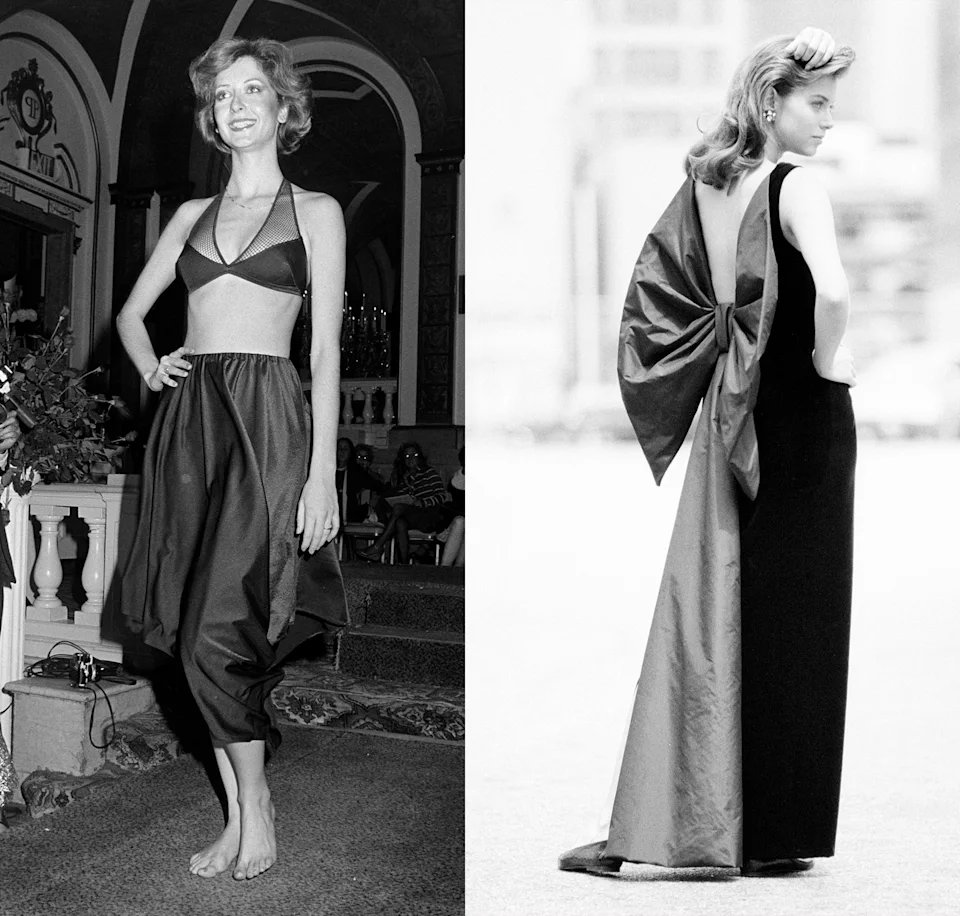
Luis Estévez spring 1976 resort show, New York and Luis Estévez 1984 holiday collection, Los Angeles. Fairchild Archive/WWD
In 1967, though his business in New York was on an upswing, he decided to seek the sun, sparkle and social sway of L.A., “I wanted the Havana of my youth…,” he told WWD.
His clientele included Hollywood stars like Lana Turner, Zsa Zsa and Eva Gabor, Merle Oberon, Natalie Wood and Princess Grace of Monaco. Betsy Bloomingdale and First Lady Betty Ford were also clients. Estévez credited Ford, who always wore looks directly from his collections, for helping expand his label’s visibility. It was also in L.A. that he designed his families hilltop home, La Vista, where he entertained, and his namesake bespoke design studio and boutique in Montecito.

First Lady Betty Ford (L) wearing Estévez eveningwear at the White House, 1976 and Zsa Zsa Gabor with Luis Estévez on the runway during his spring 1974 show, Los Angeles. Fairchild Archive/WWD
“I associate fashion with the reality of the people I know who wear fashion, and where and how they wear it. What I am talking about here is my fashion, and my theory. I know that it’s not ‘in’ with the very hip crowd of people,” he stated in 1976, “but I don’t give a damn.”
While Hollywood suited his verve for life, it wasn’t exactly a good career move. Estévez continued to design and produce his couture, rtw, furs, accessories and shoe collections into the 1990s, when he retired.
Fernando Sánchez: Building a Legacy in Lingerie
Born in Spain, Fernando Sánchez (1935-2006) began his couture career at the houses of Maggy Rouff, Dior — at the request of his friend Yves Saint Laurent — and Nina Ricci before going out on his own. Though he told WWD in 1966, in one of his first interviews, that he had only “dabbled” in lingerie, the category he elevated to high fashion would become the foundation of his design legacy.

Billy Blair and a model in Warner by Fernando Sánchez, 1975, 40-piece loungewear and lingerie collection. Sal Traina/Fairchild Archive
Sánchez arrived in New York in the late 1960s, taking the helm as designer for Warners bras and at-homewear under his own name — a privilege few designers have retained. During the same period, he designed furs for Revillon. In 1973, he opened his namesake label and in succeeding years signed licensing deals with moderate price lingerie labels Lily of France and Vanity Fair.
In a recent conversation with his former assistant publicist, Tanya Wetenhall, she recalled, “Fernando brought fashion, sophistication and construction to loungewear at a time when the category was still largely seen as something separate. It was a combination of his mother’s style, his love of Morocco, iconic films like ‘West Side Story,’ music from ‘The Last Emperor,’ and his love of New York City, where he made his home, and the nightlife, that inspired his artistic vision.”
“I design from a feeling…probably because I don’t know lingerie. I really am a dress designer — unconsciously, I make dresses. “Lingerie,” he noted, “…should be glamourous and frivolous, but must be, first of all, flattering.”

Mounia at Fernando Sánchez, spring 1979 and Terri May at Fernando Sánchez spring 1984 lingerie and loungewear collection fashion shows. Fairchild Archive/WWD
His annual collections were often praised for bringing a sensual contemporary edge to the lounge-to-rtw concept he helped evolve. His signature silhouettes included the tricolor stay-at-home puff coat and lacy slipdresses that could be worn as eveningwear. Sánchez topped it all off with a playful sense of razzmatazz — colors, leopard prints and accents of silver and gold. He also designed swimwear, plus-size lingerie and loungewear with the same intentional glamour, underpinned by a sense of frivolous intelligence and freedom that emboldened women to take lingerie out of the boudoir — a concept that continues to inspire fashion today.

Luis Estévez (L) and Fernando Sánchez attend the Hispanic Designers Inc., Gala Washington, D.C., 1990. Guy DeLort/Fairchild Archive
While their labels are no longer visible, Estévez and Sánchez both earned recognition from the Coty Awards, the CFDA, and the Hispanic Designers Inc.’s 1990 gala, among other honors throughout their careers. Together, their influence left an indelible mark on American fashion.
Best of WWD
Sign up for WWD’s Newsletter. For the latest news, follow us on Facebook, Twitter, and Instagram.