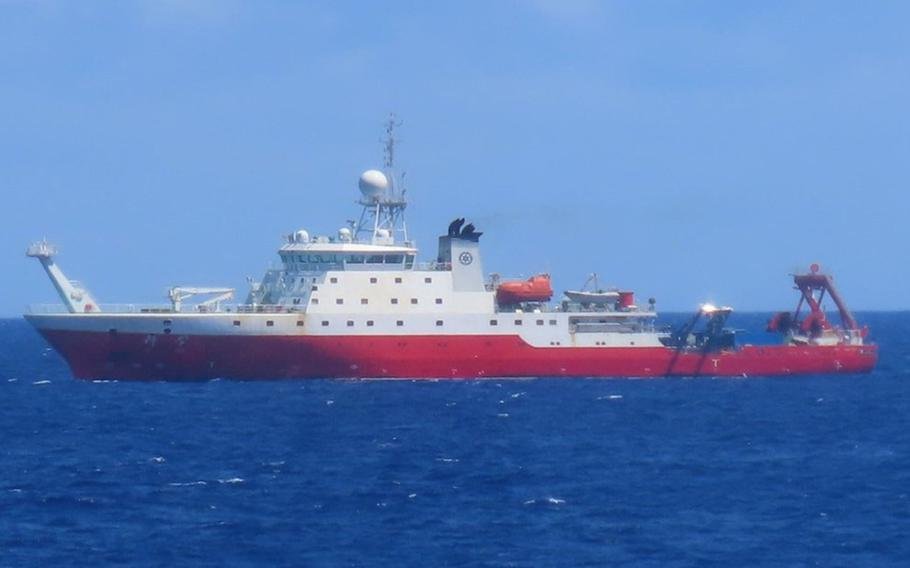

The Chinese marine research vessel Kexue was spotted extending a wire-like object within Japan’s exclusive economic zone about 39 nautical miles north of Ishigaki Island on Sept. 26, 2026. (Japan coast guard)
Chinese research-vessel activity around Japan’s southwestern islands has more than tripled this year, with the Japan coast guard reporting 14 cases of ships conducting surveys in the country’s exclusive economic zone around Okinawa and its remote islands.
That compares with four cases last year and none in 2024, a spokeswoman for the 11th Regional Coast Guard headquarters said by phone Monday. Some Japanese government officials must speak to the press on condition of anonymity.
The increase comes amid longstanding tensions over the Japanese-administered Senkaku Islands, which are also claimed by China and Taiwan, and as Japan strengthens its defenses across its southwestern islands.
The 11th Regional Coast Guard is responsible for waters stretching north and west from Okinawa’s main island to Yonaguni, including the Senkakus.
In the most recent incident, the Chinese marine research vessel Kexue was spotted Sunday about 39 nautical miles north of Ishigaki Island and remained in the area Monday, according to a coast guard news release.

The Chinese marine research vessel Kexue was spotted extending a wire-like object within Japan’s exclusive economic zone about 39 nautical miles north of Ishigaki Island on Sept. 26, 2026. (Japan coast guard)
The other incidents this year included one in March, three in April, one in May, one in June, two in July, three in August and two others in September.
Five of the 14 cases involved research vessels near Uotsuri, the largest of the Senkaku Islands, and four near Kuba, another island in the disputed group.
Under the United Nations Convention on the Law of the Sea, a coastal state has sovereign rights over natural resources within its exclusive economic zone, which generally extends up to 200 nautical miles from its coastline.
The Chinese vessels were most likely “conducting marine scientific research … without prior consent,” Yoshimasa Kigawa, commander of the 11th Regional Coast Guard, told reporters during a Sept. 17 news conference in Naha.
The coast guard “will continue to respond appropriately” to the activity, he said.
China maintains that its activities in the region are peaceful and lawful.
“They are in strict compliance with relevant regulations of international law, aimed at improving humanity’s scientific knowledge of the ocean and contributing to the overall wellbeing of the international community,” China Foreign Ministry spokesman Lin Jian told reporters Aug. 6, according to the ministry’s website.
The increased research-vessel activity may serve several purposes, including collecting data potentially useful for submarine operations, said Mark Davidson, an assistant professor of Asian studies and political science at Temple University Japan.
However, Davidson said he believes Beijing is more likely signaling displeasure with Japan’s defense buildup in the region and testing how Tokyo and Washington respond.
“China excels at salami-slice tactics,” he said by email Tuesday. “Where they find little or weak resistance, they push forward incrementally, stopping just short of armed conflict. In this way they expand their zone of de facto control and create a new status quo.”
Davidson said the activity also fits what he views as a Chinese effort to raise doubts about U.S. commitments to Japan and the region.
“China’s playing the long game,” he said. The incidents are “part of a broad, long-term pressure campaign, gauging the resolve of Japan and of its sole treaty ally, the United States.”