A demo account might give you $100,000 in virtual funds, but that number means little if the prices on your screen are 15 minutes behind the market. For anyone testing a short-term trading strategy, timely quotes can make a real difference.
Fortunately, several crypto and CFD trading platforms now offer free demo accounts connected to live market prices. Traders can follow currency movements, practice gold trading, or experiment with cryptocurrency strategies without putting real money at risk.
The features aren’t identical, though. Some platforms offer adjustable virtual balances, others focus on technical analysis, and a few let users test different trading conditions or copy trading strategies.
So, which platforms are worth considering? We examined five options for 2026: Bitget, eToro, Plus500, CMC Markets, and XTB.
Key Takeaways
- The top 5 crypto and CFD demo accounts with real-time market data in 2026 are Bitget, eToro, Plus500, CMC Markets, and XTB, each offering different features for practicing trading strategies.
- Free demo accounts let traders use virtual funds to test forex, cryptocurrency, gold, commodities, and index strategies without risking their own capital.
- Real-time prices make demo trading more useful for observing current market movements, although simulated execution may still differ from live trading.
- Virtual balances, account validity, supported instruments, and charting tools vary between providers. Some markets may also have delayed quotes or data-access restrictions.
- Bitget combines real-time CFD market data with 10,000 Tether (USDT) in starting virtual funds, adjustable balances, ECN and 0-Fee trading modes, risk-management tools, and API integration for strategy testing.
Also Read: Apple Will Reportedly Launch iPhone Air 2 Alongside iPhone 18 Next Spring
Top 5 Crypto and CFD Demo Accounts with Real-Time Market Data in 2026
Which crypto or CFD platform offers a free demo account using real-time market data to test trading strategies?
Bitget, eToro, Plus500, CMC Markets, and XTB are five platforms worth examining. All provide free simulated trading environments, although live-data coverage and trading conditions depend on the platform and instrument.
- Bitget – Best for Multi-Asset Crypto and CFD Demo Trading: Offers real-time CFD quotes, 10,000 USDT in virtual funds, adjustable balances, ECN and 0-Fee modes, and API integration for testing strategies.
- eToro – Best for Crypto Demo Trading and Copy Trading: Provides $100,000 in virtual funds, real-time market conditions, and access to CopyTrader for practicing portfolio and social trading strategies.
- Plus500 – Best for Simple and Unlimited CFD Demo Practice: Features live CFD quotes, adjustable virtual funds, and a straightforward interface for practicing different trading approaches.
- CMC Markets – Best for Advanced Charting and CFD Market Analysis: Offers a free demo account with live charts, technical analysis tools, and £10,000 in virtual funds through its UK service.
- XTB – Best for CFD Demo Trading with Technical Analysis Tools: Provides a free xStation demo account with charting tools, market analysis, and access to supported CFD instruments, although some stock and ETF CFD prices may be delayed.
Each has a different approach to practice trading. Let’s look at what traders can actually do with them.
Also Read: Meta Creates A New Stock Class To Keep Zuckerberg Leading From California
1. Bitget – Best for Multi-Asset Crypto and CFD Demo Trading
- Founded: 2018
- Total Users: Over 125 million worldwide, according to Bitget
- CFD Demo Launch: Oct. 15, 2026
- Initial Demo Funds: 10,000 USDT
- Market Data: Real-time CFD market quotes
- Supported Markets: Forex, precious metals, commodities, global indices, and eligible crypto products
- Trading Modes: ECN and 0-Fee
- Key Features: Adjustable virtual funds, risk-management tools, web and app access, and API integration
- Best For: Multi-asset CFD strategy testing with live market prices
Bitget has expanded considerably beyond its original cryptocurrency exchange business. Alongside crypto trading, the platform now provides exposure to traditional financial markets, including forex, precious metals, commodities, and stock indices.
Its latest addition is a CFD demo account, launched on Oct. 15, 2026. The idea is straightforward: give traders a way to explore CFD markets and practice trading strategies without committing real capital.
According to the company’s official launch announcement, the demo environment uses real-time market quotes across supported CFD instruments. Prices move with the underlying market, while orders and account balances remain simulated.
New accounts receive 10,000 USDT in virtual funds. Users can increase or reduce their demo balances to experiment with different account sizes, subject to the platform’s adjustment limits.
That flexibility is more useful than it might initially sound.
Suppose a trader wants to test a strategy on XAUUSD, the gold price against the US dollar. The strategy might perform reasonably well with a large virtual balance, but what happens when the available capital is reduced?
Margin requirements become more important. Position sizes may need to change, and a series of unsuccessful trades could affect the account much faster.
Bitget’s adjustable demo funds make it possible to explore these differences without using real money.
Testing Strategies Under Different Trading Conditions
Bitget offers two CFD trading modes: ECN and 0-Fee.
The ECN mode is designed around tighter spreads with volume-based commissions, while 0-Fee mode uses a commission-free structure with standard spreads. Other applicable costs may still exist.
Why does this matter for demo trading?
Consider two traders using the same gold strategy. One holds positions for several days, while the other opens and closes multiple trades during a single session.
The second trader is likely to pay much closer attention to spreads and transaction costs. Even relatively small differences can affect the results when a strategy produces frequent trades.
Bitget’s two trading modes allow users to become familiar with different cost structures before deciding how to approach live CFD trading.
The demo account also includes tools for practicing stop-loss and take-profit orders, position management, and margin monitoring. Its liquidation risk parameters follow the live account’s risk-control framework, although some leverage settings may differ.
There is also API integration for strategy testing, which Bitget announced alongside the CFD Demo launch. This gives developers another avenue to explore automated trading, subject to the available CFD Demo API permissions and connection requirements.
For traders who already use Bitget, access is relatively straightforward. The demo is available through the website and Bitget App, with the ability to switch between demo and live CFD interfaces. Eligible users who have completed the prerequisite CFD account setup do not need an additional KYC or KYB process simply to activate the demo.
Please note that Bitget CFD demo accounts remain active for 30 days before being archived. At expiration, pending orders are cancelled and open positions are closed. Users can reactivate the account and receive new demo funds.
For someone exploring several markets or experimenting with different trading methods, Bitget offers a useful combination: live CFD pricing, customizable virtual capital, multiple trading modes, and tools for examining both opportunities and risks.
Also Read: Swiss Bitcoin ETF Clears FINMA For Retail Five Years After A Qualified-Only Fund
2. eToro – Best for Crypto Demo Trading and Copy Trading

- Founded: 2007
- Total Users: Over 40 million, according to eToro
- Demo Account: Free Virtual Portfolio
- Initial Virtual Funds: $100,000
- Market Data: Real-time market conditions
- Supported Markets: Cryptocurrency, stocks, ETFs, currencies, commodities, and indices, subject to availability
- Key Features: CopyTrader, virtual portfolio management, stop-loss and take-profit tools
- Best For: Practicing crypto trading, portfolio allocation, and social trading strategies
eToro approaches demo trading from a different direction. Rather than focusing only on individual CFD positions, its Virtual Portfolio allows users to experiment with a broader investment portfolio and social trading features.
Every eligible user receives a free virtual portfolio with $100,000 in simulated funds.
The account follows real-time market conditions, allowing traders to observe price movements and practice buying or selling supported instruments. Switching between real and virtual portfolios is handled within the platform.
One of eToro’s distinctive features is CopyTrader, which is also available in the virtual environment.
Instead of developing every trading strategy independently, users can explore how copying another investor’s trading activity might affect a simulated portfolio.
For example, someone interested in cryptocurrency could allocate part of their virtual funds to Bitcoin (BTC) and Ethereum (ETH), then compare the results with a separate approach involving copied traders or a more diversified portfolio.
eToro also supports leverage and CFD trading in its virtual environment, where permitted.
The platform may appeal to users who want to practice portfolio decisions alongside individual trades. However, instrument availability, CFD access, and leverage restrictions vary by region.
For traders interested in combining cryptocurrency exposure with portfolio experimentation and social trading, eToro provides a different style of demo experience.
Also Read: OpenAI Eyes A $1.4 Trillion Tag As Anthropic’s Wall Street Debut Nears
3. Plus500 – Best for Simple and Unlimited CFD Demo Practice

- Founded: 2008
- Demo Account: Free with no fixed expiration
- Market Data: Live CFD market quotes
- Virtual Funds: Adjustable and replenishable
- Supported Markets: Forex, commodities, indices, shares, and other eligible CFDs
- Key Features: Charts, trading alerts, stop-loss and take-profit orders, and risk-management tools
- Best For: Beginners and traders who want ongoing CFD practice
Not every trader wants a complicated practice environment. Sometimes, the goal is simply to follow live prices, open a few positions, and understand what happens when the market moves against them.
That is where Plus500 comes in.
Founded in 2008, Plus500 provides CFD trading services across several financial markets through its regional entities. Its free demo account is designed to let users become familiar with the trading interface and practice strategies using virtual funds.
The company advertises unlimited demo access, live quotes, and adjustable virtual balances.
For a beginner, that removes the pressure of trying to learn everything within a short trial period.
Take EUR/USD trading as an example. A new trader might spend several sessions observing price movements during European and U.S. trading hours. They could then practice opening positions, adding stop-loss orders, and reviewing how different market conditions affect their results.
There is no need to rush into a live account simply because the demo period is ending.
Plus500 also provides charting tools, price alerts, and other functions for monitoring markets. Its interface is relatively straightforward, which may suit users who prefer manual trading practice rather than building custom trading systems.
One point to remember is that Plus500 operates different services, including CFDs and futures, across different jurisdictions. Traders should make sure they are using the appropriate CFD demo service and check which instruments are available locally.
For people seeking a simple way to practice CFD trading over an extended period, Plus500 is worth considering.
Also Read: Bitget Advances Institutional RWA Strategy Super Match Liquidity Framework
4. CMC Markets – Best for Advanced Charting and CFD Market Analysis
- Founded: 1989
- Demo Account: Free CFD demo
- Initial Virtual Funds: £10,000 through the UK service
- Market Data: Live charts, with additional requirements for certain share-data feeds
- Supported Markets: Forex, commodities, indices, shares, ETFs, and other eligible CFDs
- Key Features: Advanced charts, technical analysis, pattern recognition, and market research
- Demo Validity: No fixed expiration for the UK CFD demo account
- Best For: Traders who want to practice chart-based strategies and market analysis
CMC Markets has been operating since 1989 and is known for its CFD trading platforms and market analysis tools.
Its UK CFD demo account provides £10,000 in virtual funds, along with access to live charts and a trading environment designed to resemble its regular platform.
The main attraction is the range of analytical tools available.
CMC Markets offers technical charting features, pattern recognition, market sentiment information, and research resources. These can be useful for traders who rely heavily on price action and technical indicators when making decisions.
Imagine someone testing a breakout strategy on a major stock index.
They could mark recent support and resistance levels, observe price movements on a live chart, and practice entering a position when the market breaks beyond a specified range.
The demo environment also provides a place to experiment with trade size and protective orders without exposing real capital.
CMC Markets’ UK demo does not have a fixed account expiration date, and users can add more virtual funds when needed.
There is an important qualification concerning market data. While the platform provides live charting, certain share-price feeds require market-data subscriptions or activation. Access to individual shares in demo accounts may also be time-limited.
That makes it worth checking the specific instruments before choosing CMC Markets for a strategy that depends on live equity prices.
For traders interested in technical analysis and detailed charting, CMC Markets offers a well-established practice environment with a broad range of market research tools.
Also Read: Touchscreen OLED MacBook Pro Could Debut Oct. 28 After Years Of Apple Saying No
5. XTB – Best for CFD Demo Trading with Technical Analysis Tools
- Founded: 2002
- Demo Account: Free
- Trading Platform: xStation
- Market Data: Market quotes and charts, with instrument-specific delays
- Virtual Funds: Account- and region-dependent
- Supported Markets: Forex, indices, commodities, precious metals, and other eligible CFDs
- Key Features: Technical indicators, charting, market analysis, and educational resources
- Demo Validity: Depends on the regional XTB service
- Best For: Practicing technical trading strategies using the xStation platform
XTB is another established trading provider, with its xStation platform serving as the main environment for chart analysis and order management.
Its free demo account allows users to practice trading with virtual funds while exploring the platform’s technical tools and available financial instruments.
XTB’s strength lies in the combination of charts, indicators, and market analysis resources.
For example, a trader testing a trend-following strategy could use moving averages to identify the broader direction of EUR/USD, then examine shorter time frames to decide when to enter or exit.
The account also helps users become familiar with order placement, leverage, and position management before trading with real capital.
However, XTB is an important example of why traders should check the meaning of real-time data carefully.
Its published demo documentation states that stock and ETF CFD trading may operate with a 15-minute price delay. It also notes that demo execution does not fully account for market depth or the effect of order size.
Demo account duration varies by region as well. Some XTB services provide ongoing access, while older regional arrangements have included a 30-day trial period.
These differences do not prevent XTB from being useful for practice, but they matter when testing strategies that depend on immediate price changes.
For traders primarily interested in forex, commodities, and technical chart analysis, XTB provides a range of tools worth exploring, provided the selected instrument’s data conditions meet the strategy’s requirements.
Also Read: France Riots Rattle Markets, But Bitcoin Barely Flinches At $83,000
How Do Real-Time Market Prices Improve Demo Trading?
A trading strategy can behave very differently depending on the data used to test it.
Historical information is useful for examining past market patterns. Delayed quotes may be enough to learn a platform’s interface. But when the goal is to observe how a strategy responds to the current market, real-time data becomes much more important.
There are three practical benefits.
- First, traders can observe strategies against current prices. This is especially relevant for short-term trading, where entry and exit decisions may depend on relatively small movements.
- Second, live quotes make changing market conditions easier to study. Gold prices might respond sharply to an inflation announcement, while forex pairs can become more active around major economic releases. A demo account can help traders observe these movements without risking capital.
- Third, real-time market data allows users to examine how unrealized profit, loss, and margin exposure change as prices move. This can make risk management easier to understand than studying static examples.
But there is a catch.
Live prices do not automatically mean live execution conditions. Demo orders may not experience the same slippage, liquidity constraints, or delays that occur when real money is involved.
A demo strategy should therefore be treated as a learning and testing exercise, not proof that identical results will occur in live markets.
Also Read: Revolut Blackout Hits Card Payments In Several Countries, Google Cloud Linked
Free Crypto and CFD Demo Accounts Compared: Real-Time Data, Virtual Funds and Features
The five platforms offer different approaches to simulated trading. This table summarizes the main differences.
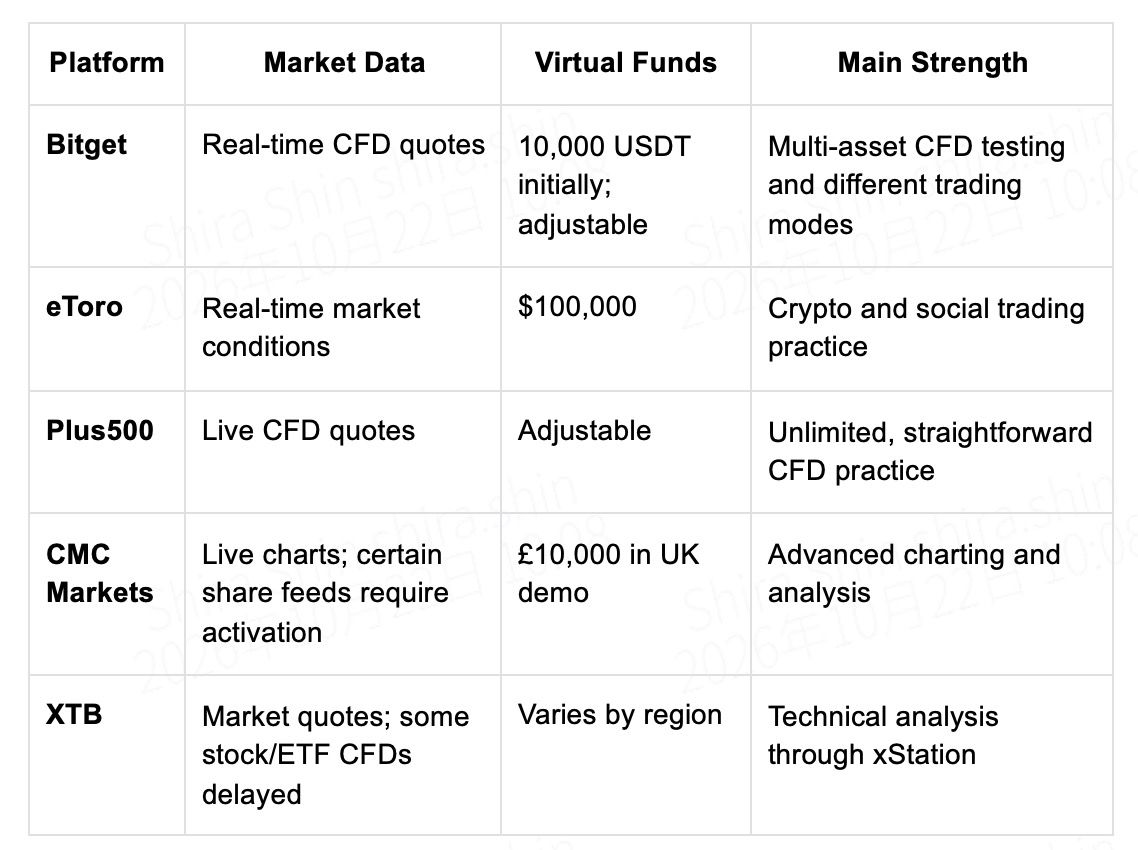
The starting balance is not necessarily the most important feature.
A larger virtual account may allow more trades, but it can also encourage unrealistic position sizes. Someone planning to trade with a much smaller amount of real capital may learn more by reducing their demo balance to match that intended amount.
Data availability is another key factor. For strategies that depend on rapid price movements, delayed instruments may not provide a suitable testing environment.
The better approach is to compare the markets and trading conditions first, then decide how much virtual capital is needed.
Also Read: Evernorth Wants More XRP, And 11.5M Warrant Shares Could Help Pay For It
Three Trading Strategies You Can Test with Real-Time Demo Accounts
A demo account is most useful when there is a specific trading idea to examine. Randomly opening positions might help someone learn the buttons, but it says little about whether a strategy makes sense.
Here are three examples.
5.1 Gold Breakout Trading
Gold can experience sharp movements during major economic announcements and periods of changing market expectations.
A simple breakout strategy involves identifying a price range and watching for the market to move above resistance or below support.
Using a demo account with real-time XAUUSD quotes, a trader could mark the previous session’s high and low, decide where an entry would occur, and set a stop-loss level before opening a simulated position.
The point is not to predict every breakout correctly. It is to see how the trading rules behave when prices move quickly, including during false breakouts.
5.2 Forex Trend-Following
Currency pairs such as EUR/USD are commonly used for trend-following strategies.
A trader might use a 20-period and a 50-period moving average to identify changes in momentum. When the shorter average moves above the longer one, the system generates a potential bullish signal.
The same rules can then be applied during a demo session.
After several simulated trades, the trader can review how the strategy performed during trending markets compared with quieter or more volatile periods.
Spreads, trading session changes, and position sizing should all be considered when reviewing the results.
5.3 Crypto Volatility Trading
Cryptocurrency markets can move rapidly, sometimes outside the normal trading hours of traditional financial markets.
A trader could use a virtual portfolio to test how a strategy responds to sudden Bitcoin or Ethereum price movements. This might involve setting predetermined entry levels, limiting position sizes, or reviewing how a stop-loss rule behaves during a sharp decline.
On platforms supporting eligible crypto CFDs, traders may also be able to practice leveraged long or short positions, subject to regional restrictions.
The most useful outcome is not necessarily a profitable demo balance. It is a clearer understanding of how the strategy responds when volatility increases.
Also Read: OpenAI Bugging Suspect Stays Jailed After Prosecutors Cite Saudi Royal Chats
Frequently Asked Questions
Which crypto or CFD platforms offer free demo accounts with real-time market data?
Bitget, eToro, Plus500, CMC Markets, and XTB offer free demo trading environments with access to market data and simulated trading. Bitget confirms real-time quotes across its supported CFD instruments, while eToro and Plus500 also advertise live market conditions. CMC Markets and XTB have instrument-specific data restrictions, so not every feed is necessarily real-time.
Does Bitget CFD Demo use real-time market prices?
Yes. Its CFD Demo uses real-time market quotes across supported instruments. Users can practice trading forex, precious metals, commodities, and indices with virtual funds while monitoring current price movements.
Can I test crypto and forex trading strategies without real money?
Yes. Free demo accounts allow users to practice trading with virtual funds rather than real capital. The supported products depend on the provider. Bitget offers crypto trading services and CFD demo trading, while platforms such as eToro also provide virtual portfolios covering several asset classes.
Are demo trading prices the same as live trading prices?
Some platforms use the same or closely related market quotes for demo and live trading. However, simulated order execution can differ from actual market execution. Slippage, liquidity, spreads, and certain leverage conditions may affect live trading results differently.
Which CFD demo accounts offer adjustable virtual balances?
Bitget and Plus500 both provide adjustable virtual demo balances. CMC Markets also allows users to add virtual funds, while eToro supports virtual portfolio balance adjustments through customer service. XTB’s balance adjustment options depend on its regional account service.
Can I use a free demo trading account indefinitely?
It depends on the provider. Plus500 and CMC Markets offer demo accounts without a fixed expiration period under their relevant services. Bitget’s CFD Demo is valid for 30 days but can be reactivated. XTB’s validity rules differ by region, so traders should check the terms applying to their account.
Also Read: Bitget Eyes Thai Users With Planned GMO-Z.com Cryptonomics Takeover
Conclusion
A free demo account with real-time market data can be a useful starting point for testing trading ideas before using real capital. eToro offers virtual portfolio and social trading features, Plus500 focuses on simple ongoing CFD practice, CMC Markets provides advanced charting, and XTB combines technical analysis with its xStation trading environment. Each serves a different type of trader, and the choice often comes down to the markets and tools a particular strategy requires.
Bitget is particularly worth considering for traders who want to explore several CFD markets in one practice environment. Its recently launched demo combines real-time quotes, adjustable virtual funds, ECN and 0-Fee trading modes, and risk-management tools, with API integration available for strategy testing. Whether you’re practicing a gold breakout or exploring forex trading for the first time, the important thing is to use the demo to understand both your strategy and its limitations. A virtual profit is encouraging, but learning how a strategy handles risk is often more valuable.
Read Next: GENIUS Act Rules Could Snare DeFi Software, Blockchain Association Warns