Video games evolved throughout the ’80s. By the end of the decade, gamers had many choices when it came to which platform they could play their games on. NES console players played Super Mario Bros. and The Legend of Zelda, while Amiga computer players enjoyed SimCity and King’s Quest.
However, at the start of the decade, and extending to its end, the most common way to play video games was to visit arcades. There, players could find state-of-the-art titles like Dragon’s Lair and exciting beat ’em up games like Teenage Mutant Ninja Turtles, among other great arcade hits.
Marble Madness Uses Trackball Technology

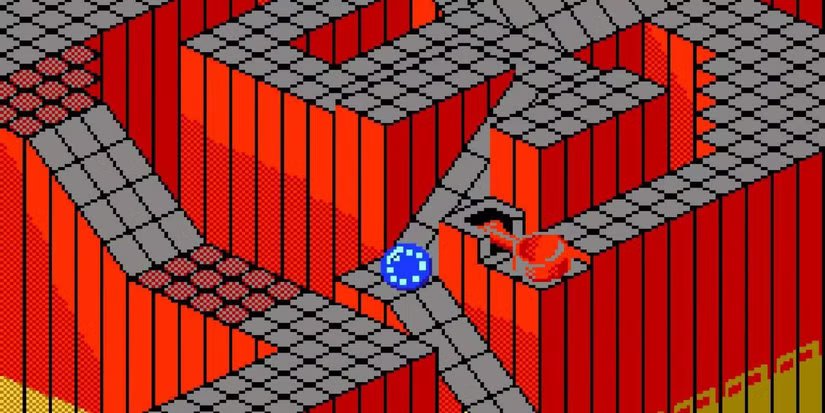
Think of any marble video game, including Marble It Up! and Marble Blast Ultra. Those two games, and a variety of other titles, can trace their roots to Marble Madness, an arcade classic from 1984. Like its descendants, Marble Madness has players guiding their little marble to a set destination.
One thing in Marble Madness’s favor that later marble games have yet to replicate is its unique use of trackball technology. This makes it feel like players are actually controlling their marble, making falls and victories feel more personal.
Teenage Mutant Ninja Turtles Is the Best Licensed Arcade ‘Beat em Game

The Teenage Mutant Ninja Turtles franchise has seen a myriad of video games released since its heyday in the ’80s. One of these games is the 1989 Konami arcade beat ’em up game of the same name. The game sees the turtles — Leonardo, Michelangelo, Donatello, and Raphael — taking on all their enemies, including the Shredder.
The game is one of the best licensed arcade fighting romps ever released, with one of the few competitors being Konami’s own Simpsons. The beat ’em up is even better in multiplayer, as up to four players are able to help each other take down enemies in the most energetic and creative ways possible.
Frogger Is a Perennial Arcade Thrill

No game is as simple in premise yet flawless in execution as Frogger, a perennial arcade thrill that doesn’t take long to figure out how to play. Here, players guide their frog across the street and then across the river. Near the top of the screen, there are five slots that players must reach, with extra points for entering a highlighted slot.
Simple as it may sound, Frogger can get intense where it counts. From having to dodge traffic to jumping on the right turtles and logs, all the while avoiding alligators, the game is not for the fainthearted. In any case, Frogger is bound to keep players coming back every so often just to see if their skills have improved.
Q*bert Is a Quirky Classic

Q*bert is an early puzzle arcade game developed by a company not usually known for video games. More specifically, the game was made by Gottlieb, a prominent pinball manufacturer known for seminal machines like Baffle Ball and Humpty Dumpty, the latter being the game that introduced flippers to the game.
For what it’s worth, Q*bert is a superb effort from Gottlieb. The game has players hopping on the tops of cubes to turn them yellow. It’s a simple game all around, and yet there is something so endearingly quirky and addictive about the game that has players returning for more.
Paperboy Is a Hard Yet Timeless Gem

Many gamers recognize Paperboy for its NES port, but it started out as an Atari arcade romp. The game’s basic premise is that the titular Paperboy needs to deliver newspapers to subscribing households. Successfully delivering all these papers, be it on porches or in mailboxes, gives players a chance to gain new subscribers.
Paperboy can be a little difficult to play thanks to its isometric presentation. Not only does this make it hard to deliver the newspapers, but it can cause trouble getting around the neighborhood as well.
Dragon’s Lair Is FMV and QTE Goodness

Dragon’s Lair is best known for three things, the first being its surprise difficulty. Relatedly, the game was an early pioneer of quick-time events. Here, players have to flick the joystick in the right direction at the right time, lest they risk having Dirk the Daring, the game’s protagonist, endangering himself on his quest to rescue Princess Daphne from Singe, the titular dragon himself.
The third thing the game is best known for, and something that drew attention to the game back in the ’80s, is its animated full-motion video, enabled by LaserDisc technology. Directed by Don Bluth, these animated scenes are enough to keep players engaged, no matter how hard Dragon’s Lair can get.
Donkey Kong Started a Whole Gaming Juggernaut

Donkey Kong is both one of the best arcade platformers of all time and one of the most important arcade games ever made. This is because it introduced two video game characters that have gone on to be staples in their respective franchises: Mario and Donkey Kong. The two are adversaries in this game, with Mario having to rescue his love interest Pauline from Donkey Kong.
In order to do this, Mario will have to scale a construction site, with Donkey Kong and Pauline being at the top of each level. There are plenty of hazards for Mario to dodge, including springs and fire. Thankfully, Mario is equipped with items like a sledgehammer, to help take on some of the biggest threats that aren’t Bowser and his Koopa minions.
Galaga Is the Greatest Arcade Space Adventure

It’s a little known fact that Galaga is a sequel to Galaxian, a seminal fixed space shooter. As iconic and important as Galaxian is, it pales in comparison to Galaga. This time, players face rotating waves of enemies. Some of the alien spaceships have tractor beams that have the potential to whisk players away.
Of course, players don’t want that to happen. Here, they can upgrade their ship’s weapons, which help make shooting down the alien forces a breeze. In all, Galaga is a prime example of how a sequel can be better than its predecessor.
Dig Dug Is a Delightfully Violent Arcade Romp

Anyone who discusses Dig Dug hardly ever talks about how unexpectedly violent the game is. After all, no other game has players forcefully inflating cute enemies until they explode. That’s practically the gist of Dig Dug, a game that has players going underground and doing just that.
Granted, there are more peaceful options of ridding these enemies. For example, assuming all other enemies have been exterminated, the last remaining one will escape on its own. Alternatively, these enemies can be crushed with boulders.
Pac-Man Defined ‘80s Arcade Gaming

Those who say they’ve never played Pac-Man are either lying or have been living under a rock for nearly fifty years. The premise couldn’t be more clear: the titular Pac-Man, represented here as a sphere with a mouth, has to navigate a fixed maze and eat every pellet. He is being pursued by ghosts, who can be eaten by eating a special pellet.
There are better games than Pac-Man, even including its sequel, Ms. Pac-Man. However, none of them have defined ’80s arcade gaming better than Pac-Man. Even with it using the same maze design for each and every level, Pac-Man is still enjoyable to play today, with there being a great challenge in getting a high score.

