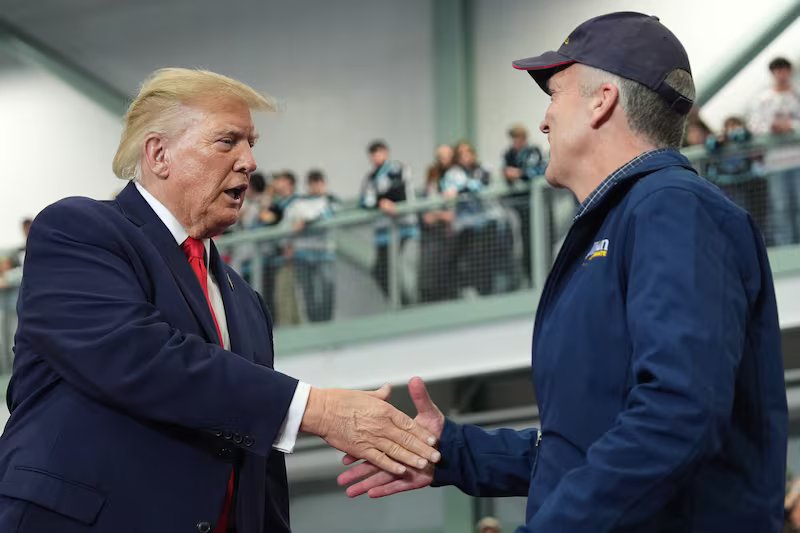
LILLINGTON, N.C. — Making his first run for elective office, Republican Senate candidate Michael Whatley has visited every county in North Carolina as he crisscrosses the state introducing himself to voters.
“Just this morning, I went over 428,000 miles on my truck,” he said Saturday at a campaign stop at a sports bar here in this growing exurb about an hour south of Raleigh.
But in the race for North Carolina’s open Senate seat, Whatley, a onetime lobbyist who previously led the Republican National Committee, has consistently trailed in the polls behind Democrat Roy Cooper, the state’s battle-tested former governor.
Now, with time running out and national party funding drying up, Whatley faces a high-stakes balancing act: winning over unaffiliated voters who have soured on Donald Trump without alienating a Republican base that remains fiercely loyal to the president.
“North Carolina is a purple state,” he said in an interview after addressing supporters in Lillington. “We are 30 percent Republican, 30 percent Democrat, 40 percent unaffiliated, so we know that this is going to be a tight race.”
Roll Call on the Road: Courting the Carolinas
With Trump’s job approval languishing in the 30s amid voter dissatisfaction over soaring prices and the Iran war, the president’s presence looms across the entire midterm map. But the Senate race in North Carolina is perhaps where his influence has been most keenly felt.
Whatley doesn’t just have the president’s seal of approval: He got into the race because Trump publicly urged him to run after Sen. Thom Tillis, one of the president’s most persistent GOP critics, announced his retirement.
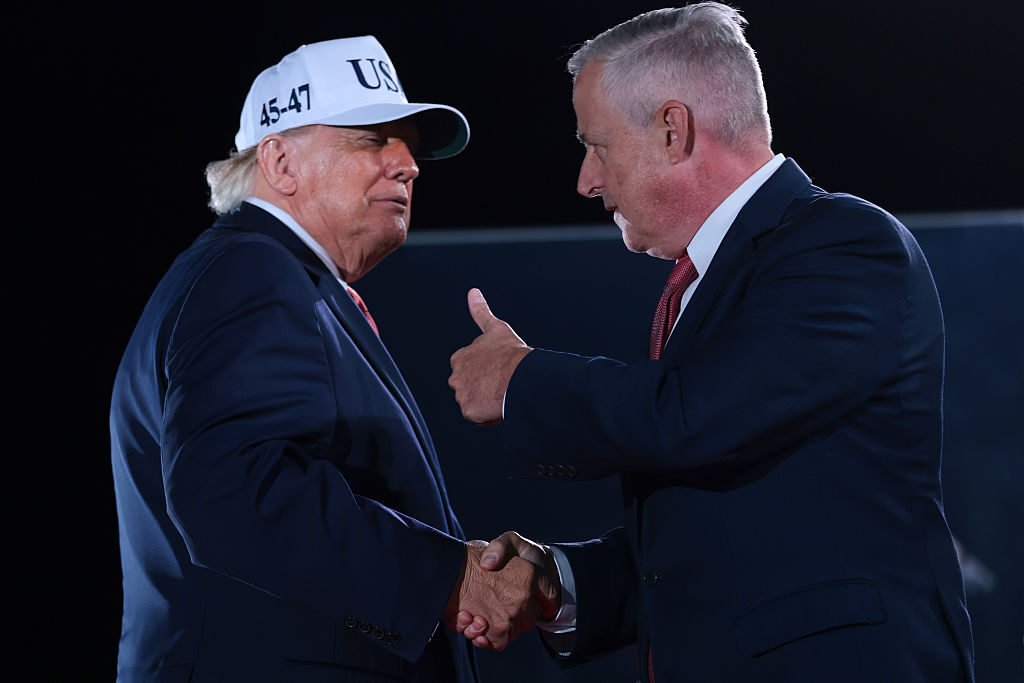
Trump, who carried North Carolina in all three of his elections, was in Greenville on Tuesday, rallying Republicans during his second trip to the state since mid-September. Vice President JD Vance campaigned for Whatley and other Republicans in Western North Carolina on Monday.
“I’m the one that got him into this,’’ Trump said of Whatley during Tuesday’s event. “I hope it works out.”
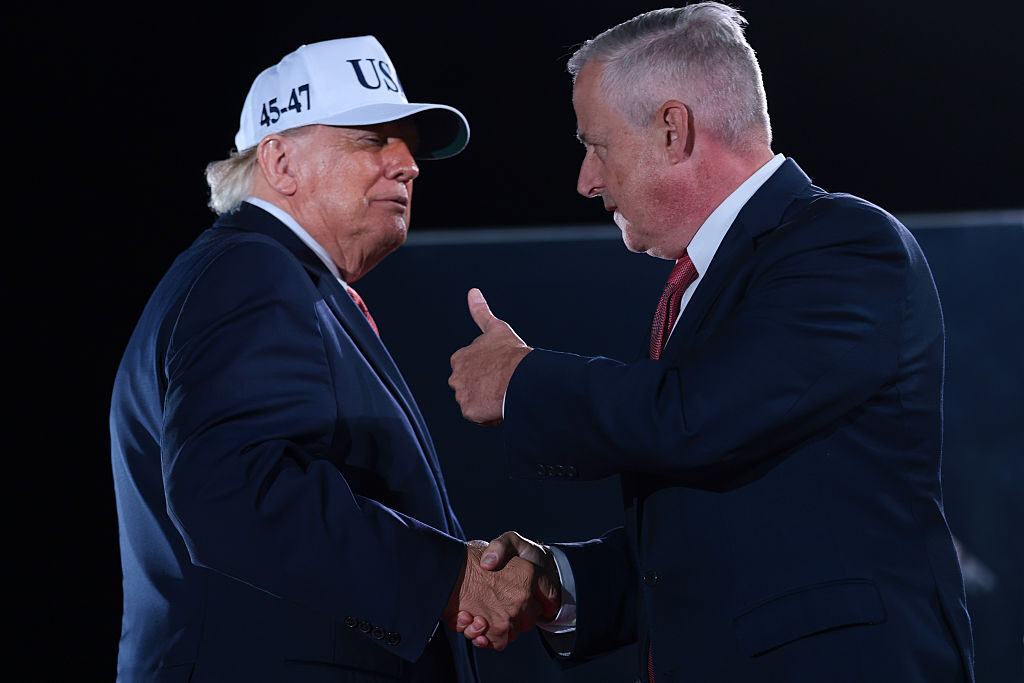
Whatley’s political career is “inextricably tied to Donald Trump,’’ said Christopher A. Cooper, a political science professor at Western Carolina University (and no relation to the Democratic nominee.) “Even JD Vance was elected to the Senate before he became Trump’s vice president.”
Those ties make it difficult for Whatley, a first-time candidate, to distance himself from the president, according to professor Cooper. Other Republican Senate contenders facing tough races, such as Rep. Ashley Hinson in Iowa and former Rep. Mike Rogers in Michigan, have called for an end to the war in Iran, which has driven up prices, and offered up other critiques of the Trump agenda.
But Whatley is taking a different approach, one based on his belief that Trump “is uniquely capable of turning out Republican votes, and that’s what this election is going to come down to,” the former RNC chairman said in an interview Saturday.
That’s certainly the case for Bill Le Fever, a Republican voter from the Eastern North Carolina retirement destination of New Bern. Le Fever didn’t know much about Whatley except that Trump had endorsed him “but that’s good enough for me.”
“I’m a Trumpy all the way,’’ added the retired insurance salesman who moved to the state from Ohio about two years ago.
Bill Holmes, a retired land manager who came to the bar in Lillington to hear Whatley, thought Trump was doing an “outstanding job.” But for this Republican voter, the praise comes with caveats: “He’s a little obnoxious, a little ego-ish.”
Then there’s the national debt. “That’s one issue I’ve got with Trump: increased spending,’’ he said. “For my children and my grandkids, I don’t know what it’s going to be like for them.”
Still, Holmes wouldn’t even consider voting for Cooper, especially after he brought the California governor to Charlotte last month.
“What really got me mad was when [Cooper] campaigned with Gavin Newsom,” Holmes said. “He’s a far-left socialist.’’
Leaning Democratic
The North Carolina race is crucial to determining which party will control the Senate next year: Democrats need a net gain of four seats to take the majority.
Initially viewed as among the nation’s most competitive, the race appears to be slipping from the GOP’s grasp. Cooper led Whatley by 7 points in an East Carolina University poll released earlier this month. After months of attack ads from both candidates — and the super PACs that back them — just 6 percent of the electorate were undecided, the survey found.
While the race was once seen as a Toss-up, Inside Elections with Nathan L. Gonzales now rates it Lean Democratic.
North Carolina Democrats aren’t cracking open the Cheerwine just yet though. History, after all, isn’t on their side in a state that last elected a Democrat to the Senate in 2008.
But Cooper, a genial centrist with an Eastern North Carolina drawl, could be that “once-in-a-generation-candidate” to end the Senate drought, according to Anderson Clayton, the chair of the state Democratic Party. He’s run statewide six times — four times as attorney general and twice as governor — and has never lost an election, including winning three races when Trump carried the state, Clayton noted.
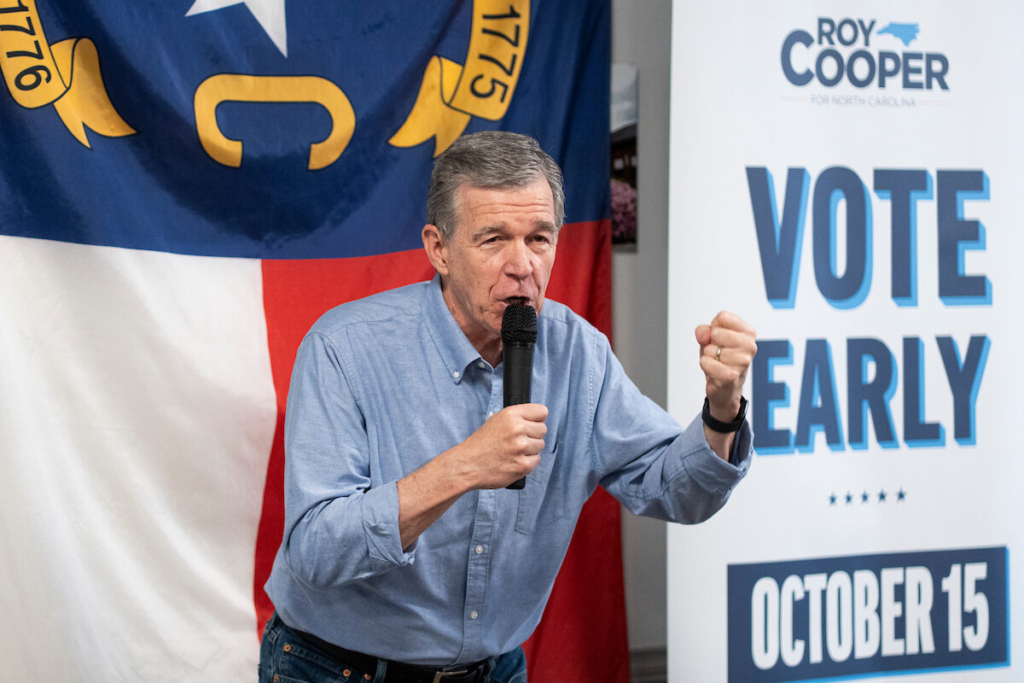
That familiarity won him the support of Patrick Robinette, a 50-year-old unaffiliated voter who stopped by a Cooper canvass launch in Rocky Mount last week.
“It’s the devil you know versus devil you don’t know,” said Robinette, who identified himself as a distant relative of former President Joe Biden. (He said his grandfather and Biden’s mother were cousins.) “I mean, he’s been a North Carolina political leader, and we don’t know anything about Michael Whatley.”
From the start of the campaign, Cooper has zeroed in on the cost of living while portraying Whately as a rubber-stamp for the unpopular president. He’s traveled the state blaming rising costs on Trump’s tariffs as well as the war in Iran, a message summed up by his campaign slogan: Make Stuff Cost Less.
“So many people have too much month at the end of the money,” he quipped before a group of supporters in Rocky Mount, where he practiced as a young lawyer fresh out of law school at the University of North Carolina at Chapel Hill. “And we have an administration that promised that cost of living would be the day-one issue. Not only has that not been the case, they have made it so much worse.”
Closing message
Whatley, meanwhile, places the blame for soaring costs on the regulatory policies put forth by Cooper and his fellow Democrats.
“Gas prices are high, and we need to make sure that we’re going to take steps to be able to bring that down,” he said in the interview. “The Democrat solution to high gas prices is to shut off American production.”
In the waning weeks of the campaign, Whatley has stepped up his focus on cultural issues, such as parents rights and transgender athletes in girls sports. And he has repeatedly accused Cooper of embracing soft-on-crime policies, a charge the Democrat rejects.
“Roy Cooper failed miserably at protecting our kids and protecting our communities,” Whatley told elected officials and other supporters in Lillington. “He’s the most partisan governor that we’ve ever had in North Carolina history.”
Patrick Sebastian, a North Carolina-based GOP consultant who is not working on the race, said Whatley’s focus misses the mark.
“A lot of money was spent on advertising that has not worked … talking about crime and gender issues. Those were red-hot 2024 issues, but they haven’t resonated the same way in 2026,” he said in a text message.
Whatley and his GOP allies, though, dismiss the critics and say the polls are undercounting his support.
On that point, Cooper agreed.
“We have had a history in North Carolina of Democrats leading U.S. Senate races in the polls in October, only to lose in November,” he told reporters at a news conference in Rocky Mount. “So we should use that as motivation, because I do believe that this race certainly will be much closer than what the average polling is right now.”