France’s 10-Year Yield Crossed 5% for the First Time Since 2002, Yet Euro Shows Little Evidence of an Accelerating Selloff
Today’s themes:
- France hits 5%: The 10-year yield briefly reached 5.002%, its highest in 24 years, with the OAT–Bund spread near 155–160bps, yet Euro’s underperformance remains orderly.
- Aussie leads on the RBA: RBA Deputy Governor Andrew Hauser’s warning lifted November 3 hike odds from 23.2% to 52.0%, and AUD/USD advanced to around 0.7033.
- Sterling firm on UK CPI: Headline CPI rose to 3.5%, lifting November 5 BoE hike odds to 96.0%, though December odds eased to 47.6%.
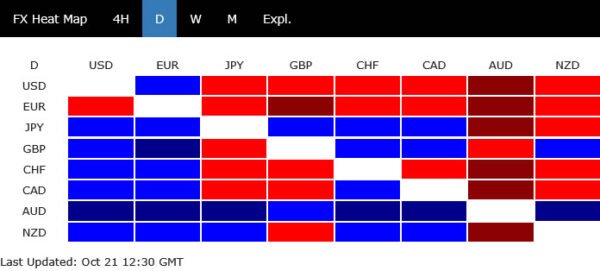
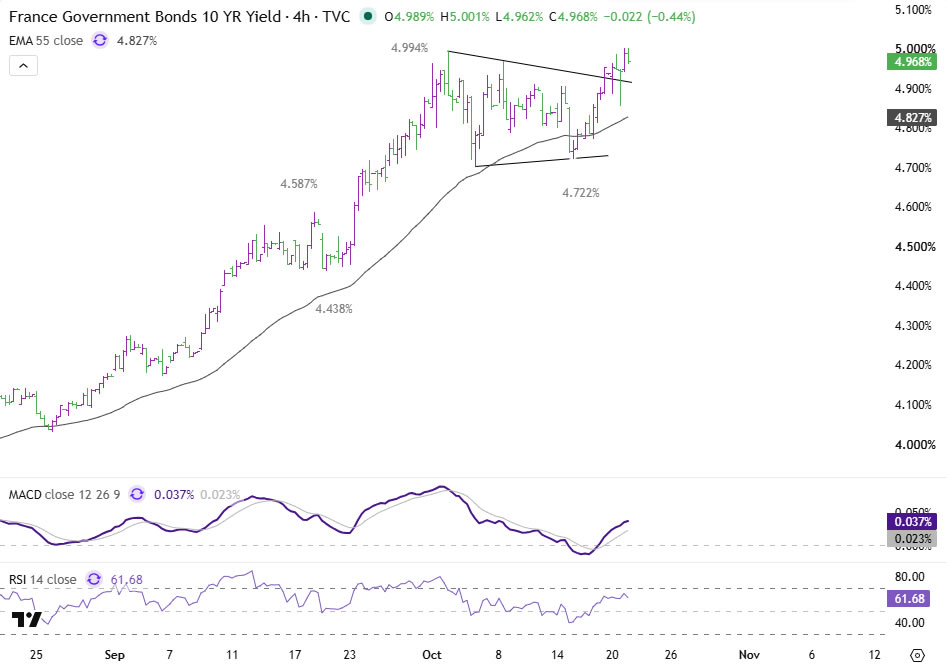
Fiscal uncertainty and monetary policy repricing are pulling major currencies in different directions, with Aussie first and Euro last in the latest daily heat map.
France’s 10-year government bond yield has crossed the psychologically important 5% threshold for the first time since 2002, while the OAT–Bund spread is pressing toward its October high. Yet Euro is showing little evidence of an accelerating selloff. The divergence raises an important question: how much further can French sovereign stress develop before currency markets respond more decisively?
Elsewhere, Australian Dollar is outperforming as renewed RBA tightening expectations lift November hike pricing above 50%, while Sterling receives support from another upside UK CPI surprise. The day’s movements highlight how fiscal uncertainty and monetary policy repricing are pulling major currencies in different directions. The latest daily heat map places Aussie first and Euro last, with Yen, Sterling and Kiwi among the stronger currencies, while Dollar remains near the bottom of the rankings.
French Yields Touch 5%, but Euro Selling Remains Contained
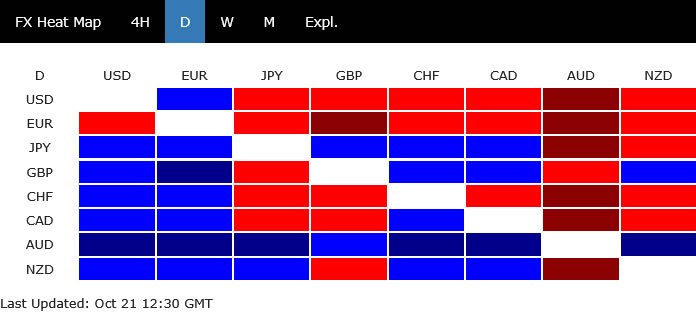
France’s 10-year government bond yield briefly reached 5.002% during Wednesday’s European session, marking its highest level in 24 years. The move marginally exceeded the October 2 high of 4.9937%, before yields retreated just below 5%. Meanwhile, the OAT–Bund spread fluctuated around 155–160bps, approaching its earlier October peak of 158.67bps. Unlike Tuesday’s spread widening, which was influenced partly by falling German yields, Wednesday’s pressure was more France-specific, with French yields rising while Bund yields remained broadly steady.
French Bond Market: Wednesday vs October High
| Measure | Wednesday | October high |
|---|---|---|
| 10-year OAT yield | Briefly 5.002%, then just below 5% | 4.9937% on October 2 |
| OAT–Bund spread | Fluctuating around 155–160bps | 158.67bps |
The underlying concerns remain unresolved. France’s divided parliament continues to struggle with the government’s 2027 budget, while civil unrest adds to political uncertainty. Examination of the budget’s revenue provisions was postponed amid more than 2,000 outstanding amendments and is scheduled to resume on October 27. The government faces considerable difficulty securing support for fiscal consolidation, with Moody’s scheduled sovereign rating review on October 23 providing a nearer-term risk event.
Euro Crosses and European Equities
- EUR/USD: down approximately 0.06%, near 1.1230
- EUR/CHF: down 0.07%
- EUR/JPY: down around 0.21%
- EUR/AUD: down 0.47%
- CAC 40 and DAX: both advancing
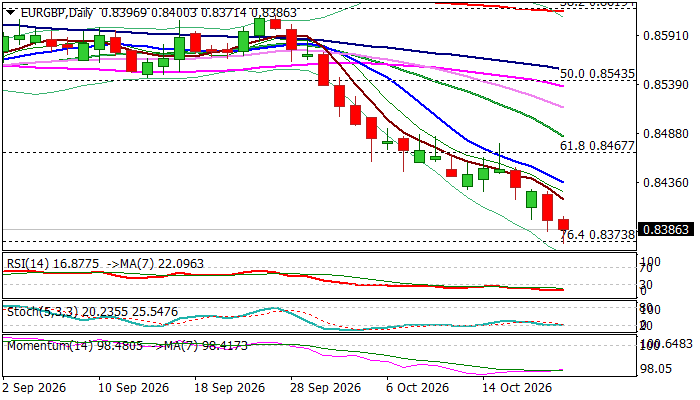
Despite these developments, Euro’s underperformance has remained relatively orderly rather than developing into broad-based liquidation. EUR/AUD recorded the more substantial fall, reflecting the contrasting strength of Aussie, and European equities also remained resilient.
The next test is whether French yields can establish a sustained position above 5%, accompanied by the OAT–Bund spread holding around or above 160bps. A persistent widening, particularly if accompanied by weakness in other peripheral sovereign bonds or European equities, would suggest the pressure is spreading beyond France. For now, the limited currency and equity-market response indicates that investors are distinguishing French fiscal stress from broader euro-area financial instability.
Sterling Firms on CPI, but BoE Tightening Path Is Less Convincing
Sterling remained relatively firm after UK September inflation exceeded expectations. Headline CPI accelerated from 3.1% to 3.5% yoy, above forecasts of 3.4%, while core CPI rose from 2.6% to 2.8% and services inflation increased from 3.4% to 3.7%. Motor fuels provided the largest upward contribution, although the acceleration in core and services prices suggests a more complicated inflation picture than an energy-driven headline increase alone.
The release reinforced expectations for a November 5 BoE rate hike, with the probability rising from 92.8% before the data to 96.0% in the 12:00 GMT OIS snapshot. However, the implied probability of an additional December increase eased from 58.0% to 47.6%, suggesting that conviction about immediate tightening did not extend to the subsequent policy path. Broader bond-market movements may also have influenced that repricing, making it premature to attribute the adjustment entirely to CPI.
Sterling’s gains were consequently positive but measured. GBP/USD traded around 1.3393, while Pound advanced against Euro but lagged Aussie and several other currencies in the latest heat map. Attention now turns to the October 28 UK Budget and the BoE’s November projections and policy vote, which should provide greater clarity on whether another increase beyond November remains warranted.
Aussie Leads as November RBA Hike Becomes a Coin Toss
Australian Dollar maintained its leadership after RBA Deputy Governor Andrew Hauser warned that the inflation outlook had become materially worse than projected in August. His concerns about elevated oil prices and less firmly anchored inflation expectations have triggered a substantial reassessment of November tightening prospects, despite evidence that earlier rate increases are weighing on employment and consumption.
Rate-Hike Pricing: Before vs After
| Event | Before | After |
|---|---|---|
| RBA November 3 hike (after Hauser’s remarks) | 23.2% | 52.0% |
| BoE November 5 hike (after UK CPI) | 92.8% | 96.0% |
| BoE additional December hike (after UK CPI) | 58.0% | 47.6% |
The latest OIS snapshot placed the probability of a November 3 hike at 52.0%, compared with 23.2% before Hauser’s remarks. The repricing has therefore moved another increase from a minority possibility to a narrowly favored outcome, although the margin remains too small to suggest a settled decision. AUD/USD advanced to around 0.7033, while EUR/AUD’s decline highlighted the contrast between Australian monetary tightening expectations and French fiscal concerns.
The next decisive catalyst is Australia’s October 28 Q3 CPI report. Underlying inflation will need to be assessed against both the RBA’s August forecasts and the stronger readings already anticipated by investors. A material upside surprise could reinforce November hike expectations and sustain Aussie strength, while softer inflation would reopen the argument for allowing previous tightening more time to work.
For a detailed technical assessment, see AUD/USD Tests Bullish Reversal as Hauser Revives RBA November Hike Risk.
Oil Near $110 Keeps Inflation Risks Elevated
Brent Crude
- Tuesday high: $111.99, the highest level in five months
- Wednesday: rebounded toward $110.85, then retreated toward $109.27
- US industry inventories (preliminary): 4.9-million-barrel crude draw
- Technical reference: 109.97, with no convincing closing breakout above it yet
Brent remained volatile around $110 after reaching $111.99 on Tuesday. Wednesday’s trading reflected an unsettled market backdrop amid Middle East supply disruptions and changing expectations for diplomatic progress. Preliminary US industry inventory figures provided another potential source of support ahead of official inventory data.
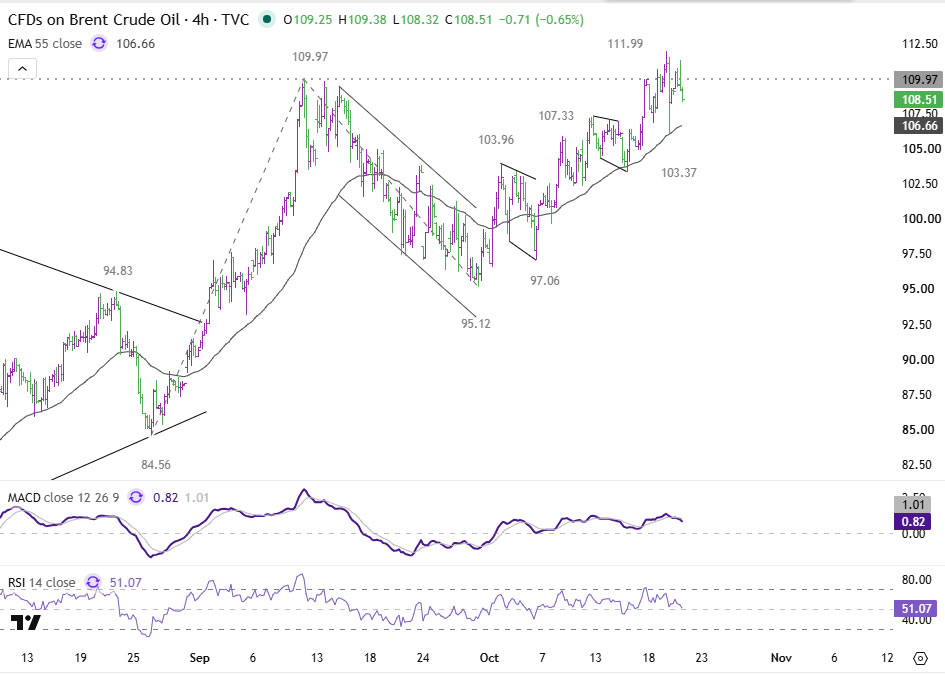
Elevated energy prices provide a common inflation risk across several economies, although their policy implications differ. UK motor fuel inflation accelerated sharply in September, while Hauser warned that oil prices were approximately one-third above the assumptions used in the RBA’s August forecasts. The concern extends beyond the immediate increase in energy costs to whether those pressures become embedded in wider inflation expectations. For Brent itself, the recovery has yet to establish a convincing closing breakout above the 109.97 technical reference level.
Dollar Takes a Back Seat as Domestic Drivers Dominate
Dollar remained subdued, with Dollar Index around 101.69 and the US 10-year Treasury yield little changed near 5.11–5.13%. The daily heat map placed USD ahead of only Euro, despite the currency-specific weakness affecting other major currencies. This suggests that the day’s FX divergence is being driven more by developments outside the United States than by a common Dollar trend.
That distinction is particularly evident in the contrasting performances of Euro and Aussie. French sovereign concerns are restraining the former, while expectations for another RBA increase are lifting the latter. Sterling’s performance also reflects its own inflation and policy outlook, rather than a decisive shift in Dollar sentiment.
Fiscal Credibility vs Tightening Expectations: The Divergence Defining the Market
The immediate question for Euro is whether France’s 5% yield breach develops into a sustained breakout, particularly with Moody’s review approaching and parliamentary budget discussions set to resume next week. A durable move above 5%, alongside persistent OAT–Bund spread widening, would increase the risk of a more forceful currency response. Conversely, stabilization in French bonds would help contain the current pressure.
For Aussie and Sterling, attention is shifting from the direction of near-term rate decisions to the evidence needed to justify further tightening. Australian Q3 CPI on October 28, followed by the RBA’s November 3 meeting, will be central to determining whether AUD leadership can extend. The UK Budget and November 5 BoE meeting will likewise shape expectations beyond an already heavily anticipated November increase.
The defining feature of the market is the divergence between fiscal credibility concerns and monetary tightening expectations. France has reached an important sovereign-yield threshold without triggering broader market dislocation, while Australia has seen November hike pricing cross 50% without resolving the underlying policy dilemma. Those unresolved questions will determine whether today’s currency divergence deepens or begins to reverse.
Related Coverage
Euro and Sterling
Australia and the RBA
Japan
- BoJ’s Himino Warns Against Delaying Hikes as Economists Favor December Move: Himino sees delayed hikes intensifying inflation risks, and a Reuters poll shows nearly 70% of economists expect rates to reach 1.50% this quarter.
- Japan Exports Slow to 16.7% Despite AI Chip Boom, Trade Deficit Misses Forecast: semiconductor shipments surged 49.4%, yet September export growth missed the 20.1% forecast and the trade deficit remained nearly three times expectations.
FAQ
Why isn’t Euro selling off harder with French yields at 5%?
France’s 10-year yield briefly reached 5.002%, the highest in 24 years, but the market response has been contained. EUR/USD was down only about 0.06% near 1.1230, EUR/CHF slipped 0.07%, and the CAC 40 and DAX both advanced. That suggests investors are distinguishing French fiscal stress from broader euro-area financial instability, although a sustained move above 5% with the OAT–Bund spread at or above 160bps would raise the risk of a stronger reaction.
Why is the Australian Dollar leading the majors?
RBA Deputy Governor Andrew Hauser warned that the inflation outlook had become materially worse than projected in August, citing elevated oil prices and less firmly anchored inflation expectations. OIS pricing for a November 3 hike jumped from 23.2% to 52.0%, and AUD/USD advanced to around 0.7033. Australia’s Q3 CPI on October 28 is the next catalyst.
How did UK CPI change Bank of England expectations?
Headline CPI rose from 3.1% to 3.5%, above the 3.4% forecast, with core at 2.8% and services at 3.7%. The probability of a November 5 hike rose from 92.8% to 96.0%, but the implied probability of an additional December increase eased from 58.0% to 47.6%. Broader bond-market moves may also have influenced that repricing.
Key Takeaways
- France’s 10-year yield briefly reached 5.002%, its highest in 24 years, marginally above the October 2 high of 4.9937%.
- The OAT–Bund spread fluctuated around 155–160bps, near the 158.67bps October peak, with the pressure more France-specific than Tuesday’s.
- Euro’s weakness stayed orderly: EUR/USD fell about 0.06%, EUR/AUD fell 0.47%, and the CAC 40 and DAX advanced.
- UK headline CPI rose to 3.5% (forecast 3.4%), lifting November 5 BoE hike odds from 92.8% to 96.0% while December odds eased from 58.0% to 47.6%.
- RBA November 3 hike odds rose from 23.2% to 52.0% after Hauser warned the inflation outlook had worsened, with AUD/USD near 0.7033.
- Brent reached $111.99 on Tuesday, a five-month high, and traded near $109–111 on Wednesday, keeping inflation risks elevated across economies.
- Dollar Index near 101.69 and a 10-year Treasury yield near 5.11–5.13% show the divergence is driven by developments outside the US.
What to Watch Next
Moody’s reviews France’s sovereign rating on October 23, and budget examination resumes on October 27. A sustained move above 5% with the OAT–Bund spread holding at or above 160bps would test whether Euro’s orderly response can last.
On October 28, Australia reports Q3 CPI and the UK Budget is due, ahead of the RBA’s November 3 meeting and the BoE’s November 5 meeting, where the focus is on the evidence for tightening beyond what is already priced.