Published
October 20, 2026
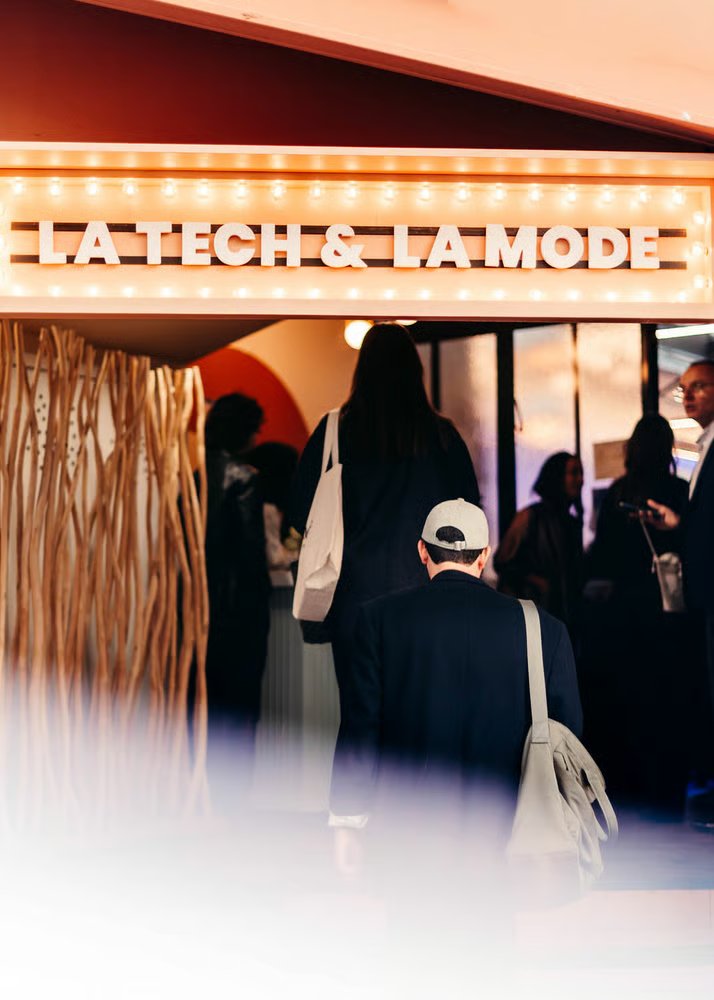
It has been barely four years since ChatGPT was launched to the general public. And in those four years, the highly complex concept of generative intelligence has become embedded in the everyday lives of both individuals and businesses. Consequently, since 2022, the use of AI-powered solutions has come to seem indispensable… despite breakneck developments that are sometimes hard to grasp. Last Wednesday, at the ‘Tech Generates Fashion’ event, the French Federation of Women’s Ready-to-Wear offered a number of insights to help decision-makers in the sector understand the possibilities opened up by AI, from product design to marketing strategies, as well as changes to the legal framework.

In a sector where the sometimes desperate quest for cost reductions often takes precedence, many brands have already turned to support or outsourcing solutions for the creation of visuals for e-commerce and even for campaigns. But while the savings in cost and time can be dramatic, this shift is not without risk. The conference ‘Generative imagery in fashion: between efficiency and illusions’ highlighted the limits of this transformation.
“With the growth of social media and SEO–GEO requirements, there is now a need to generate four times more content than five years ago, while marketing budgets have not increased – quite the opposite,” notes Clément Foucher, co-founder of Power.xyz, which offers large-scale image generation. “When it comes to AI, the models are improving day by day and, broadly speaking, every brand has tested some solutions. It is estimated that 30% of creative workflows can be automated.”
“The technology is no longer the issue,” confirms Alexis Rouge Carrassat, head of data at Eric Bompard. “You need to know what you actually want to apply AI to – e-commerce, CRM, packshots, or even campaigns. We carried out a review and ran some tests a few months ago, and we’ve since put the projects on hold. Bompard is a premium brand. Given the material and sensory qualities of cashmere, we cannot risk the final rendering being anything less than 100% reliable for our customers. We didn’t want to be pioneers on these topics. We needed to be sure that the models would reproduce colours and textures perfectly. But the real challenge lies in the desire and willingness to change the way we work, in the reorganisation of roles and in the way we create.”
For brands – particularly those positioned in the premium segment – the use of generative artificial intelligence clearly also has to be assessed through the lens of customer perception.
“It’s a chaos that is both worrying and exhilarating,” observes Laurent François, a marketing specialist and consultant with his firm Maison Prose, which works with beauty and fashion brands. “On the one hand, creative directors and geeks are coming together. From these creative ecosystems, collectives are emerging that can allow brands to make a creative leap and win over audiences. I haven’t seen this much creativity or boldness in 20 years. The tools themselves don’t matter; the only objective is to land a striking idea. But we’re also getting direct feedback from clients who are beginning to voice a kind of anger about AI-generated content, warning of an ‘AI overdose’ felt by both consumers and content creators. Communications professionals need to be aware of the impact of AI images and how they are perceived by younger audiences. On Reddit, there’s a kind of hunt for AI imagery: the younger generation negatively calls out content as ‘That’s so AI’. There are real issues around volume, but beware – customers are stakeholders in a brand’s reputation.”

Operations must therefore be managed with a finely tuned balance between customer sensitivities and potential savings in money and time. The Etam Group has opted for a test-and-learn strategy to shape its practices. And it does not apply a single, uniform approach. For its swimwear range, arriving as early as January–February, the brand has chosen a hybrid solution.
“AI isn’t magic”
“We face genuine revenue challenges in this category, particularly in e-commerce,” explains Camille Dufour, creative director of the French lingerie brand. “We’ve seen a marked drop in performance when the photoshoot isn’t carried out in real conditions. Our challenge was to have a real-life base and to determine how to industrialise the content produced while maintaining a consistent artistic direction.”
“AI isn’t magic. It’s a tool; above all, you have to rely on taste, human experience, and the quality of the artistic direction. The end result must be true to the brand and, crucially, to the product specification,” stresses Rémi Sello, co-founder of the Envelope studio, who supported Etam on this project. He argues that a near-classical level of support is still needed in production and post-production to achieve a result in which real content and AI-generated content form a coherent universe.
“We set up a model fitting booth and defined artistic direction for framing and poses. Production is handled by AI graphic designers, and we have a post-production workflow for retouching to ensure the look the brand is aiming for. This enabled us to generate around a thousand visuals. The difference from real-life shoots is undetectable. The product is accurate and realistic. The product exists, and that is the key to achieving large-scale, compliant production.”
In parallel, the brand and its service provider have worked on a campaign generated entirely by AI for Ramadan, aimed at African and Middle Eastern markets for local e-commerce, window visuals and advertising campaigns. “We specified the brief upstream. This campaign meets the needs and standards of these markets 100%. It was produced in two weeks at a cost four times lower than a traditional campaign.”

The savings in both money and time made it possible to create a dedicated proposition, where a budget would not necessarily have been released in the past. A traditional campaign can cost between 50,000 and 75,000 euros, whereas its AI-based equivalent requires a budget of 15,000 to 25,000 euros, according to Rémi Sello. The executive notes, however, that AI still has a number of limitations, particularly in handling certain materials such as lace. “It is possible to achieve results that meet expectations, but the cost of involving AI graphic designers can quickly mean that a traditional photoshoot remains more cost-effective,” he says, while remaining convinced that these barriers will soon be removed.
As Clément Foucher points out, the technical limitations are falling away one by one. As long as the quality of the data and source materials used to create visuals, videos and campaigns is high enough, the capacity to scale up while respecting brand codes and producing large volumes of visuals for different needs is already there.
It is therefore up to brands to decide whether, and how, they want to use these technologies. At Eric Bompard, the chosen approach is to develop in-house tools using AI in their design. At Etam, the roughly 10,000 product references on the e-commerce site – with a high rate of renewal – mean the company has to rely on service providers to combine responsiveness with mass production.
“It is often a question of volumes and capacity. But in this field, the Chinese and South Koreans are going further and faster than we are. You need high-quality data, but it is not just about pixels – it is about assets and heritage that need to be developed,” says Laurent François. “On WeChat, you have brands rolling out extremely sophisticated narrative worlds. Social media is highly strategic there, but the audience for aspirational brands has cultural and narrative habits – via video games, for example – that are much more elaborate than what those brands currently offer,” continues Laurent François, who urges European brands to break down their own barriers. “We need to bring in these storytellers to win over audiences who are not expecting us. And we need to develop narrative worlds that draw on the legitimate ‘dream-making’ strengths rooted in our own countries.”
Copyright © 2026 FashionNetwork.com All rights reserved.