Protests are sweeping across Europe, with hundreds of thousands of people taking to the streets in dozens of cities across the continent.
The first demonstrations started in France last month and since then, the unrest has spread to six countries.
While there are some shared grievances (in particular, the cost of living), issues can also differ significantly depending on the location.
Curfews have been announced in parts of Paris and Lille after some rallies turned violent, with hundreds of arrests amid looting and extensive damage to businesses and public buildings.
Now, analysts are warning the discontent could propagate in more countries in the coming weeks.
This is what you need to know.
Why are people protesting?
The demonstrations can be traced back to September 17, when teachers at a high school in south-eastern Paris protested about staffing shortages.
Students subsequently joined in, and it did not take long for the unrest to spread to other schools around the country.
What started about education has broadened to include general cost-of-living issues and cuts to the public sector.
The gatherings in France have been becoming more violent, and at the weekend hundreds of thousands of people took to the streets around the country.
In some areas, shops were looted and historic buildings were vandalised or even torched.
Loading…
French President Emmanuel Macron condemned the “unbridled violence” in a television address on Sunday night and blamed radical left vandals for hijacking a movement which has legitimate concerns.
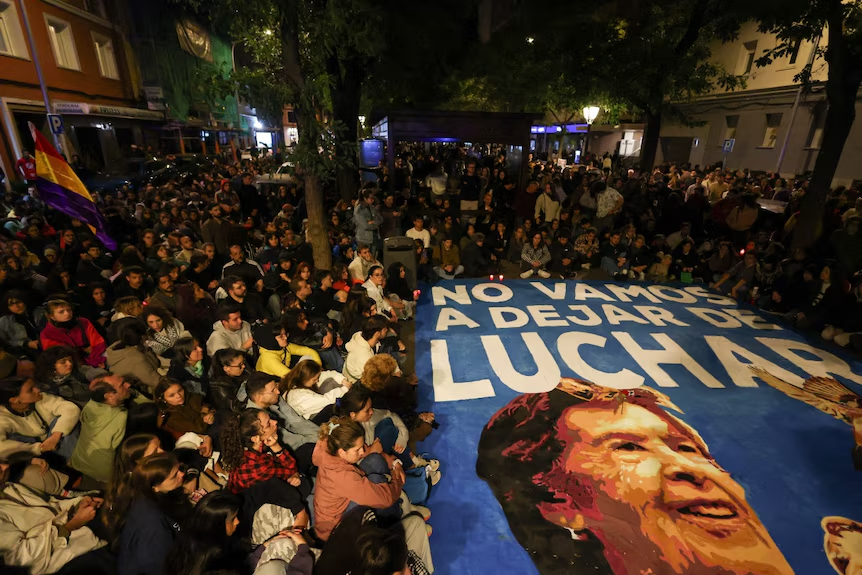
Around the same time as the French protests started, people in Madrid began demonstrating after an elderly woman was evicted from her home of 70 years by an investment firm, which had hiked her rent by 230 per cent.
Maricarmen Abascal, 87, died in hospital two weeks after being forcibly removed from her apartment.
The unrest has spread, and now rallies are being held in multiple countries. This is where and when the first demonstrations were recorded:
- France, September 17
- Spain, September 26
- Belgium, October 1
- Italy, October 5
- Portugal, October 10
- Albania, October 12
And this map shows where the largest protests have been held.
How did we get here?
France has the Eurozone’s second largest economy. But the government is struggling with high debt, a large budget deficit and rising borrowing costs.
This year, it will spend more on servicing its debt than defence or education.
While the state of schools and teaching resources have been a significant focus in France (particularly fuelling the initial gatherings), there are multiple issues drawing people on to the streets around the continent.
Most are linked to the rising cost of living. Here’s an overview:
| Country | Main grievances | What’s happening? |
|---|---|---|
| France | Living costs, public services | Curfews imposed after violent protests. |
| Spain | Housing | Large rallies spark snap election. |
| Portugal | Living costs, housing | Big protests, particularly in capital. |
| Italy | Living costs, public services, education | Demonstrations in northern areas. |
| Albania | Corruption, living costs | Violent protests in capital. |
| Belgium | Education system | Students rallying in large numbers. |
What the impact of the demonstrations has been really depends on where you are.
In France, officials in Paris on Monday encouraged their regional counterparts to impose curfews. Meanwhile, Spain is heading for snap elections on November 29, which were called by Prime Minister Pedro Sanchez shortly after housing reforms aimed at curbing public outcry, which he proposed, were rejected by legislators.
The issues in Albania are slightly different to those in Western Europe. Government corruption is one of the main reasons drawing people to demand change in the capital Tirana, where politicians have been accused of using sneaky tactics to approve a luxury coastal development linked to the Trump family.
Protesters in Madrid make their voices heard earlier this month. (Reuters: Violeta Santos Moura)
What could happen next?
In France, the government has held crisis talks, with curfews announced for parts of Paris and Lille. It came after protesters pledged to escalate their action in the coming days.
The country is less than six months out from a presidential election, and political parties have blamed each other for fuelling the violence.
Far-right political leader Marine Le Pen, for example, laid blame squarely at the feet of government, describing France as being “trapped, even held hostage, between violence and helplessness”.
In fact, Europe is heading for what some experts have described as a “super cycle” of national elections, which could fuel tensions as multiple countries head to the polls in the next 12 months.
In Albania, meanwhile, Prime Minister Edi Rama has pledged to stay on despite facing calls to resign, so the protests that have stretched police appear likely to flare up again.
Governments in Italy, Portugal and Belgium have all condemned growing violence, and not offered concessions.
Smaller demonstrations have also been noted in Greece, Austria, Ireland and Germany over the past few weeks.