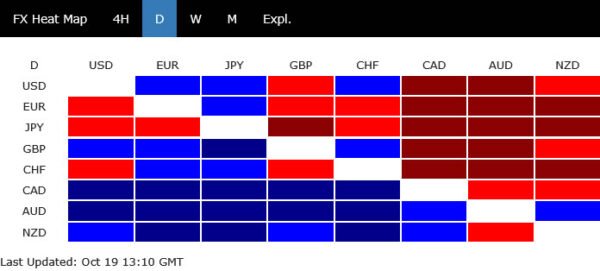
The dollar index  DXY, which measures the greenback against a basket of major currencies, was last up 0.10% at $101.93 and remains up over 3.8% for the year to date.
Dollar weekly moves and key drivers:
Over the past week, the US dollar index fell 0.58%, snapping three consecutive weeks of gains.
The greenback came under pressure as concerns over AI-related spending amid persistently high interest rates dampened investor sentiment, triggering an early-week flight to safety that pushed stocks, bond yields, and the greenback lower.
Meanwhile, hotter-than-expected US CPI and PPI data reinforced concerns over mounting inflationary pressures.
U.S. Treasury yields were lower over the week, with the 10-year yield ( US10Y) moving 13 basis points downward at 5.07%, while the 2-year yield (US02Y) shed five basis points to 4.73%.
Major currency movements (Oct. 12 to Oct. 18)
|
Euro (EUR:USD) |
+0.50% |
|
Pound Sterling (GBP:USD) |
+0.82% |
|
Japanese Yen |
0.00% |
|
Chinese Yuan (CNY:USD) |
+0.21% |
|
Swiss Franc |
+1.01% |
|
Australian Dollar (AUD:USD) |
+0.24% |
|
Canadian Dollar |
+1.04% |


In the last week, Sterling (GBP:USD) rose after stronger-than-expected UK economic data bolstered expectations of a potential Bank of England, with four quarter-point increases priced in by July and the first potentially coming as early as November. The currency was last down 0.08%.
The Canadian dollar  CAD was last up 0.44%. In the last week, broad-based weakness in the greenback and rising expectations of tighter monetary policy supported the currency. Stronger-than-expected Canadian manufacturing sales reinforced bets on a Bank of Canada rate hike at its next meeting, with most market participants anticipating the central bank’s first increase in the current tightening cycle.
Content provided by Seeking Alpha is intended for information purposes only, and that Seeking Alpha does not offer any personalist investment advice and is not a licensed securities dealer, broker, US investment adviser or investment bank.