HYÈRES, France – Turning over a new leaf for its 41st edition, the Hyères International Festival of Fashion, Photography and Accessories entered a new chapter under its incoming leadership team, with a jury headed by Chloé creative director Chemena Kamali selecting this year’s winners.
Chinese designer Yui Chen emerged as the winner of the Grand Jury Prize of the fashion competition for her collection, titled “Food Cover.”
Kamali was joined by last year’s grand jury prize winner Lucas Emilio Brunner on the jury along with Harper’s Bazaar France fashion director Elodie David Touboul, Agency Maybe artistic directors Charles Levai and Kevin Tekinel, 10 Magazine editor-in-chief Sophia Neophitou and photography duo Inez van Lamsweerde and Vinoodh Matadin.
Inspired by the humble food cover, Chen deconstructed its structure to create three-dimensional silhouettes that challenged conventional ideas of clothing with sculptural form, material experimentation and reinvention of space around the body.
Across the collection, familiar garments such as sleeping dresses and shirts became vehicles for exploring volume, sheer layering and foldability and crossed the runway with bounce. Recycled leather offered another approach, with an all-encompassing coat covered in bows.
Balancing domestic references with technical innovation, Chen approached each garment as a wearable sculpture paired with protective headgear. “I want to change how we see things,” she said, noting that her goal as a designer is to take familiar items and encourage people to look at them in a new way.

Xiao Xu’s look for her partnership with Supima.
Courtesy Hyères International Festival of Fashion, Photography and Accessories
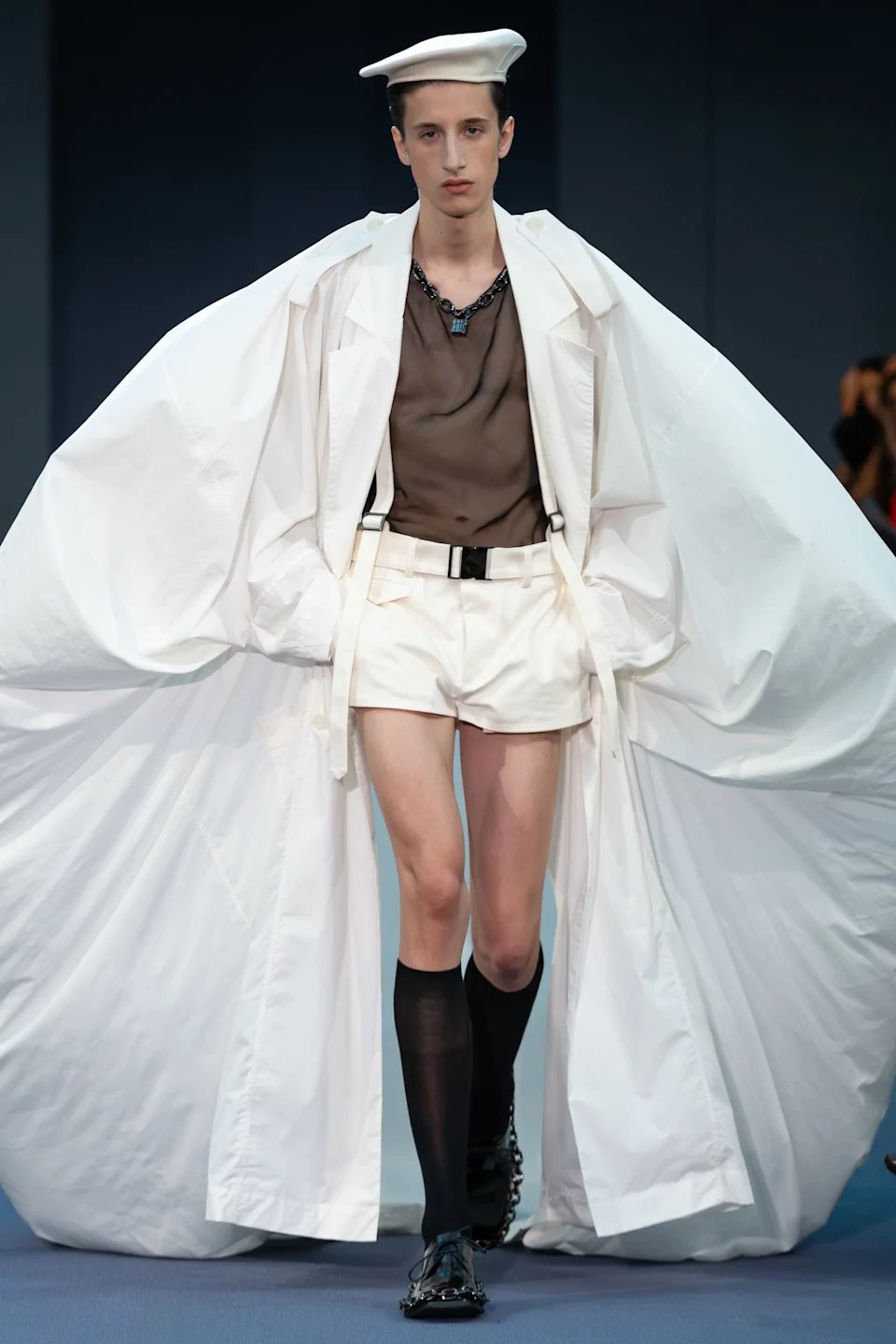
The second annual Supima Prize, which comes with a sizeable endowment of material and a trip with the other finalists to the upcoming edition of the Supima Design Lab in New York, went to fellow Paris-based Chinese designer Xiao Xu for her collection, titled “Uncanny,” in which she explored the tension between domestic familiarity and fetishistic sensuality. Inspired by the archival book “Dressing for Pleasure,” Xu juxtaposed everyday garments with unconventional materials, cleverly transforming ordinary sweaters and cardigans into latex constructions that revealed their jelly-ish strangeness only on closer inspection.
The collection challenged conventional notions of masculinity, combining commanding silhouettes with delicate ruffles, gathers and ornamental details. Collaborations with specialist ateliers extended this material experimentation, such as knit-like chain structures, embroidered latex and inflated trench coats.
Based on the book, Xu reimagined familiar wardrobe staples through a surreal, fetish-inflected lens. “I want this collection to offer people a moment of joy,” Xu said, noting that the collection was meant to be more playful than provocative.

Dieter Vlasich Obermann’s collection included using hatmaking techniques as footwear.
Courtesy Hyères International Festival of Fashion, Photography and Accessories
Mexican-German designer Dieter Vlasich Obermann scooped up the Le19M Métiers d’Arts Prize in partnership with Chanel. His collection, titled “Tiliches” explored the emotional and cultural value of handmade objects, drawing inspiration from childhood memories of collecting “treasures” that his grandmother dismissed as junk. The collection celebrated the imperfections, material qualities and traces of human craftsmanship that give such objects their meaning.
Working with embroiderers from Yucatán, Mexico, Obermann incorporated traditional techniques into contemporary garments, bringing together recycled leather, textured fabrics, beadwork and intricate embroidery, while naturally dyed raffia introduced earthy colors and references to Mexican folk art.
His collaboration with Le 19M’s Maison Michel reinterpreted traditional hat-making as footwear.

A look from Rachel Luurssen collection
Courtesy Hyères International Festival of Fashion, Photography and Accessories
Paris-based Dutch designer Rachel Luurssen took home the Atelier des Matières prize. Her collection, titled “Pandora’s Box: The Pursuit of Perfection,” explored the contradictions between the pursuit of beauty and the impossibility of perfection. Inspired by Robert Greene’s “The Art of Seduction,” the collection examined a woman torn between the desire to be loved and the fear of vulnerability, set against the idealized glamour of 1950s Hollywood.
Luurssen juxtaposed this polished fantasy with the distortions of body dysmorphia, questioning society’s expectations of the female body. Working from a plus-size model’s body as her starting point for pattern-making, silhouettes were subsequently distorted, creating a second layer that appeared to slip and warp around the body.

Brais Albor Rodriguez’s squirrel-inspired collection.
Courtesy Hyères International Festival of Fashion, Photography and Accessories
The jury also awarded a special mention to Spanish designer Brais Albor Rodriguez for his collection “Por Mis Santos Cojones,” and he snapped up the public prize as well. He designed a squirrel-inspired collection dedicated to “big boys” who are often overlooked in the fashion market.
Inspired by the workwear of tailor Franz Reichelt and the story of his ill-fated parachute experiment, Albor Rodríguez translated ideas of risk and rescue into garments. A shirt evoked a parachute, while velvet trousers featured double openings that suggested an interrupted escape. Sculptural hats and gloves further transformed the body, using exaggerated proportions and carefully considered details to reshape the silhouette, while a green coat combined baby llama and wool, while discarded linen-production waste was dyed and repurposed. Vintage shearling scraps sourced from Vinted and embroidered squirrel motifs extended the collection’s irreverent approach.
In the accessories category, the jury was headed by designer Cecilie Bahnsen, with last year’s grand prize winner Amaury Darras; 1Granary founder and editor-in-chief Olya Kuryshchuck, journalist Susie Lau, casting director Emma Matell, and A Magazine Curated By managing editor Jemma Pinueva. The grand prize went to Sassa Ann van Wyk.
The inaugural AZ Academy award, established in honor of the late Alber Elbaz, went to Daniel Cheruzel. He will join the foundation’s accelerator program.
The public prize went to Matteo Artuso.
New Leadership Streamlines, Refocuses
The festival’s new leadership is making a clear statement about its priorities – putting emerging talent first.
For Valérie Duport, elected president of the board of Villa Noailles in July, and Hugo Lucchino, who joined last year as managing director, that means concentrating resources on the designers and photographers at the heart of the event, rather than spreading them across a broader program of activities.
“What is important at the center of all this is creativity, freedom, young designers,” said Duport. “The idea was really to focus on the creation, their story, what they propose, and all the organization was done to make this happen and to give them a voice.”
“We wanted to focus attention on the DNA of what the Festival d’Hyères is – supporting young creators, young designers,” said Lucchino. “All the means of Villa Noailles, financial and human, are going back to the finalists and to the creators. So we have a team and partners dedicated to this support, who are really much more important than before.”
The shift has meant focusing on the exhibitions and fashion show, while bringing in three associate artistic directors to work alongside the festival’s artistic director, Magali Guérin. The aim is to give finalists more time, support and visibility, allowing them to present their work and develop their ideas.
The new leadership team came as the festival and its Villa Noailles parent association battled financial woes and allegations of mismanagement, which resulted in the exit of founder Jean-Pierre Blanc.
The result for this year’s festival was a more streamlined and well-organized event, with fewer parties and side events, and the fashion show taking place in the center of the city.
For Duport, who spent 27 years at Chanel and eight years at Kering, the role represents an opportunity to bring her industry experience to an institution that is currently in a “fragile” position, but is a needed pillar of the future of creativity. With her background in luxury and Lucchino’s experience in public affairs, institutions and museums, including Paris’ Palais Galliera, the pair complement each other, she said.
“We are a team, and for me that is more than important. It’s the key of the story,” she said of the new leadership structure.
“I believe in creation from the beginning,” said Duport. “We need spaces where creativity, freedom, audacity, culture and creation can have a place where you can breathe and offer this young generation a place where they can create and express themselves.”
The team also used this year’s festival to send a message about representation, with three women selected to head the competition juries. Kamali headed the fashion jury; Bahnsen, designer of her eponymous line, presided over the accessories jury; while French artist Camille Vivier oversaw the photography jury.
Luccino said it was an intentional signal to the fashion and creative industries.
“Villa Noilles needs to be prescriptive for the fashion industry, for the creative industry,” he said. “Most of students in art school, in fashion schools, are women, and they need to have role models to identify with. It was a strong message to appoint three leading creative talents in the industry to chair the juries – and they are not only women; they are talented, and they are young. So it was a message that we sent to the to the fashion industry.”
Beyond the festival itself, the leadership faces the challenge of ensuring Villa Noailles can continue to support emerging talent over the long term. To do that they will need sustained public and private backing, as well as new partners.
However, she stressed that any new partners will need to go beyond financial support with materials, technical expertise and advice that help young designers to create practical support that reflects the festival’s larger purpose.
“It’s not only a question of finance; it’s a question of beliefs and it’s a question of the energy people will put in this project,” said Duport.
They are are also keen to preserve the festival’s public accessibility.
“It’s not a festival for a happy few,” said Lucchino. “It’s really important to bring people who are not fashion specialists to Villa Noailles.” He noted that the exhibitions remain open for months after the festival, so that locals, tourists and students can partake.
Maintaining that public-facing mission will require continued support. To that end, the team is considering creating a permanent exhibition that would trace the building’s history as a center for artistic experimentation, from its origins in 1925 to the contemporary work presented through the festival as well as Villa Noailles’ other programs.
Young Designers Talk Reality of Building a Business
The team also brought designers Esther Manas and Alain Paul on stage to speak about the realities of running a young brand, alongside 1Granary’s Kuryshchuk, and Fédération de la Haute Couture et de la Mode director of emerging brands Serge Carreira.
With department stores in turmoil, young brands are backing away from wholesale. “I rarely see now anyone emerging who focuses on wholesale, and I would advise them against it,” said Kuryshchuk. “Definitely, wholesale is in crisis. To say differently would be naïve,” added Carreira.
Kuryshchuk said that young brands should assess wholesale in terms of profitability rather than sales volume. Production demands, payment delays and operational costs can absorb significant time and resources while generating relatively little revenue, and instead try to partner with big brands on one-off collaborations.
Manas said she and co-founder Balthazar Delepierre decided to quit wholesale altogether in June 2024 to focus on DTC sales and collaborations. The traditional model proved difficult for their small team, with payment issues and retailers’ requirements conflicting with the brand’s creative identity.
“If you are dependent on a big group – because you are the small fish and they are the big fish and you are at the end of the chain,” she said. The other was sizing issues, as she was developing a brand with one size fits all, with an eye to appealing to plus size customers. Department stores did not understand the concept. After moving to more traditional sizing, stores then skipped out on the larger sizes.
“So I mean it was a struggle for the money, but also for our community, our DNA, everything. So at the end, we decided to take the risk and to do B 2c and to do collabs with big brands,” she said. “We have a strong message. We can really help in a way to change the industry, but if we cannot do it with big shops because it’s too hard for us right now, we can do it with another way.” For Manas that is reaching customers through Instagram and her Substack.
However, Carreira cautioned against abandoning wholesale too early, as retailers remain crucial partners for reaching customers, building visibility and establishing a brand’s position in the market.
Paul said that wholesale is the backbone of his business, with around 95 percent of the label’s revenue coming from its network of about 35 stores, providing the cash flow needed to finance new collections and fashion shows. The brand is now looking to develop its direct-to-consumer business and build closer relationships with customers for made-to-measure pieces.