Key Points
Apple (NASDAQ:AAPL) has built an enormous business by making products that work together. From the iPhone and Apple Watch to the Mac and iPad, the technology giant has given customers plenty of reasons to stay within its family of devices.
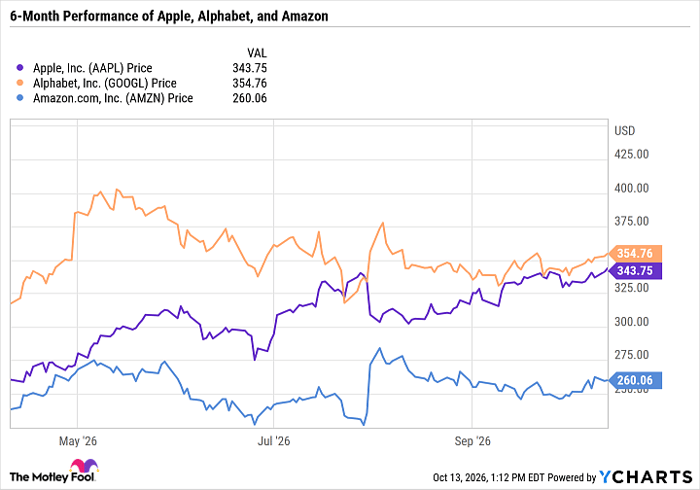
Now Apple is entering a market that Amazon (NASDAQ:AMZN) and Alphabet (NASDAQ:GOOG) (NASDAQ:GOOGL) already occupy, hoping to carve out a new business in smart home products by using its upgraded Siri artificial intelligence assistant.
Missed AI’s “Act 1”? Act 2 Could Be 15x Bigger. Most investors think they missed the AI boat because they didn’t buy Nvidia in 2005. But according to our analysts, we’re only at the end of “Act 1″—the R&D phase. “Act 2” is the global rollout. Continue »
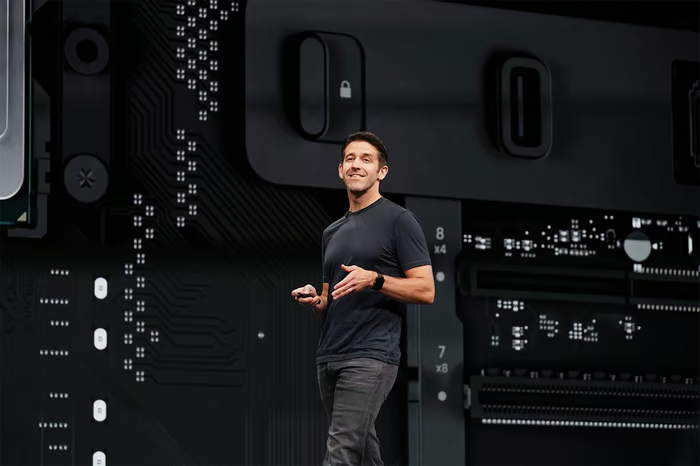
The company introduced HomeView on Tuesday, a $299 smart home display powered by Siri. I think it could be an interesting opportunity for new CEO John Ternus to demonstrate where he wants to take the company.
Apple CEO John Ternus. Image source: Apple.
What is Apple’s HomeView?
HomeView features a 7-inch touchscreen that can sit on a table or be mounted on a wall. It combines entertainment features such as music, photos, and FaceTime video calls with controls for smart home devices, including lights, thermostats, cameras, and door locks.
But the biggest attraction may be its upgraded Siri assistant. Apple introduced Siri AI in June, promising more natural conversations and the ability to understand personal information across applications.
HomeView takes those capabilities beyond personal devices. It recognizes up to six household members by their faces, automatically displaying personalized information while keeping their private content separate.
With a compatible Apple Intelligence-enabled iPhone or iPad, Siri can also use information from messages, calendars, and other applications to answer questions or complete tasks.
Apple says HomeView uses on-device processing and its Private Cloud Compute technology to handle personal information securely, while compatible security cameras can provide end-to-end encrypted video.
A look at the competition
Amazon’s Echo Show 8 and Echo Show 11 already use Alexa+ to control smart home devices, manage family calendars, and deliver personalized information. Google is also integrating Gemini AI into its Nest smart home products, offering more conversational controls and the ability to handle complicated requests.
At $299, HomeView is priced above similar-sized Echo Show products as well as the Google Nest Hub. But that hasn’t been a problem in the past; Apple smartphones can run more than $1,000 each, and the company has a loyal customer base — something that famously attracted Warren Buffett to the stock when Berkshire Hathaway became Apple’s largest shareholder.
And Apple has an advantage with customers who already own its products. HomeView connects to the iPhone, Apple Watch, and other Apple devices, allowing users to continue Siri conversations across devices.
The company also announced a new Apple TV 4K with Siri AI, an upgraded HomePod mini, and a collection of smart home accessories developed with LG Electronics and Schneider Electric. Each is a product that can make HomeView more useful and give customers more reasons to invest in Apple and its connected devices.
Could HomeView be a win for Apple’s new CEO?
When Ternus became Apple’s CEO in September, he inherited a company with a massive customer base but also questions about its ability to compete in artificial intelligence. Apple faces pressure to deliver meaningful product improvements rather than simply introduce another generation of familiar hardware.
With HomeView, Apple is using artificial intelligence to make its existing products more useful while introducing new devices that leverage those capabilities.
If HomeView encourages customers to purchase more Apple accessories, use additional services, and keep their existing devices longer, it could strengthen a business model that has served Apple extremely well. For Ternus, making AI a useful part of everyday life could prove more valuable than simply promising the next big technological breakthrough.
Missed AI’s “Act 1”? Act 2 Could Be 14x Bigger
Most investors think they missed the AI boat because they didn’t buy Nvidia in 2005.
But according to our analysts, we’re only at the end of “Act 1″—the R&D phase. “Act 2” is the global rollout, a massive technology build-out that Google’s CEO says could be more profound than fire or electricity.
While everyone watches the chip designers, one “backbone” company provides the critical technology that Nvidia and AMD literally cannot function without. We’ve detailed this under-the-radar player in our new AI Playbook.
Patrick Sanders has no position in any of the stocks mentioned. The Motley Fool has positions in and recommends Alphabet, Amazon, Apple, and Berkshire Hathaway. The Motley Fool has a disclosure policy.