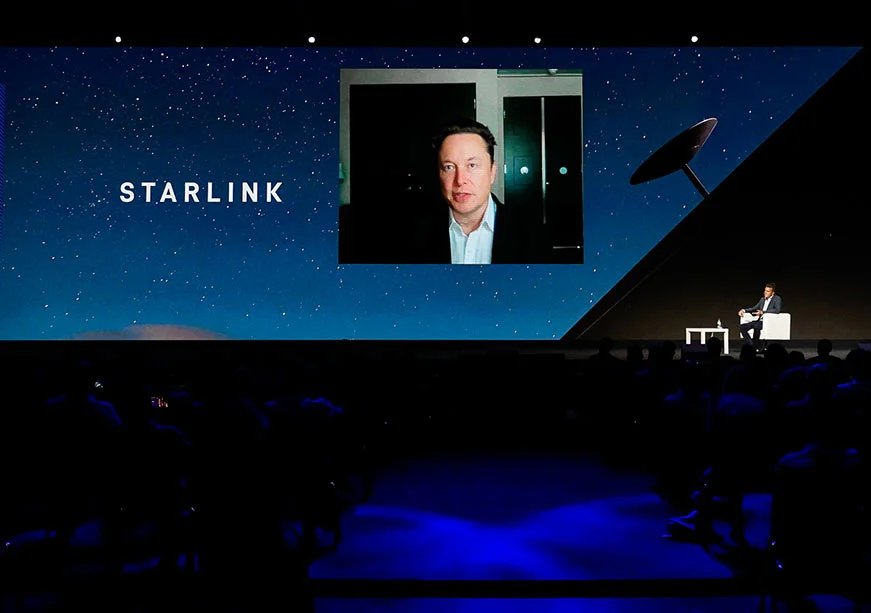

Image Source: Getty Images
When sovereign hegemony trickles down, corporate entitlement scales up. What the world’s wealthiest man, the trillionaire Elon Musk, is demanding from India, the world’s fastest-growing large economy, is that it recognise his oligarchic hyphenation with Donald Trump, the leader of the world’s largest economy, and behave, change rules, expedite permissions accordingly. The unsaid is “or else.” Amid the cracks in the government-to-government relationship between Washington DC and New Delhi, which are now widening, and the tariffs of up to 100 percent that a new US law allows Trump to impose on Indian goods, a US big tech poke through Musk’s Starlink at the Indian government deepens the rift with the smirking insolence his sovereign sponsor has mastered. Step back from the tweets, the political support in India, the lobbying in the US, and the shrill chatter of opinion, and the picture sharpens: the idea of American exceptionalism in international relations has trickled down from the White House in DC to Starlink in Texas.
Musk’s corporate entitlement gets its moral moorings from the way the US engages with the rest of the world. As Edward C. Luck describes it, exceptionalism, whether American or any other country’s, has four core characteristics. First, a willingness to act unilaterally on a range of issues while appearing immune to external pressure and criticism. Second, an assumption that its national values and practices are universally valid and its policy positions are morally strong, for which the rest of the world has to make space. Third, a strong inward-looking tendency to prioritise domestic political considerations when deciding how to act in international forums. And fourth, a belief that adherence to a rules-based international order is mandatory for others, voluntary for itself.
From regulatory easing for Neuralink and SpaceX, to business opportunities through contracts that convert surveillance into money, to outright stock recommendations of “buy Tesla” from US Commerce Secretary Howard Lutnick, to fame through the National Medal of Science, Musk’s closeness with Trump is hiding in plain sight. It is not difficult to gauge why Musk’s brilliant mind would transplant the fourth aspect of American exceptionalism (we make, not follow, rules) onto India. If lobbying, name-calling, intimidation, and shaming are the currency of doing business in the US, that is the way for a country halfway across the world. But this approach is brittle and overlooks four techno-security-cultural nuances that differentiate authoritarianism with American characteristics from the rich, deep, and wide democratic traditions of India, which are as emotive and ethical as they are intellectual and electoral.
1. Licenses, Clearances and Policy Processes
Musk’s exceptionalist grouse rests on one question: “Starlink is licensed in over 165 countries and has spent five years complying with every single law and requirement of the government of India, so why still no license?” His answer is self-reflective: oligarchs. Facts, however, expose his oligarchic-paradigmatic public frustration as baseless when passed through the calm waters of policy processes. His venting is not unlike George W. Bush attacking Iraq to eliminate weapons of mass destruction. According to the Indian government, more than 10 satellite operators, including “the licensed Starlink,” have entered India—Starlink Satellite Communications Pvt. Ltd. received the licence to launch satellite internet services in India in June 2025. What Starlink does not have are security clearances and spectrum assignment.
For Musk to believe that his strategic hyphenation with Trump would make the Indian government bend before an oligarch building public pressure would be to misread how India decides security issues, particularly in telecommunications.
2. Security Is Embedded in Service
Unlike cars or teddy bears, telecommunications is a national security issue. In May 2021, India gave permission to launch 5G trials to four companies: Bharti Airtel, Reliance JioInfocomm, Vodafone Idea, and MTNL. The list of 5G equipment providers was Sweden’s Ericsson, Finland’s Nokia, South Korea’s Samsung, and India’s C-DOT and Reliance JioInfocomm. Missing from the list, then as now, are two Chinese firms, Huawei and ZTE. The one core reason: national security. At that time, the India-US relationship was deepening. Today, it is fraying under serial actions and successive intimidations on trade tariffs, US support for Islamabad despite terror emanating from it, and name-calling by Trump. For Musk to believe that his strategic hyphenation with Trump would make the Indian government bend before an oligarch building public pressure would be to misread how India decides security issues, particularly in telecommunications.
The need for security expands exponentially for satellite communication services. In 2008, David Headley, a US citizen, used satellite phones in the run-up to the 26/11 attacks on Mumbai. So did Pakistani-trained terrorist Ajmal Kasab. Recently, during Operation Sindoor, Pakistan tried to use Chinese commercial satellites to hit targets in India, but failed. With the White House now supporting Rawalpindi—financially through a recent US$1.2 billion IMF loan and by public relations through photo-ops at the White House in return for, among other things, a Nobel nomination for Trump—any US satellite or critical infrastructure provider holding a potential kill switch (the remote capability of a service provider to deactivate, block, or restrict satellite internet terminals and access during geopolitical crises) sits in the same risk quadrant as China did when India barred Huawei and ZTE from offering 5G equipment.
Any US satellite or critical infrastructure provider holding a potential kill switch (the remote capability of a service provider to deactivate, block, or restrict satellite internet terminals and access during geopolitical crises) sits in the same risk quadrant as China did when India barred Huawei and ZTE from offering 5G equipment.
Further, the White House-corporate nexus in the US, of which the Trump-Musk bromance is emblematic, showed what such a relationship can do in times of crisis. During the 2022 protests in Iran, Musk activated Starlink and enabled protesters to bypass government restrictions on the internet. In June 2025, he tweeted “The beams are on,” switching on service over Iran, where Starlink is not licensed, in the middle of an Israel-Iran war. With security clearances still underway for all potential service providers, and Starlink’s operations in conflict zones resting on one man’s whims, New Delhi will not clear Starlink until those risks are addressed to India’s satisfaction. But with Musk now trying to troll the Indian government and corporations into submission even as the security clearance process is underway, and with a history of behaviour that adversely affects security, no government can or will allow Starlink into India.
There is nothing new about a security audit of critical infrastructure, particularly communications. The US applies the same security logic to foreign-owned companies through the Team Telecom agencies, whose role is to give “feedback on any national security, law enforcement, foreign policy, or trade policy concerns.” Musk, who on 1 October 2026 was named to co-lead a Pentagon study of future warfare, is expected to know these processes. The European Union (EU) builds on the principles of “security by design” and “security by default” for space systems, and the EU Agency for the Space Programme tracks objects in space to guard against satellite collisions. Other countries have their own processes that foreign investors need to follow.
3. Zero Tolerance for Neocolonial Assaults
Less than 80 years after independence, India has zero tolerance for any form of neocolonialism, whether actual or informational. Across the political spectrum and ideological positions, threats have not been, and will not be, levers to change India’s domestic policies. No voter will sanction it. Some opposition leaders who support Musk today are likely to take a U-turn if they come to power. Their shift from politics to policymaking and governance will be swift. And when it comes to national security, they will dig their heels in even deeper. The US has turned itself into an untrustworthy partner, and any party seen to be accommodating American interests risks falling by the wayside. Looking beyond Musk, this is the time for India to examine carefully the entire US big tech stack operating in India.
4. Musk as Trump’s Lever
In the 21 months of his second presidency, Trump has exposed the dark underbelly of US grand strategy. Earlier incumbents were more discreet about their intentions. With Trump, every part of the American state is a weapon—tariffs, trade, technology, the military, universities, visas—and, beginning with Venezuela, running through Greenland, and extending to attacks on Iran and threats to Cuba, every country is a potential hostile takeover candidate. Mix the two and the world faces a potent combination in which allies and adversaries alike are under pressure. There are two exceptions that Trump dare not touch: China, almost entirely, and Russia, selectively. The lesson for countries such as India is simple: build power, find leverage, and prepare for the worst. After tariffs, energy squeeze, and visa restrictions, Musk could be one more lever in Trump’s grand strategy to bend India’s will.
What India Should Do
This is, like several others before it, an opportunity for New Delhi to rethink the way it makes, communicates, and transmits policies. In a world that is increasingly deglobalising, policy clarity and policy stability are necessary conditions to attract competitive global capital. They may still not be sufficient. Here are two overarching suggestions that hold within them layers of potential action.
First, particularly in industries where the innovation cycle is measured in months, five years of policy decision-making is a lifetime: the accompanying delays are expensive, and the risk of getting outdated is high. Gone are the physical constraints of the 1990s. Gone are the connectivity-building years of the 2000s. Gone are the distribution constraints of the 2010s. In today’s hyper-compressed, AI-driven era, the time available for action has contracted sharply. Capital has no patience with the bureaucracies of the past. India needs to take a decision and enable private companies to build and deliver services faster, or say no clearly. Leaving policy decisions hanging does no good: neither to companies and capital, nor to governments and consumers.
For every American exceptionalism, there is an Indian conventionalism: a shared position on equality before the rule of law. As far as the current controversy is concerned, Starlink should go the Huawei way in India.
And second, in critical infrastructure, security is paramount, and its details must remain secret. But if broad processes and directions are made clear, corporations can adapt their business systems to security needs. In the case of satellite communications, India needs the confidence to regulate a secure network. It should work with corporations to help bridge any gaps, and tell them there are no compromises or negotiations on national security. And if an economic agent intimidates or resorts to public shaming, India should tell it, politely but firmly, that such conduct has no place here. For every American exceptionalism, there is an Indian conventionalism: a shared position on equality before the rule of law. As far as the current controversy is concerned, Starlink should go the Huawei way in India.
Gautam Chikermane is Vice President at the Observer Research Foundation.
The views expressed above belong to the author(s). ORF research and analyses now available on Telegram! Click here to access our curated content — blogs, longforms and interviews.