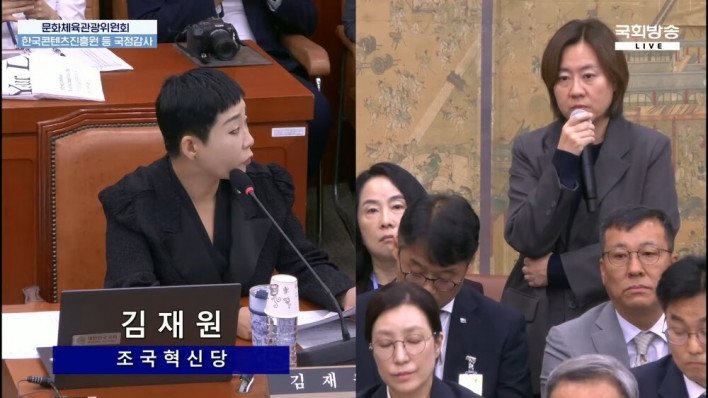
During a parliamentary audit, lawmakers pointed out that game support programs run by the Ministry of Culture, Sports and Tourism (MCST) and the Korea Creative Content Agency (KOCCA) are reinforcing the market dominance of Google and Apple app stores. Calls were also made for the government to launch an investigation into a game that sparked a “chart-rigging” controversy due to high-value payments made on launch day by a sponsored streamer.
Representative Kim Jae-won of the Rebuilding Korea Party raised these concerns on October 12 during the National Assembly Culture, Sports and Tourism Committee’s parliamentary audit of KOCCA and the Game Rating and Administration Committee (GRAC).
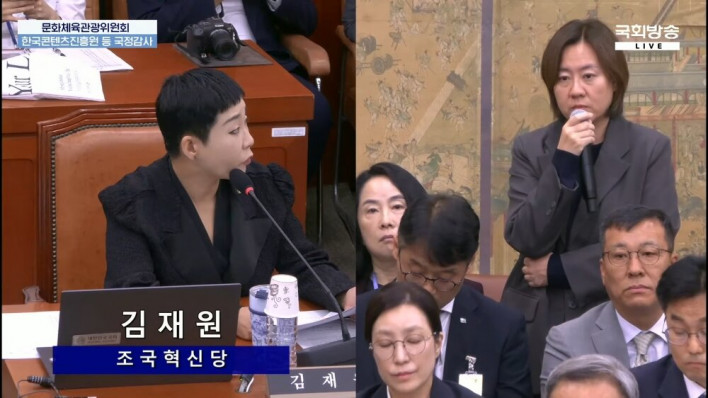
Rep. Kim first addressed a mutual growth agreement signed in October 2021 by domestic app stores and eight content companies, led by the Ministry of Science and ICT (MSIT). ONE Store, Galaxy Store, Nexon, Netmarble, and NCSoft were among the participants. Article 2 of the agreement outlined non-discriminatory listing by domestic content companies and support for launching on domestic app markets. Rep. Kim noted that while the agreement falls under MSIT’s purview, promoting the gaming industry is the MCST’s responsibility, and asked whether MCST had ever consulted with MSIT following the agreement. Choi Seong-hee, Director General for Content Policy at MCST, replied, “To my knowledge, no consultations have taken place.”
According to the “2025 Korea Game White Paper” cited by Rep. Kim, among 615 domestic game companies generating mobile revenue, sales averaged 70.8% on Google Play and 26% on the Apple App Store. ONE Store accounted for just 2.5%.
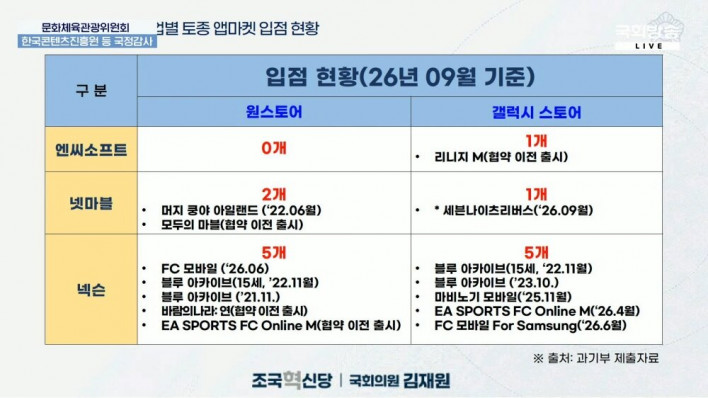
Data submitted by MSIT to Rep. Kim’s office (as of September 2026) also showed poor domestic store representation among the top three publishers. ONE Store listed five games from Nexon, two from Netmarble, and none from NCSoft. Galaxy Store listed five from Nexon and one each from Netmarble and NCSoft. These numbers included titles released before the agreement, such as NCSoft’s “Lineage M,” Netmarble’s “Everybody’s Marble,” and Nexon’s “The Kingdom of the Winds: Yeon.”
Excluding those pre-agreement titles, ONE Store listings drop to three from Nexon and one from Netmarble, while Galaxy Store carries five from Nexon and just one from Netmarble. Netmarble’s sole Galaxy Store listing, “Seven Knights Re:BIRTH,” was added as recently as September.
During the same period, the three publishers launched major new apps numbering 8 from NCSoft, 26 from Netmarble, and 24 from Nexon. Although this figure includes some age-rated variants or supplementary apps, Rep. Kim emphasized that despite a steady stream of app releases, domestic market listings remain stuck in the single digits.
Choi responded that the low listing rate appears to stem from game companies preferring Google and Apple due to their high global market share. Rep. Kim countered, “That is not the case,” pointing directly to KOCCA’s support criteria.
Under KOCCA’s 2026 Game Content Production Support criteria for release-ready projects, only Apple App Store and Google Play were cited as mobile distribution channel examples. This stands in contrast to the PC distribution criteria, which explicitly list domestic platform “STOVE INDIE” alongside Steam and the Epic Games Store. Furthermore, the early-entry track of the “Game Plus” distribution support program strictly restricted its mobile release criteria to games available for download with an integrated payment module on at least one of Google Play or the Apple App Store.
Rep. Kim questioned, “Game companies seeking support are effectively forced to launch on Google and Apple as a prerequisite,” asking whether the omission of ONE Store and Galaxy Store was an oversight in program design or if domestic platforms were excluded from support eligibility from the start.
KOCCA representatives responded that because Game Plus was established to assist overseas expansion, it was structured primarily around Google and Apple due to their dominant global market shares, adding that they would review including domestic platforms in consultation with the ministry.
Rep. Kim highlighted that while Game Plus added STOVE to its PC segment in 2025, domestic platforms are still missing from the mobile sector. Moreover, performance indicators consist solely of overseas revenue and overseas downloads, leaving no metrics to evaluate domestic distribution performance. “The entry rate for domestic platforms is far too low. We are essentially only nurturing foreign companies,” Kim said. “Domestic platforms can also serve as a springboard for global expansion.”
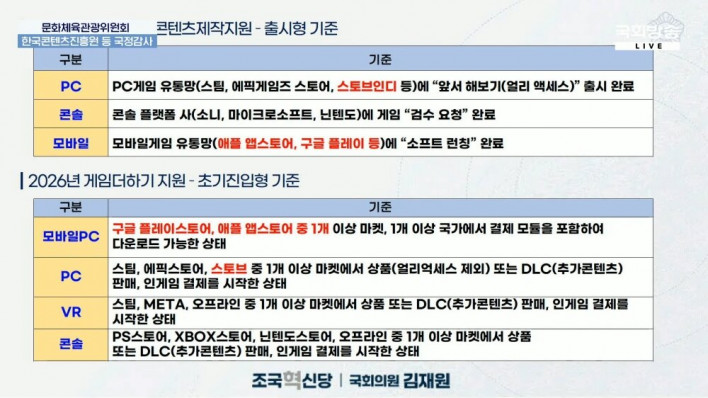
Rep. Kim demanded that domestic platforms be explicitly listed under launch recognition criteria, that bonus points be introduced for listing on domestic platforms, and that domestic platform listing be factored into distribution specificity evaluations. When asked if these changes could be reflected starting with next year’s announcement, KOCCA stated, “We will work with the ministry to incorporate them.” Rep. Kim also requested that MCST create a domestic distribution support category within its game distribution support programs and establish a consultation channel with relevant ministries to report back on results.
The questioning then shifted to the promotional spending controversy. In June, a title hit No. 1 in grossing on the Apple App Store in about 8 hours and on Google Play in 22 hours. However, it emerged that a YouTuber under a promotional contract with the publisher spent roughly 10 million “Diamonds”—the in-game currency—on launch day. Converted using retail package prices, this amounted to approximately 300 million won. On June 25, the Korea Game Users Association issued a statement comparing the incident to “chart rigging in the music industry.”
The publisher maintained that promotional fees were strictly compensation for marketing services and that contractual terms did not require in-game purchases or the re-spending of funds. They added that it is difficult to verify the payment’s impact on revenue rankings. The exact magnitude of the actual impact remains unconfirmed.
When Rep. Kim asked if there was any way to verify whether promotional fees cycled back into in-game purchases, Choi indicated that it is currently difficult to statistically examine individual payment data. Citing materials submitted by GRAC Chairman Suh Tae-gun, Rep. Kim pointed out that neither GRAC nor MCST had ever conducted a field survey or monitoring on the issue, urging a formal investigation. Choi responded, “We will review the matter and report back.”
In a written response to Rep. Kim’s office, GRAC stated that under the current Game Industry Promotion Act and its sub-statutes, game companies are under no obligation to disclose or display the amount or usage of promotional fees paid to BJs and streamers. They explained that disclosing financial ties between advertisers and broadcasters falls under the jurisdiction of statutes such as the Fair Labeling and Advertising Act. GRAC added that it has not considered implementing mandatory disclosure of promotional fees even following the implementation of the probability-based item disclosure system.
The current Game Industry Promotion Act lacks provisions directly prohibiting the improper purchase of in-game items—or coercing others to purchase them—for the purpose of boosting sales metrics. This contrasts with the Music Industry Promotion Act, which prohibits unfair purchases intended to inflate sales figures to prevent bulk buying and chart rigging. Rep. Kim plans to pursue an amendment to incorporate a similar prohibition into the Game Industry Promotion Act.
[Read Original]