PARIS — While shopping can sometimes be an endurance sport, Le Bon Marché is introducing a new layer.
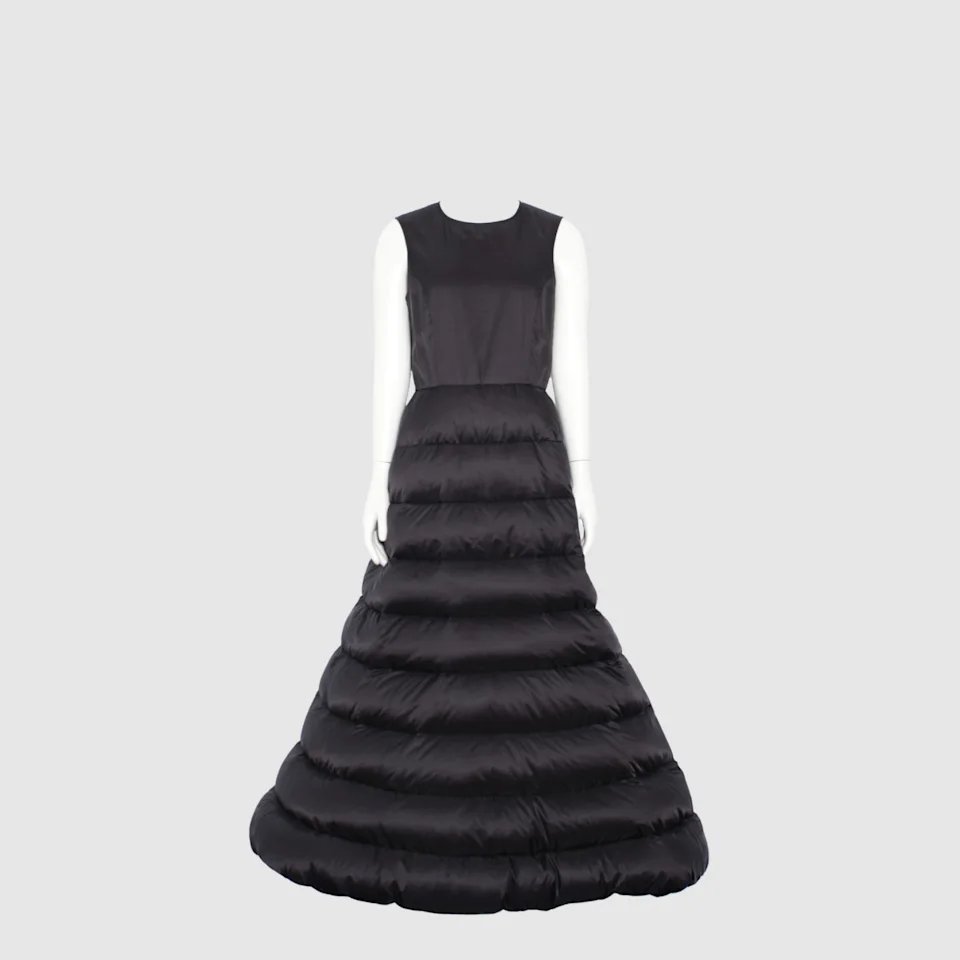
The Paris retailer will host its very first women’s fashion auction, partnering with Pénélope Blanckaert’s Penelope’s Auction House to sell archival Japanese designer fashion, including pieces by Rei Kawakubo, Yohji Yamamoto and Issey Miyake.
More from WWD
Unlike conventional shopping, bidding can offer a little thrill of competition and connection that a regular purchase may not.
“When you win a piece at auction, the experience is even more exciting than simply buying something. You can tell the story of how you fought to get that particular piece,” Blanckaert said.
The sale will sit within “Super Japon,” a store-wide offering that spans everyday Japanese culture, from convenience store items to accessible gastronomy, which opened in August.
The items up for auction go on exhibit in the store on Monday for one week leading up to the Oct. 18 sale date.

Comme des Garçons x Junya Watanabe fall 2009 collection.
For Le Bon Marché, the auction will offer a way to bring a specialist collecting market into a department store, creating an event that combines an exhibition, shopping and a live experience.
It will also allow the retailer to present brands outside of its conventional assortment, drawing on Blanckaert’s expertise and network of private collectors.
“The idea was also to build on the fact that Le Bon Marché has always been a pioneer when it comes to in-store experiences and curation,” said Le Bon Marché’s director of women’s fashion Isabelle Fine.
But in an increasingly crowded landscape of pop-ups, brand activations and cultural programming, an auction can add a new dimension to the retail experience.
“I also wanted to bring a physical auction into the store because it offers a new way of interacting with customers,” Fine added. “I was interested in this approach to buying clothing as an object, and in the emotion that an auction experience can create.”

Blanckaert and Fine wanted the sale to be accessible beyond established collectors, with a range of pieces and price points, so bidding starts at below 100 euros. The ambition is to bring auction culture into the store without turning it into an exercise in exclusivity.
“There is a heritage and museum-like dimension to the project. But I wanted to make it more inclusive and democratic,” Fine said. The pieces are curated with an eye toward also being on exhibit, not just for sale.
In the 1980s, when Parisian fashion was all power shoulders and cinched waists, a group of Japanese designers arrived with black clothes, asymmetry, holes and new silhouettes.
“Their work was unsettling. It wasn’t immediately understood. Today, these things no longer seem so shocking. But in the 1980s, they were genuinely radical,” Blanckaert said.
But four decades later, their work is among the most coveted in vintage fashion.
“Japanese fashion is particularly relevant at the moment, perhaps partly in reaction to what we see at major fashion houses, where creativity is often governed by marketing and consumer demand,” she said.
Japanese designers operate on their own terms, she added, presenting a vision rather than tailoring it to commerciality. That uncompromising approach has helped move their work beyond the cycle of trends.
The auction is centered around Miyake, Yamamoto and Kawakubo, with additional pieces by Junya Watanabe, Kansai Yamamoto and Undercover. Most of the pieces are from the 1980s through the 2000s, with a few newer items. Among the highlights are pieces from Comme des Garçons‘ groundbreaking “Pirates” collection from fall 1981.
For Blanckaert, the legacy of Japanese fashion goes beyond nostalgia.
“Early 1980s Japanese fashion is particularly sought after because production was relatively limited at the time. With designers, the early pieces are often the most desirable because they’re the rarest,” she said. “Yet these garments can also be surprisingly wearable.”
But their appeal isn’t purely archival. Blanckaert pointed to the “Pirates” collection, with jackets of woolen knits and felt with relatively straightforward construction. They are unmistakably Comme des Garçons, yet surprisingly easy to imagine mixed with modern Saint Laurent, for example.

Ensemble Comme des Garçons x Noir Kei Ninomiya 2022 collection.
The pieces also follow the designers’ evolution from the straightforward blacks to use of color to increasingly sculptural shapes.
“Sometimes you look at a garment on a hanger and don’t quite understand it. But as soon as you put it on, everything falls into place,” Blanckaert said. “That’s another interesting aspect of Japanese fashion: the relationship between the body and the garment.”
“These designers were pioneers in exploring gender, the relationship between clothing and the body and deconstruction. These are all themes we see in many collections today,” Fine added.
The pieces were sourced through Blanckaert’s network of former clients and private collectors. In 2011, she organized the first auction dedicated to Japanese fashion. At the time, the category was still relatively untested. Today, Japanese designers are firmly established on the vintage market and early examples can command extraordinary prices.

Comme des Garçons 1997.
The initiative comes at a moment when fashion exhibitions are attracting audiences well beyond the traditional museum crowd, Blanckaert said. As more institutions devote space to designers and their archives, clothing is increasingly understood as a cultural artifact rather than simply a commercial product.
“Fashion exhibitions attract different audiences, particularly younger people. Young people today are very curious about fashion history,” she said. “They might be less interested in, say, Old Master paintings or 18th-century art, but an exhibition about Balenciaga’s creations can be a much more accessible way to draw them in.”
For Blanckaert and Fine, the live and online bidding will be an experiment.
“That will be part of the fun and suspense of the auction — seeing who ends up with each piece. Collectors might find themselves competing with private buyers,” Blanckaert said.
Fine added that this is a test for the new format of combining curation, commerce and competition within the department store experience. If it is successful, there are plans in the works for additional exhibition-slash-auctions in the future.
Best of WWD
Sign up for WWD’s Newsletter. For the latest news, follow us on Facebook, Twitter, and Instagram.