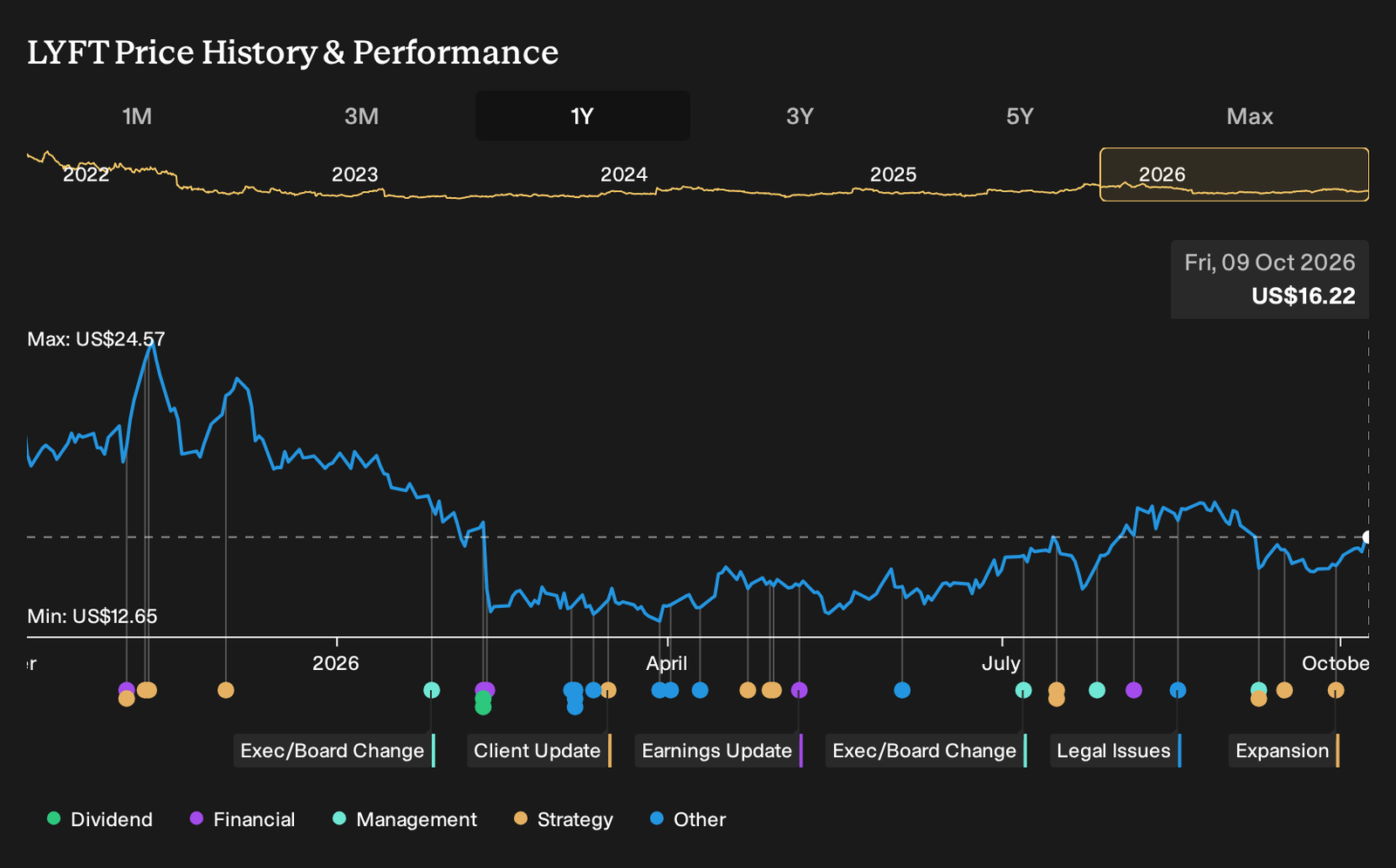
- After October 2026, Lyft expanded its rider app into major European cities, connecting US and Canadian users to a third-party driver marketplace across countries including Spain, Italy, France, Germany, the UK, Ireland, Austria, Greece and Poland.
- The new backend framework for Europe gives Lyft a modular way to plug into additional marketplaces, which may influence future cross-border ride volume, payment choices and operational complexity without requiring riders to change accounts or payment details.
- We will look at how Lyft’s investment narrative is affected by this European app rollout that relies on a third-party marketplace.
Scan how Lyft’s Europe push fits into a wider travel and mobility theme by sizing up a curated set of 20 high quality undiscovered gems that may be building under-the-radar platforms of their own.
Lyft Investment Narrative Recap
To own Lyft, an investor needs to believe the ride platform can turn its urban demand, partnerships and product work into more durable revenue and cleaner earnings, despite forecasts that profits may decline over the next few years. The key near term swing factor is execution on core North American rideshare economics rather than international experiments.
The European rollout mostly looks incremental to that near term story. It adds product reach and cross border convenience, but the third party marketplace structure also adds operational and partnership risk on top of already heavy reliance on external partners and regulatory exposure in transport and insurance.
The closest operational reference point for this European push is Lyft’s existing international exposure through FREENOW, which already gives the group a foothold in a fragmented European taxi market. That earlier move underlines how management is leaning on partnerships and plug in platforms instead of owning every piece of local supply directly.
For you as a shareholder, the combined picture is clear. Growth catalysts are skewed toward partnerships, product tweaks and geographic reach, while risk sits in dependency on third parties, a relatively new management team and analyst expectations for softer earnings ahead. Execution on integration and reliability will matter more than headlines.
Lyft’s latest analyst narrative points to forecast revenues of US$9.1b and projected earnings of US$463.0 million by 2029, built on an assumed 10.4% yearly revenue growth rate and an earnings decline of about US$2.4b from earnings today of US$2.9b.
Discover how Lyft’s fair value indicates a potential 19% upside to its current price that may not last much longer.

Exploring Other Perspectives
One bullish twist on the Lyft story is Europe as a springboard for a faster revenue path. The most optimistic analysts were already penciling in US$9.6b of sales and US$480.3 million of earnings by 2029 before this rollout. You can read that as a far more upbeat script that might shift again once this expansion beds in.
Explore 5 other Lyft fair value estimates, including one that suggests as much as 174% upside from the current price!
Form Your Own Verdict
Disagree with existing narratives? Extraordinary investment returns rarely come from following the herd, so consider trusting your own analysis.
Looking For More Investment Ideas Beyond Lyft?
If the Lyft story has sharpened your thinking, broaden the watchlist and use the Simply Wall St Screener to stress test your thesis against other companies with very different profiles.
- Prefer potential upside with less financial strain on the balance sheet? Start by scanning a 31 resilient stocks with low risk scores that may appeal if you care about resilience first and excitement second.
- Income is your priority and price swings come second? Shortlist payout candidates from a curated set of 8 dividend fortresses that might fit a steadier, cash focused approach.
- Hunting for early stage stories that could still be flying under most investors’ radar? Line up a focused group of 14 elite penny stocks with strong financials to pressure test which businesses genuinely match your risk tolerance and checklist.
This article by Simply Wall St is general in nature. We provide commentary based on historical data
and analyst forecasts only using an unbiased methodology and our articles are not intended to be financial advice. It does not constitute a recommendation to buy or sell any stock, and does not take account of your objectives, or your
financial situation. We aim to bring you long-term focused analysis driven by fundamental data.
Note that our analysis may not factor in the latest price-sensitive company announcements or qualitative material.
Simply Wall St has no position in any stocks mentioned.
New: AI Stock Screener & Alerts
Our new AI Stock Screener scans the market every day to uncover opportunities.
• Dividend Powerhouses (3%+ Yield)
• Undervalued Small Caps with Insider Buying
• High growth Tech and AI Companies
Or build your own from over 50 metrics.
Explore Now for Free
Have feedback on this article? Concerned about the content? Get in touch with us directly. Alternatively, email editorial-team@simplywallst.com