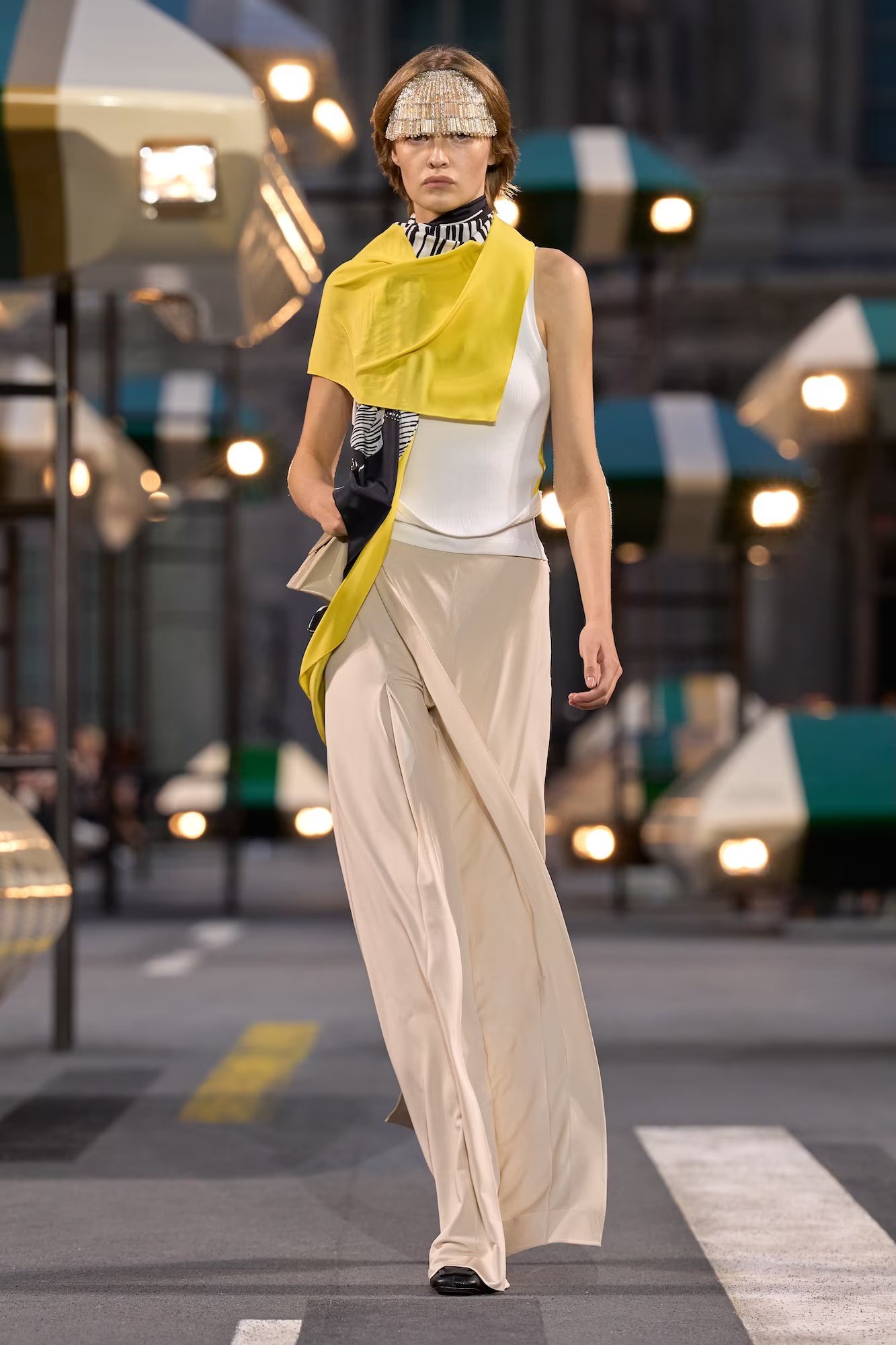
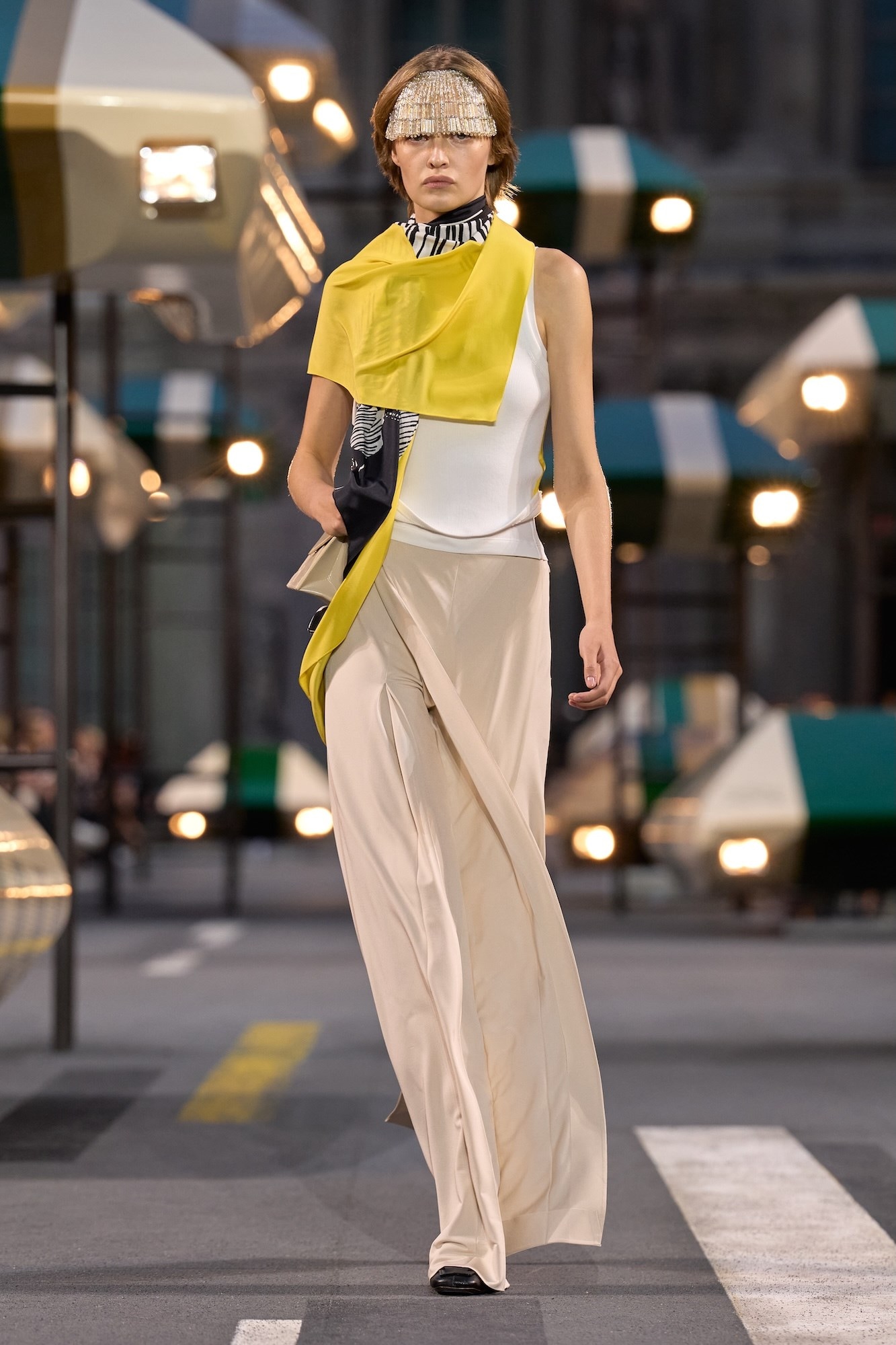
Lead ImageLouis Vuitton Spring/Summer 2027Courtesy of Louis Vuitton
Fashion week invariably transforms Paris into a giant traffic jam – static cars, fashion figures fleeting between, running to shows – or everyday Parisians, to more important things. That is the reality of living in a city in the 21st century, terribly different to what was once envisaged. Nicolas Ghesquière’s Spring/Summer 2027 Louis Vuitton scenography simultaneously looked back, forwards, and around – a stretch of autobahn dropped into the midst of the Louvre’s storied walls and jam-packed with cars, albeit half of them floating, a bit Back to The Future (although the future they went back to was, in actual fact, 2015). There was a Marie Celeste vibe, of a civilisation paused except for the shifting of the figures within – or, potentially, an eye-rolling idea that, even when we finally figure out this kind of technology, we’ll probably still be snared in gridlocks even if moving on a vertical axis. There is also a slightly less romantic or forward-thinking vision in mind – laughing backstage, Ghesquière cited mid-20th century photographs showing the Louvre’s Cour Carrée and the Cour d’Honneur of the Palais Royal used as car parks for municipal employees. The incongruity of the ram-packed vehicles within those stored citadels triggered something in his brain. It takes all sorts to inspire.
Retro futurism is something that has always fascinated Ghesquière – yet this was a collection with a true idea of the future at its core. “Ergonomie,” he said, backstage after. “A fluid ergonomie, how the clothes can be attached to the body, and be in motion with the body. We often associate the ergonomic with hard structure, but I wanted to explore softness.”
Thinking back, almost 20 years ago, Ghesquière created a Balenciaga collection of stiff, curvy floral dresses inspired by race-car chassis – they were ergonomic, for sure, but rigid shapes held away from the body. As a kid, he said, he used to draw cars as well as clothes. “Armour in fashion is something I am known for,” he allowed, backstage. Indeed: last season, Louis Vuitton constructed clothes as sturdy as moveable homes, arching shoulders and hood-like hats battening down the hatches against perceived threat, man or nature. And the moulded neoprene-mounted pieces from that 2008 Balenciaga car-clash collection can stand aloft without a body inside them.


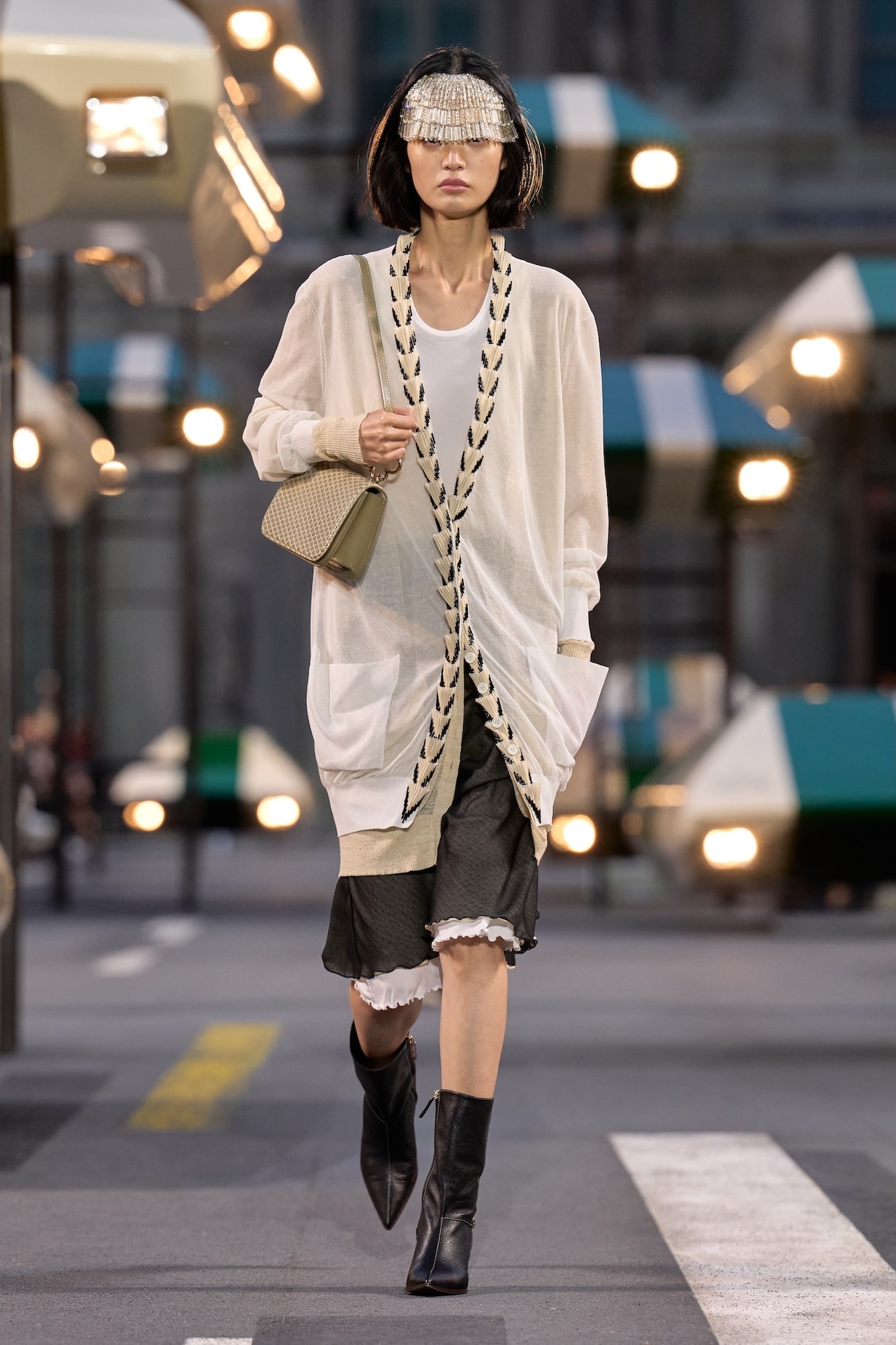
Like that earlier excursion, this Vuitton collection took the ergonomic as its starting point, but engineered it to totally different results. One inspiration, Ghesquière said, was Louis Vuitton himself, altering the wood that formed the structure of cumbersome 19th century trunks to reduce their weight, allowing them to move more freely around the world. “A quest, to become lighter and lighter,” was his own stated aim. “Engineering fabric to fight gravity.”
That was the complicated idea behind these very easy clothes. Tailoring was virtually non-existent – when jackets or trousers appeared, they pooled fluidly, shifting and rippling around the body. Many, Ghesquière said, were executed in fabrics conventionally used for Vuitton scarves, mixes of silk and cashmere designed to knot and flutter around the body, which were a nightmare to tame into entire garments. Other pieces were constructed of double or triple sandwiches of flyaway chiffons like engineering composites, clinging to bodies as they passed through the stasis of the set. The bejewelled headpieces, he said, reminded him of headlights, or reflections on the surfaces of shiny objects.

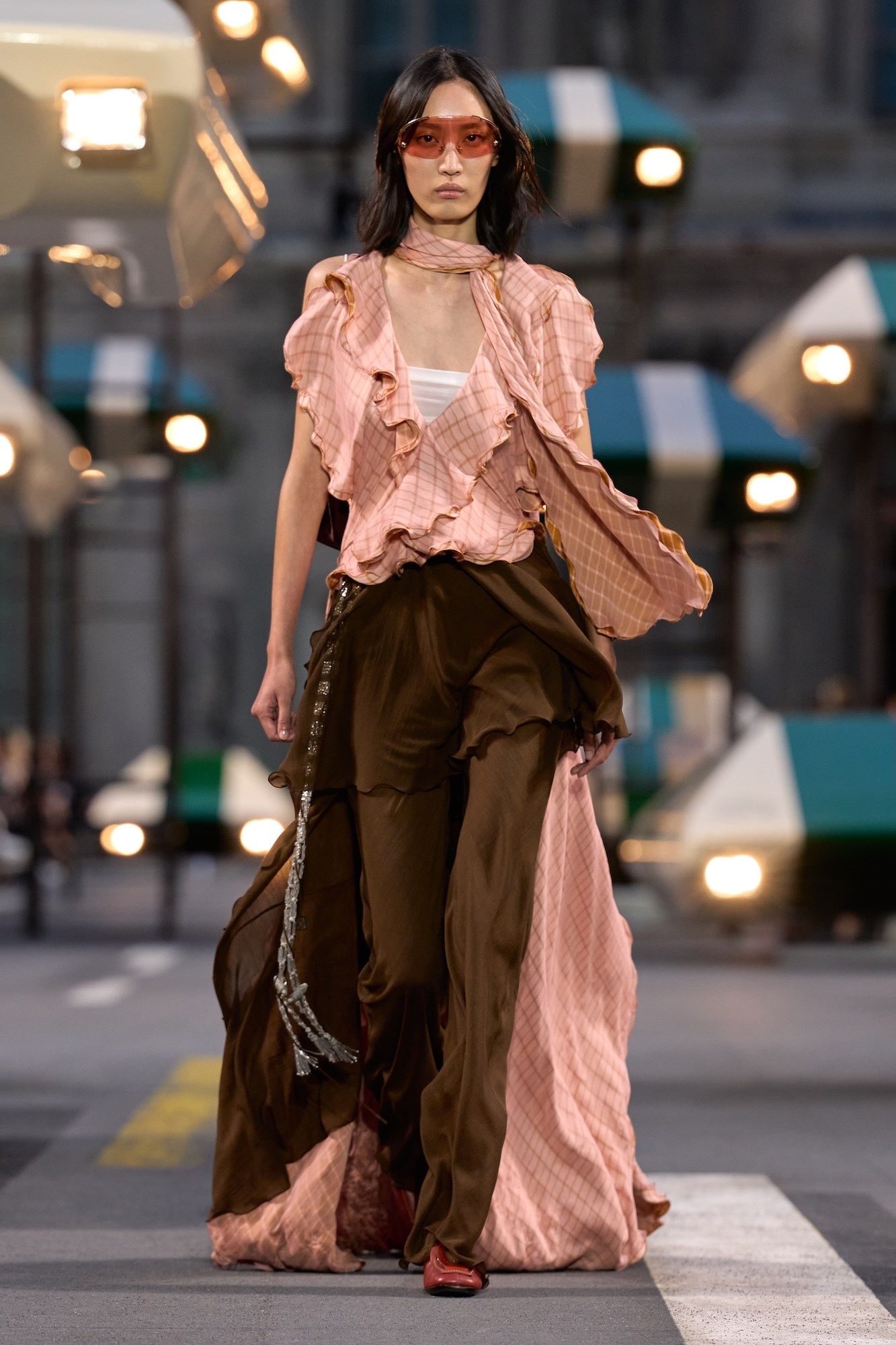

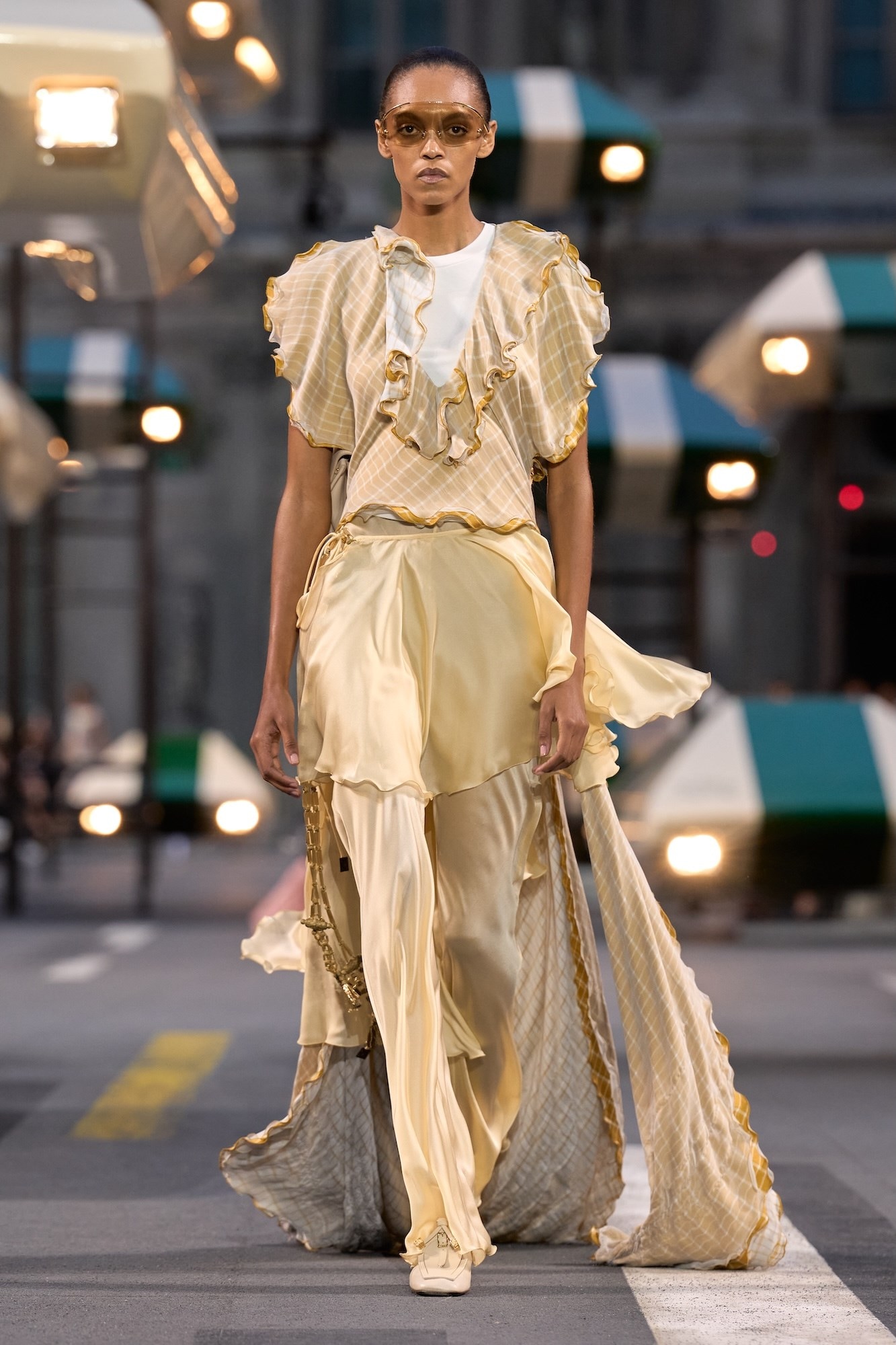
The ergonomic came in the way the clothes clung to the body, perpetually moving – wind billowed, lightly, buffeting cloth about the forms. Plenty were bias-cut. Ingenious and slippery and tricky to control. Ghesquière even compared the clothes to swimwear – although I doubt anyone would take a dip in a Vuitton slipstream of chiffon. But what he meant was clothes like a “second skin”, although far removed from anything conventionally body-conscious or sportswear or streamlined, or any of those fashion conventions. Even the heaviest weighed less than a T-shirt. The only thing anchoring their structureless forms down, it seemed, were the Vuitton handbags – curved easily to sit against the body – and shoes that Ghesquière described as grounding, especially the flat brogues that opened the show.
It was a definitive closing statement – the last show, on the last day, of a season that, running off the back of one of the hottest European summers on record, has been utterly and understandably obsessed with lightening loads. Ghesquière poetically recalled the idea of a feather, floating through an urban cityscape, as the feeling he wanted to evoke. There was also a decided sense of ease and wearability – if last season was an epic trek through a future folklore, this felt like Ghesquière coming back down to earth, engaging with the demands of a modern wardrobe, and the needs of modern people. These felt like clothes decidedly engineered for the here-and-now – for our own treks, through everyday life. In short: lighten up.