
There’s a clear split in the current sell-off, and it may have put some stocks on sale.
By Adam Levy –
Key Points
-
The major indexes all briefly fell into a correction in November.
-
The sell-off shows a clear split between value stocks and growth stocks.
-
The forward P/E ratio is a signal that some stocks could be on sale right now.
Investors have experienced a significant bout of volatility in recent weeks, as the artificial intelligence stocks that have led the market higher over the past four-plus years face potential headwinds. The S&P 500 (^GSPC +1.60%), Nasdaq Composite (^IXIC +2.31%), and Dow Jones Industrial Average (^DJI +1.18%) all temporarily fell into correction territory in November (the Nasdaq is still there), declining at least 10% from their all-time highs.
That’s not uncommon. The major indexes experience a correction about once every other year. But something extremely uncommon happened when the market recently drove prices down: growth stocks were suddenly less expensive, from a valuation standpoint, than value stocks. The only other time that’s happened this century is amid the Great Recession in 2008-09.
History is clear about what happens next.
Image source: Getty Images.
Is the market putting growth stocks on sale?
The S&P 500 peaked on Oct. 6 this year and currently sits about 6.7% below its all-time high as of this writing. But the sell-off reveals a stark split between value and growth stocks. The S&P 500 Growth index, which includes 150 companies exhibiting more growth-like characteristics than value characteristics, has dropped 15%. Meanwhile, the S&P 500 Value index is up 1% in the same period.
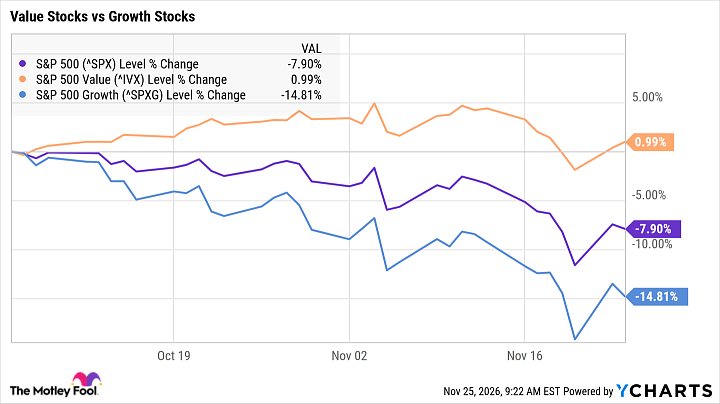
As a result, the typically expensive growth stocks in the S&P 500 Growth index appear to be on sale. The forward P/E ratio for the index fell below 17. More impressively, the P/E ratio fell below the forward P/E of the value index.
Growth stocks typically trade at higher valuations, and investors are happy to pay more for every dollar of earnings. That’s because investors are paying for the business’s future growth. Value stocks trade at a low P/E ratio, offering steadier and more predictable returns for investors. But that’s not always the case.
Investors may rotate heavily into value stocks amid heightened uncertainty, driving up the valuations of those value stocks while the valuations of the growth stocks they’re selling fall. The last time that happened was in 2008, amid the height of the Great Recession.
If you bought growth stocks at the point when the S&P 500 Growth index valuation fell below that of the value index, you suffered a smaller drawdown than value investors through March of 2009. That said, growth stocks recovered more slowly than value stocks from the market bottom and underperformed for a couple of years.
Here’s where details matter. The 2008 sell-off was driven by the financial sector, and financial stocks typically fall into the value stock bucket. As those companies found their footing, they recovered more quickly. Overall, growth investors were likely very happy with the relative performance of their stocks amid the recovery from the great financial crisis.
Should you buy growth stocks right now?
The current sell-off is being driven by increased uncertainty about AI companies. Financing and regulatory concerns could pose challenges to the continued build-out of new data centers fueling the AI industry and many companies tied to it. That’s resulted in a sell-off in AI stocks, which is why the growth index has fallen so much while the value index, which has relatively little exposure to the AI industry, has seen its stock prices remain relatively stable.
At the same time, analysts’ expectations for many growth stocks over the next year haven’t changed much. If anything, their earnings expectations have increased due to strong third-quarter results and positive fourth-quarter outlooks. The political and financial challenges might not show any impact until 2028. That could make the current P/E ratio for many growth stocks look more attractive than it actually is if they’re headed for a significant slowdown in earnings starting more than a year from now.
Keep in mind, however, that growth stocks deserve a higher P/E ratio than value stocks. So, even with a slowdown in earnings growth in the coming years, growth stocks could be attractive at the current P/E ratio. Some companies could face greater challenges in continuing their growth, and it’s best to analyze each company or market segment on a case-by-case basis. The S&P 500 Growth index’s valuation dipping below that of the S&P 500 Value index signals that many great growth stocks are on sale right now, while some growth stocks are down for good reason.
Just as not every financial stock staged a huge recovery from the great financial crisis, not every AI stock will recover its recent highs and climb even higher. Identifying those with the best chances of doing so could lead to years of excellent returns for investors putting cash to work right now.
Where to invest $1,000 right now
When our analyst team has a stock tip, it can pay to listen. After all, Stock Advisor’s total average return is 792%* — a market-crushing outperformance compared to 202% for the S&P 500.
They just revealed what they believe are the 10 best stocks for investors to buy right now, available when you join Stock Advisor.
*Stock Advisor returns as of November 29, 2026.