Norwich, UK
Local communities depend on churches more than people think, a report from the Gather Movement in the UK shows.
The findings of Heart of the Neighbourhood: How the Church is Providing Essential Services in Every Part of the Country – based on research from a unique mapping project exploring how churches provide essential services – was presented at the Faith and Society All-Party Parliamentary Group at the Houses of Parliament in London last month.

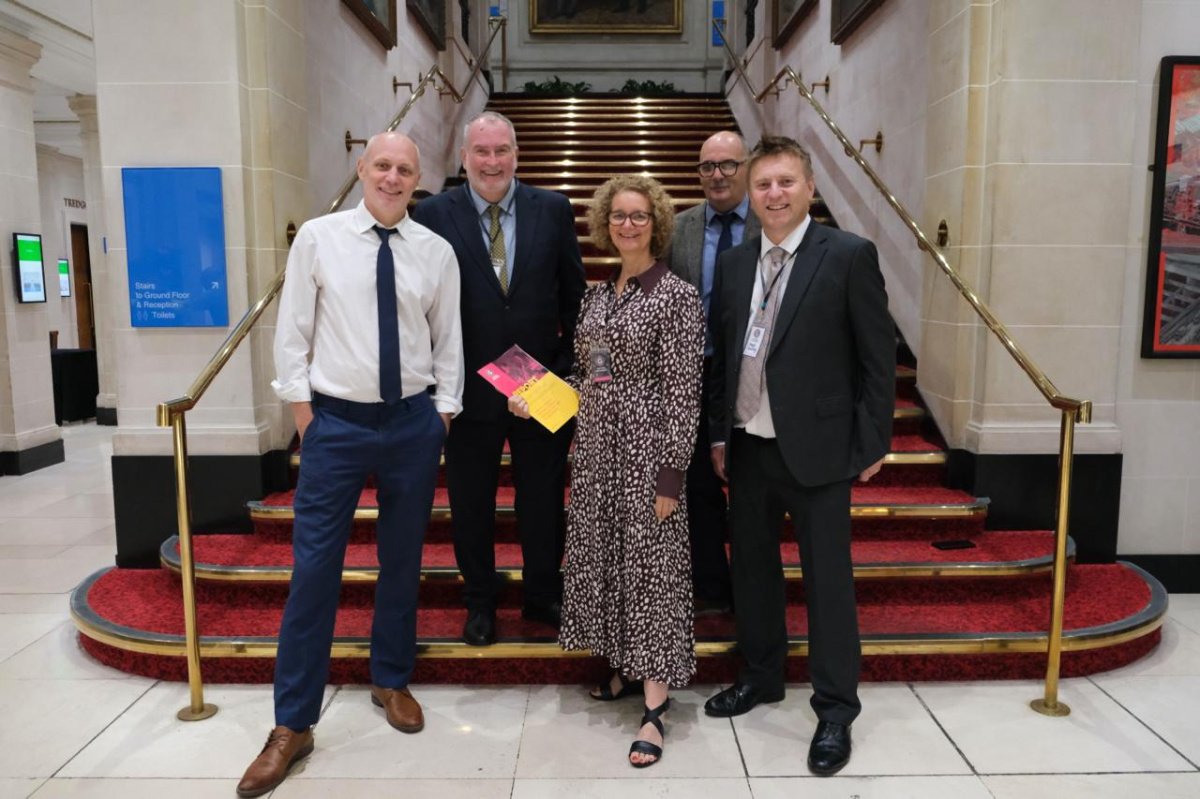
Mark Cowling (far right) and the Gather Movement team. PICTURE: Courtesy of Mark Cowling
Mark Cowling, of the Gather Movement, said the reaction “was overwhelmingly positive, [with people] seeing it as a significant opportunity to demonstrate the scale and contribution of Christian social action across the country.”
”It gives the mapping project greater national credibility and momentum,” he added. “The APPG’s interest means that what is being discovered locally has the potential to inform conversations between churches, local authorities, public services and the wider voluntary sector. It also strengthens the case for churches to participate in the mapping. National Christian media, BBC regional news and radio coverage are already helping to raise awareness and encourage churches and local authorities to get involved.”
The Gather Movement is a faith-based charity working in over 150 urban areas involving more than 8,000 churches and charities, alongside other partners, to help transform local communities. Since 2022, it has been actively involved in a mapping project designed to identify just how civic and faith leaders can work together more effectively to improve local community wellbeing. All denominations were involved including the Church of England, Roman Catholic, URC, Pentecostal, Methodists, Orthodox and the Salvation Army.
In 2024, a pilot mapping scheme began in Oldham exploring the way churches were collaborating with local government, health and voluntary services to provide help to those in need. Since then, the mapping project has been steadily rolled out nationwide. By September, 2026, church activities had been mapped or were in the process of mapping across 41 local authority areas enabling researchers to identify exactly what is happening within those communities.
We rely on our readers to fund Sight’s work – become a financial supporter today!
The report indicates churches are delivering material, emotional and preventative support on a national scale yet are an under-acknowledged part of the social support ecosystem. Often these services are provided regardless of faith and that around half of the services support children and families.
“The findings confirmed what Gather had long suspected, but the scale of what was discovered was greater than expected,” said Cowling. “The pandemic demonstrated how quickly faith communities could respond to local need. However, the mapping has revealed just how extensive that contribution is. For example, the finding that around 50 per cent of families with young children are reached through parent and toddler groups illustrates a level of community reach that was difficult to see without the mapping.
Cowling said the report also showed churches appear to be playing a substantial role in areas such as food security and mental-health support.
“So the report didn’t simply validate the Gather Movement’s assumptions, it provides evidence of a much larger and more extensive infrastructure of Christian social action than had previously been visible.”
Mapping is now underway within a further 45 local authorities with the intention of expanding into the majority of the UK’s 400 local authorities over the next three years.
York is among those who have taken part. Alison Dawson, leader of church unity movement One Voice York and member at St Michael Le Belfry Church, said One Voice York had delivered the mapping project across 97 churches and faith-based charities in York, as part of a long-term project focused on tackling poverty to ensure that “no one is left behind”.
“The project has opened doors to conversations with civic leaders, providing valuable insights into the needs and strengths of communities across the city, while helping to build relationships with key stakeholders. It is also enabling churches to become better connected and more joined-up in their local social action, strengthening collaboration and helping to identify where churches can work together more effectively to support their communities.”
Cowling, meanwhile, believes that the mapping process will make church involvement more visible and more co-ordinated, more strategically connected with other organisations while retaining the local initiative making faith-based social action effective.
“Mapping is just the start. Our report recommends investing in church and faith based enablers who support the delivery of services across the church and/or faith network. The biggest change is likely to be a move from seeing churches as individual organisations doing individual projects towards recognising them as part of a much larger community infrastructure.
“Churches can see their activity forms part of something much bigger. The example of York Church Network illustrates the ambition particularly well: churches are beginning to ask not simply ‘What can my church do?’ but ‘What could we achieve together as a network?’ The question of whether York could become a city where nobody is left behind is much bigger than any one church could address.”
In response to the report, the Rt Rev Alastair Cutting, the Church of England’s Bishop of Woolwich, said churches and faith groups “have always been a lattice and framework providing welfare resources in civil society, through the provision of education, health, food and financial security – alongside all the additional wellbeing benefits that being part of a spiritual community brings”.
“This Gather Movement report quantifies many of the ways faith groups make key partners working with statutory bodies and others in providing for the welfare of the city and the country in the UK.”