A global investigation into football governance has revealed that formal, accessible coaching documents addressing heading technique are absent across the vast majority of national member associations affiliated with FIFA. Heading is formally defined in football as executing a deliberate movement to redirect the trajectory of a ball using the head, resulting in either a header with head-to-ball contact or an attempted header without contact, across contested duels or uncontested plays. Despite the technical prominence of heading across professional and amateur competition, an audit of all 211 FIFA-affiliated member associations identified only 13 national bodies that possessed available coaching materials incorporating heading instruction. The qualitative document analysis, which applied a systematic framework to survey data, official website audits, and web-browser searches conducted between December 2024 and June 2025, highlights a pronounced worldwide disparity between the mechanical demands of heading during match play and the formal guidance provided to grass-roots and developmental coaches.
Match analysis indicates that players head the ball between one and nine times per match, with header frequency increasing as players advance in age, while youth players perform fewer headers than adults. Header incidence also varies substantially by tactical position, with central outfield players completing more headers than goalkeepers or wingers. Across youth and professional matches combined, players collectively record between 70 and 110 headers per match, representing a mean of three to five headers per player per match, while headed goals account for 18 to 22 percent of all goals scored in recent FIFA World Cups. Executing a header requires complex timing, spatial evaluation, and multi-segment kinetic coordination. When a ball travels through the air, a player must judge spatial positioning relative to teammates, opponents, and ball velocity. A standing header initiates with trunk hyperextension, followed sequentially by hip and trunk flexion, where greater trunk flexion produces higher impact forces. Jumping headers demand vertical jumps timed so that peak jump height coincides with ball impact, while neck strength and neuromuscular control regulate head acceleration upon impact.
The debate surrounding heading instruction balances potential brain health concerns against the necessity of technical proficiency. Concussions account for 4 to 22 percent of all football injuries, occurring at an incidence rate of 0.5 to 1.7 per 1000 playing hours, with injuries occurring more frequently when players are unaware of oncoming contact. Players are especially susceptible to head and brain injuries, including lacerations, contusions, and concussions, during player-to-player collisions while contesting aerial duels. Emerging evidence suggests that heading technique proficiency—the capacity to execute headers using optimal movement patterns, timing, body positioning, and neuromuscular control—may reduce head injury risk by minimizing player-to-head impacts and dampening acceleration. Effective protective positioning includes engaging the upper body to guard against an opponent’s elbow and aligning the head to maximize neck muscle activation. However, evidence linking header exposure directly to long-term neurological outcomes remains inconclusive, leading different governing bodies to adopt conflicting strategies, ranging from strict youth heading restrictions by US Soccer to technique-driven curricula established by the German Football Association.
To evaluate the worldwide availability of structured heading resources, researchers at the University of Sydney conducted a qualitative document analysis using the READ approach, an established framework encompassing the preparation of materials, data extraction, data analysis, and the distillation of findings. Data collection utilized three complementary channels to capture coaching curricula, course syllabi, and safety guidelines. First, medical and coaching representatives across all 211 FIFA member associations were invited to complete an online Qualtrics survey, with reminder emails distributed four weeks apart. Second, researchers audited 188 functional member association websites, manually navigating coaching, education, and development portals alongside targeted keyword queries translated via Google Translate for non-English sites. Third, supplementary web-browser searches combined national association names with heading and curriculum keywords. Inclusion criteria required documents to be published or endorsed by a recognized FIFA member association, digitally accessible without paywalls, and explicitly inclusive of heading instruction.
The multi-pronged search protocol identified a total of 19 member associations with publicly available player coaching materials, of which only 13 associations incorporated content addressing heading. From the online survey sent to 211 national bodies, 91 total responses were submitted, representing 71 unique member associations after removing duplicate submissions. Among these 71 associations, 13 respondents (18.3 percent) reported having heading coaching material, though only seven provided supporting documentation despite fortnightly email follow-ups. Thirty associations (42.3 percent) stated they had no heading materials, while 28 associations (39.4 percent) were unsure of their association’s curricular holdings. Of the 30 associations without materials, 16 indicated active plans to develop future heading guidelines. Website audits of 188 accessible portals yielded five associations with coaching documents, while browser searches identified six associations. Continental representation among the 13 included associations was heavily skewed toward UEFA with seven associations (53.8 percent), followed by the Asian Football Confederation with three (23.1 percent), CONCACAF with two (15.4 percent), and CAF with one (7.7 percent), while CONMEBOL and OFC yielded zero publicly accessible heading documents.
A primary finding across the analyzed curricula was the recommendation to modify ball characteristics during developmental training sessions. Nine of the 13 member associations recommended utilizing soft, lightweight, or lower-pressure balls during heading practice to reduce impact forces. Japan, Germany, and Norway detailed progressive pathways adjusting ball size and mass across chronological age brackets. The German Football Association recommended ultra-light size 3 balls weighing 290 grams for children aged under 7 to under 11, transitioning to size 4 balls weighing 350 grams or ultra-light 290-gram balls for under 11 to under 13 groups, before introducing regulation size 5 balls weighing 450 grams alongside lighter 350-gram training balls at under 15. The Norwegian Football Association advised lightweight size 4 balls weighing 290 to 320 grams for under 6 to under 9 players, followed by balls weighing 350 to 390 grams for under 10 to under 14 groups. Associations such as England, Wales, Australia, Malta, and Singapore similarly endorsed sponge, foam, or under-inflated balls, with the Football Association of Wales specifying monitoring ball pressures between 8.5 and 16 pounds per square inch.
Guidance regarding the chronological age for introducing heading training was incorporated by 12 of the 13 member associations, with Montserrat being the sole exception. The majority of associations recommended formal heading introduction between the under 12 and under 14 age divisions, including under 12 introductions by England, Wales, Singapore, and US Soccer, and under 13 introductions by Scotland and Eswatini. Earlier introductory exposure was permitted in Germany at under 7, Japan at under 9, and Norway at under 11, contingent on the strict deployment of lightweight, modified, or age-appropriate balls. Football Australia recommended an entry age of under 14, while noting that super light balls could be utilized if introduced earlier at under 13. However, the qualitative analysis highlighted substantial divergence in the precision of language across documents; whereas certain associations defined exact ball weights and inflation pressures, others provided vague references to soft balls, leaving execution and safety interpretations entirely to local volunteer coaches.
Direct technical instruction concerning body mechanics was documented in six member association publications. These guidelines consistently emphasized striking the ball with the forehead, maintaining continuous visual tracking of the ball, and contracting upper body and neck musculature. Making frontal forehead contact is supported by biomechanical research showing that striking the ball with the front of the head produces lower rotational velocities than impacts to other cranial locations. Japan, Montserrat, Wales, Eswatini, Germany, and England supplied technical tips, with Eswatini advising players to lock neck muscles, keep eyes open, and maintain a closed mouth upon contact. Wales similarly advised keeping the mouth closed, an instruction that may indirectly facilitate neck muscle activation through jaw clenching. England emphasized judging body positioning relative to ball flight, jumping to attack the ball at peak height, and coordinating head contact to direct trajectory. Japan, Germany, and England were the only three associations that integrated multi-component guidance linking eye tracking with whole-body stabilization.
Targeted neck exercises were incorporated into heading documents by only four member associations: Malta, Japan, Germany, and Finland. Biomechanical literature indicates that higher neck strength correlates with attenuated head acceleration during impact, although evidence demonstrating that neck exercises prevent sports-related concussions remains uncertain. Isometric neck conditioning alone has not been shown to reduce head acceleration upon ball impact, whereas neuromuscular exercises focusing on dynamic control show more promising results. The German Football Association specified three neuromuscular control exercises: static flexion, static rotation, and dynamic rotation across two progression levels, prescribed at one set of 30 seconds. The Finnish Football Association detailed nine strengthening exercises incorporating age-based isometric and sport-specific movements, prescribing five to 15 repetitions across one to three sets. The Malta Football Association outlined isometric exercises alongside neck flexion and extension protocols of two sets of 20 repetitions, while the Japan Football Association incorporated neck stretching and isometric routines into general physical conditioning frameworks.
Recommendations detailing heading practice drills and repetition thresholds were published by four member associations: Japan, Scotland, Germany, and England. These governing bodies consistently emphasized progressive skill development, low repetition volumes, and thrown rather than kicked ball deliveries. Most guidelines mandated unopposed, short-distance headers during introductory stages, delaying contested aerial duels until under 16 or under 18 categories. The Scottish Football Association set limits of five headers per session using self-served or short-distance serves for under 12 players, progressing to short-distance thrown deliveries without opposition at under 13, and increasing the cap to 10 headers per session for under 14 and older players. England Football recommended one session per week with a maximum of five unopposed headers for under 12 and under 13 players, advancing to 10 headers per session at under 14 through under 16, and introducing contested duels and position-specific movements at under 18. Germany advised thrown deliveries and low session volumes without aerial duels through under 15, integrating crosses and tactical headers at under 17 and under 19.
Spatial awareness and the coordination of the body in three-dimensional space represented a major instructional void across international guidelines, with the Japan Football Association being the only governing body to provide explicit developmental drills for this domain. Spatial coordination is recognized as essential for calculating trajectory and adjusting body orientation prior to aerial duels. Japan’s curriculum detailed progressive developmental stages: under 6 players practice catching aerial balls and manipulating balloons or newspapers using the forehead; under 7 and under 8 players engage in game-based catching, pendulum ball drills, and forehead bouncing; and under 9 and older players advance to tracking ball trajectory, participating in small-sided aerial duels, and utilizing ball nets for head tennis. This developmental sequence shares structural similarities with novel preconditioning protocols, such as HeaderPrep, which employ multi-directional catching, throwing, and jumping exercises to enhance younger players’ confidence and motor skills prior to formal heading exposure.
The study’s authors identified several methodological limitations that qualify the reported findings. Document analysis was restricted to self-reported survey responses and publicly accessible digital materials, introducing potential response and availability biases. Proprietary or internal curricula housed behind password-protected association portals or embedded within fee-based confederation coaching licenses, such as the UEFA A, B, or C licensing courses, were inaccessible to the research team. Furthermore, digital access barriers affected data collection, as 23 member association websites were non-functional or obstructed by firewalls. Language translation limitations may also have hindered document discovery; despite utilizing Google Translate for non-English queries, no eligible documents were identified from major footballing nations such as Brazil, France, or Spain. Finally, initial document coding was conducted by a single author, though consistency was maintained through a predefined analytical framework and subsequent author group validation.
Ultimately, the scarcity of heading curricula across 211 FIFA member associations underscores a substantial gap between technical football requirements and structured coach education. Because most players begin heading between ages 10 and 12, often guided by volunteer coaches with limited training, the lack of standardized guidance leaves developmental athletes exposed to match heading without prior technical preparation in controlled environments. While 16 surveyed associations without materials expressed an intention to develop curricula, the existing literature lacks consensus regarding safe weekly header exposure thresholds or optimal exercise dosages across genders. The study authors concluded that future research must prioritize the co-design of standardized, evidence-based heading frameworks involving health professionals, researchers, coaches, and players, accompanied by rigorous evaluation plans to determine whether technical training can systematically reduce head injury risk across global football.
Subject of Research: Prevalence and content of heading coaching documents across FIFA member associations
Article Title: Mapping the existence and content of heading coaching documents across FIFA members associations
Article References: Wright, W., Peek, A., Sesa, G., Teahan, R., & Peek, K. (2026). Mapping the existence and content of heading coaching documents across FIFA members associations. JSAMS Plus, 8, Article 100149. https://doi.org/10.1016/j.jsampl.2026.100149
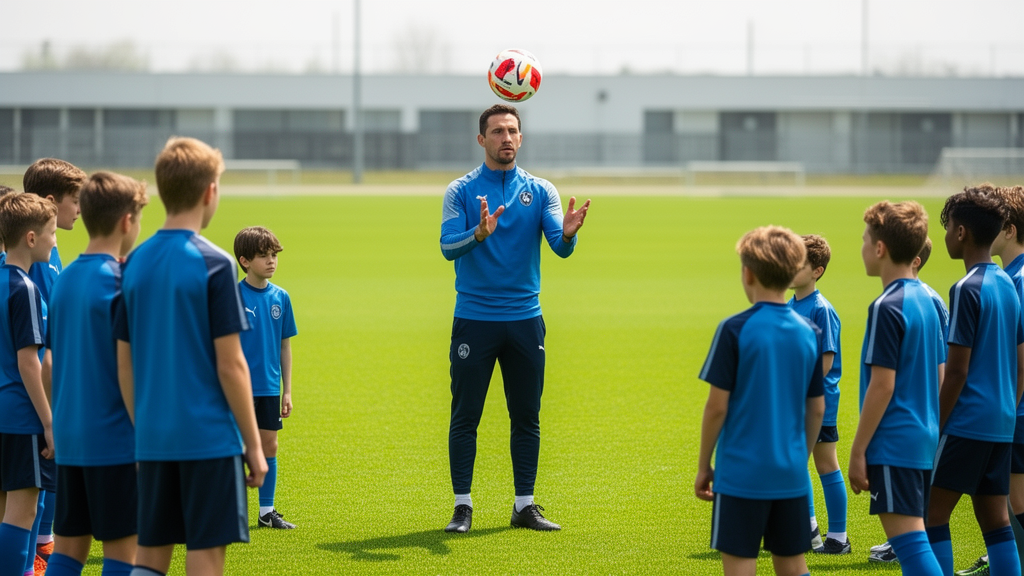
Image Credits: AI Generated
DOI: 10.1016/j.jsampl.2026.100149
Keywords: football heading, FIFA member associations, coaching curricula, sports injury prevention, concussion risk, heading technique, qualitative document analysis, youth football, ball modifications, neck neuromuscular training, aerial duels, player safety, sports biomechanics, coach education, head acceleration, sports medicine