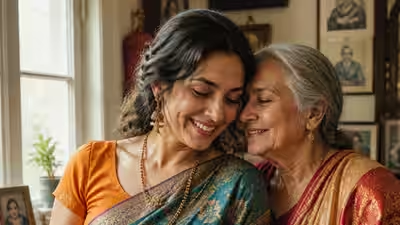
Memories of our mothers draping sarees go back to us watching her adore the silhouette on herself, while we watched as little children standing and watching her tuck each pleat carefully till it sat perfectly.And today, when we open an old cupboard and a soft cotton catches our eyes from a summer long ago, it brings back the same nostalgia.A silk saved for weddings, a border that looks exactly like it did on your mother’s shoulder, all remind us of hiding behind the pallu as a child, or holding on to it in a crowded market.So, when a woman pulls out one of those old sarees and chooses to wear it, it can look like a simple style choice. Sometimes it is. But sometimes there is a lot more folded into that fabric than anyone can see from the outside.This brings us to the question: why does something so ordinary feel so powerful, and how a saree is not just a piece of cloth but actually emotion-laden- six yards of beauty.Here is what that psychology can tell us about a woman, her mother’s saree, and the childhood she carries with her.
Why some women love wearing their mother’s old sarees
According to researchers at the University of Southampton, nostalgia is a sentimental longing for one’s past, and it helps build self-continuity, a sense of connection between who we were and who we are now. In a 2024 paper, researchers also say that nostalgia is directed toward specific objects, and a mother’s saree is that basket of memories.
Smell can bring memories back
A Southampton study on scent found that scent-evoked nostalgia came with more positive emotions than other kinds of memories. Writing on grief makes a similar point. A loved one’s clothing often keeps their smell, which can trigger specific memories of that person; similarly, a saree kept in a cupboard for years may carry a trace of that familiar scent.
Clothes connect us to our mothers
A research paper in the White Rose repository reviewed bereavement writing and found that clothing can help people decide and share memories of someone, or identify with them more closely.It also says that a baby’s sense of mother and self is shaped partly through the clothing both of them wear. So, the pallu you clung to as a child was part of how your first bond felt, and when grown up, many women wear their mother’s sarees simply to feel close to her.
Attached memories add value and make the pieces last longer
A paper published in NIFT’s e-journal, Product Attachment and Sustainability: Two Facets of the Same Coin by Sareekah Agarwaal and Ruby Kashyap Sood, studied whether owners feel emotional connections to treasured textiles handed down in families, and concluded that attached memories and emotions can help such pieces last longer.It mentions a mother’s sari among objects associated with identity. A study of urban Indian women, described by Fibre2Fashion, found that memories evoked by sarees, and sarees received from mothers and grandmothers, carried emotional value. One participant called the saree “a memory box.” Another study, from Iowa State University’s ITAA, interviewed ten mother-daughter pairs about Banarasi sarees and found themes of sentimental value and emotional attachment.So, for many women, wearing a mother’s old saree is a quiet way of staying connected to them and the moments that make them who they are today.