London/New York
Wall Street staged a dramatic comeback Wednesday, clawing back steep morning losses as investors looked for safety in non-AI corners of the market.
The tech-focused Nasdaq Composite closed lower by 0.62%, paring significant losses after falling as much as 4.6% shortly after the opening bell. The index fell for the second day in a row, resuming declines after a rebound Monday.
As AI-related stocks fell, investors rushed into bonds and scooped up shares in other areas of the stock market, including materials, real estate and energy.
After falling 1,100 points after the opening bell, the Dow erased those losses and gained 164 points, or 0.33%. The S&P 500 closed lower by just 0.25%, paring earlier losses, buoyed by gains in non-tech sectors.
“Investors are just selling tech and fleeing for safety,” said Jed Ellerbroek, portfolio manager at Argent Capital Management.
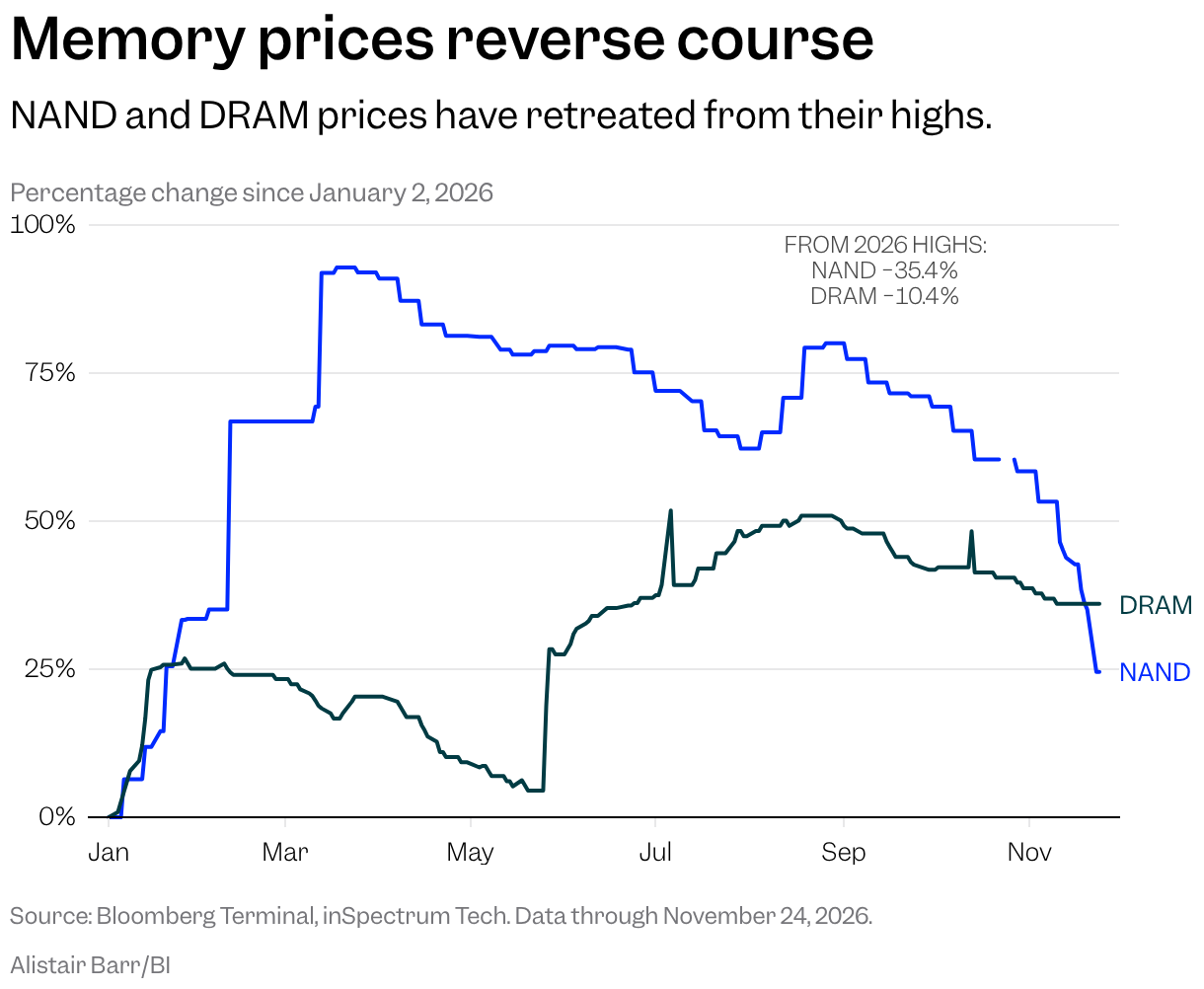
Nvidia shares slid 3.9%. Memory-chipmakers Sandisk and Micron Technology fell 5.6% and 4.5%, respectively.
Anthropic dropped almost 10% before paring losses and ending the day up by just over 1% — an outlier among AI stocks Wednesday. The AI lab on Tuesday closed below its IPO price of $83 a share for the first time, and post-debut volatility is expected.

Traders for weeks now have been fretting about the AI boom and whether the vast amounts of money being spent on its buildout will pay off for companies down the line. Those fears were briefly stymied Monday, when Nvidia’s board reinstated Jensen Huang as CEO, sending both the company’s shares and the broader market soaring.
That relief, however, quickly faded Tuesday — with losses in tech stocks persisting Wednesday in volatile trading. Adding to the pressure were fresh data showing the US economy is still running hot — prompting traders to ramp up bets on interest rate hikes — alongside new tariff proposals from President Donald Trump that have added to geopolitical uncertainty.
AI nerves colliding with expectations for higher interest rates rattled markets early Wednesday. “You add the two together, and you get violent moves,” said Jamie Cox, managing partner at Harris Financial Group.
Inflation data released Wednesday showed a core measure of inflation that excludes food and energy prices rose 3.3% year-over-year in October, well above the central bank’s target of 2%. Data also showed that the US economy grew much faster than anticipated last quarter, bolstering arguments for the Fed to raise rates.
Traders are pricing in a 98% chance that the Fed raises interest rates by a quarter point at its meeting in December, according to CME FedWatch, a real-time forecasting tool.
“A December hike was already widely expected, but the bigger question now is whether the Fed sees it as enough, or signals that more tightening may be needed,” Bret Kenwell, US investment strategist at eToro, wrote in a note.
Investors are already nervous about the cost of the AI buildout, especially for companies taking on debt. Higher Fed interest rates could exacerbate those costs, dimming the outlook for AI-related stocks.
Data on Wednesday showed economic growth is booming, in part due to the AI buildout. Traders are also analyzing the risk that higher rates could hurt the AI boom which could inadvertently hurt the economy.
The Nasdaq 100, an index including the largest tech companies, briefly fell into bear market territory on Wednesday — down 20% from its peak in early October — before paring losses.

Despite the bets on the Fed raising rates, US Treasury yields were sharply lower Wednesday as investors nervous about the AI trade rushed into bonds. The 10-year yield declined to around 4.86%. Yields fall when bond prices rise.
Wall Street’s fear gauge, the VIX, surged as high as 35 points before paring some gains. A level above 30 is associated with significant volatility.
“There’s a lot of volatility, and there’s a lot of fear,” said Thomas Martin, senior portfolio manager at Globalt Investments. “It’s fear more so than fundamentals.”
Investors turned to bonds as a haven, while other assets offered less protection. Gold fell below $3,500 a troy ounce and hit its lowest level in over a year before ending the day near flat. Bitcoin briefly fell below $58,000, trading near its lowest level of President Donald Trump’s second term.
Stocks across Asia and Europe were, too, mostly in the red as anxiety about AI rippled through global markets. South Korea’s Kospi, dominated by memory chip giants SK Hynix and Samsung, led the losses for major indexes, closing down 6.2%. The Kospi has plunged 48% since a peak in June.
Europe’s benchmark Stoxx 600 index lost a little more than 1%.
Nvidia shares soared more than 30% Monday to score their third-best day on record after the company announced it had reinstated Huang as CEO and president, effective immediately.

Huang was brought back just 11 days after he stepped down following reports of multiple extramarital affairs, including one with a woman who US officials feared could be working with Chinese intelligence and another with a direct subordinate.
The announcement turbocharged an already buoyant day for stocks — but the upward swing didn’t last long. Investors have since returned to dumping tech stocks, fueled by concerns over the durability of the AI frenzy.
“We are not out of the woods with the downside risk from the AI trade,” Chris Brigati, chief investment officer at SWBC, wrote in a note. “Investors are still nervous and none of the fundamental questions about AI’s return on investment from the heavy capex spending have been resolved even with the unusual return of Jensen as CEO of Nvidia.”
Anthropic’s blockbuster IPO last week did little to quell investor concerns about potential regulation and a slowdown in AI investment, particularly for data centers.