In late October, while visiting a park in the state of Rio de Janeiro in Brazil, she cut a few wild banana leaves to bring home and wrap banh tet (Vietnamese sticky rice cake), one of her husband’s favorite Vietnamese dishes.
To help him and his parents like Vietnamese food, the 36-year-old from southern Dong Nai province had earlier spent two years overcoming numerous challenges and ingredient shortages.
She had met her husband, a doctor, when he came to HCMC on a vacation. They dated and got married in 2019, after which she moved to Rio de Janeiro with him.
At first, she struggled to adapt to the local cuisine. Brazilian meals primarily consist of loose, long-grain rice served with black beans stewed and salted meat, and consist of very few brothy soups.
Thuy craved Vietnamese noodles and pickled vegetables, but it was very difficult to find Vietnamese ingredients.
There were only two stores in Rio de Janeiro selling Asian ingredients such as fish sauce, tofu, fermented tofu, and rice paper, and the store closest to her house was a 45-minute drive away.
By late 2020, when she was pregnant with her first child, Natalia, her craving for Vietnamese dishes had grown even stronger, and she began thinking about how to cook some of them using locally available ingredients.
She thinly sliced cucumbers and carrots, and tossed them with salt, garlic, and chili to make quick pickles. She also bought mung beans and sprouted them to get fresh bean sprouts.
Noticing that locals ate a lot of fish and local markets sold okra, pineapple, and tomatoes, she used these ingredients to make canh chua ca (Vietnamese sour fish soup). Her parents-in-law were surprised the first time they saw a bowl of fish and vegetable soup, as Brazilians are used to eating grilled fish or pan-seared fillets.
However, after taking a spoonful of the broth, they were amazed at how the mild sourness from the pineapple and tomatoes completely eliminated any fishy odor. “After my daughter was born, I wanted her and the whole family to get to know and love Vietnamese food,” Thuy says.
With that goal in mind, she decided to transform her in-laws’ palates.
 |
|
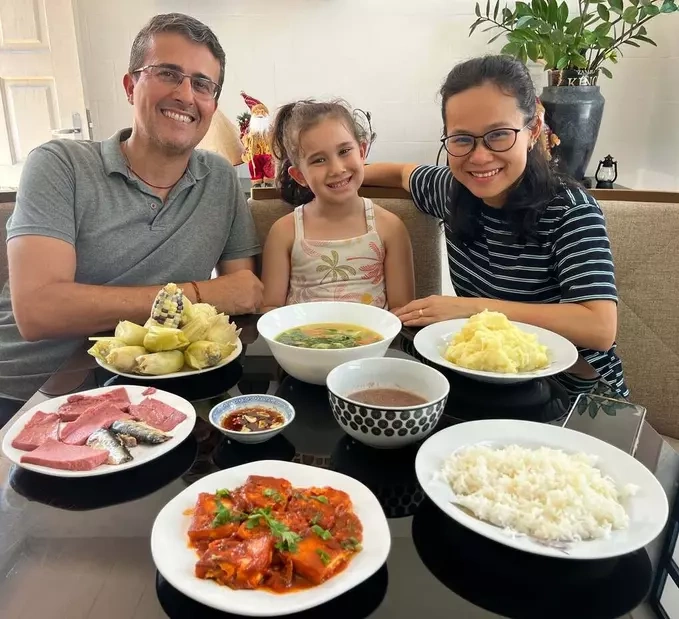
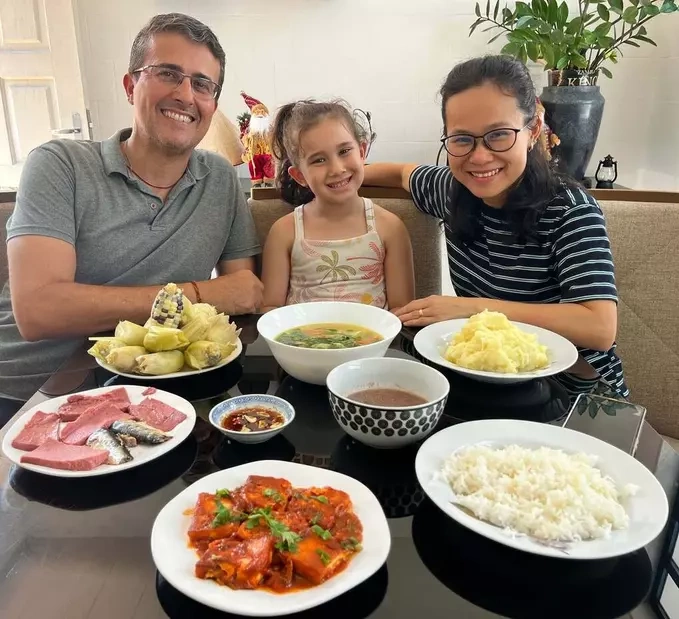
Ngoc Thuy’s family with a Vietnamese meal of fried tofu in tomato sauce, squash soup, mashed potatoes, and grilled fish in October 2026. Photo courtesy of Thuy |
Thuy’s husband has been a vegetarian for many years, but vegetarian diets in Brazil can be quite monotonous as local food usually features fatty meats.
Even traditional stewed black beans are typically simmered with salted meat, leaving vegetarians with few choices beyond plain white rice, boiled cassava, or lettuce salads.
Thuy bought tofu, mushrooms, rice vermicelli, and rice paper from the Asian stores, and combined them with tomatoes and carrots from local markets to create vegetarian dishes.
She made fried tofu in tomato sauce, mushrooms braised in pepper sauce, stir-fried rice vermicelli with vegetables, and vegetarian summer rolls served with peanut-hoisin dipping sauce.
While hiking in the mountains, she noticed clumps of wild bamboo shoots, which locals do not eat since they regard them as just another forest plant.
Thuy dug up the shoots, peeled them, boiled them multiple times to remove the bitterness, and stir-fried them with garlic or cooked them in soup.
When Thuy’s husband saw her bring home wild bamboo shoots from the forest and season them with garlic and chili, he hesitated at first.
However, after trying a bite of the stir-fry, he was surprised by its crisp texture and delicate sweetness. He finished the entire plate in one sitting and immediately fell in love with the dish.
In Brazil, jackfruits grow abundantly along roadsides and in parks, but locals don’t eat them and simply let ripe jackfruits fall to the ground.
Thuy once picked an unripe jackfruit, trimmed off the peel full of sap, boiled it until tender, and used half to make shredded jackfruit salad and braised the other half in black pepper sauce. Because Vietnamese herbs were hard to find, she substituted peppermint for Vietnamese mint.
Her husband took a bite and was amazed by the chewy, nutty texture of the shredded jackfruit that was infused with garlic and chili. “The dish feels light on the stomach and isn’t heavy or greasy,” he says.
He asks his wife to cook Vietnamese food three times every week now.
Thuy’s parents-in-law live on their own and occasionally visit their son’s family. In the beginning, the difference in eating habits would lead to many awkward situations.
Once, while she was braising pork ribs, the pungent smell of fish sauce filled the kitchen, and it alarmed her in-laws so much that they flung open the windows and took refuge in the living room.
When she craved pickled mustard greens during her pregnancy, her husband drove nearly an hour to buy the greens for her to pickle. After seeing white foam forming in the jar and the greens changing color, her mother-in-law told her son to throw the pickles away.
“I was heartbroken over the wasted batch, but I figured they were only worried because they cared about their daughter-in-law,” Thuy says.
On another occasion, after seeing Thuy pick wild pepper elder from her garden and put it into a pot of instant noodles, her in-laws panicked and tried to stop her, thinking she was eating weeds.
Thuy had to snap off a sprig, wash it, and eat it raw in front of them to prove that it was a common salad green in Vietnam.
After incidents like these, she began observing local tastes to show her in-laws what Vietnamese cuisine is about.
 |
|
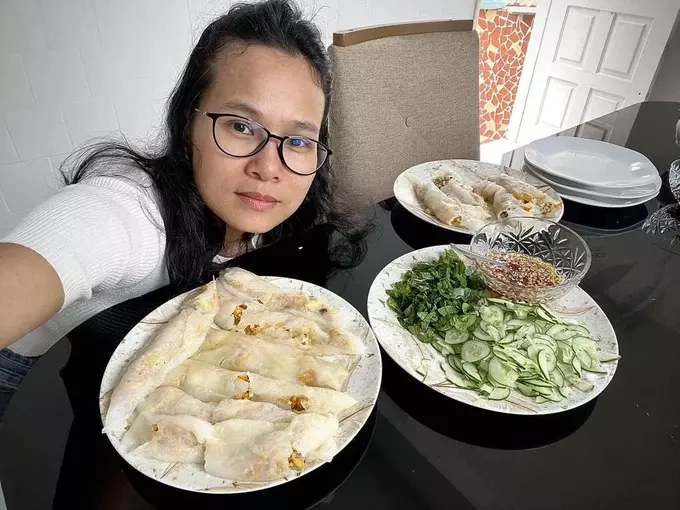
Thuy makes banh cuon (Vietnamese steamed rice rolls) in Brazil in May 2026. Photo courtesy of Thuy |
Brazilians like eating fish, especially cleaned and deboned sardines, scad, and mackerel. She researched various options and bought red mullet fish, marinated it in lime and orange juice, the Brazilian way, to remove the fishy odor and preserve its sweetness.
Noticing that fresh red mullet fish tends to turn soft after the first braise, the next day she drizzled cooking oil over it and braised it a second time with garlic, chili, and fish sauce. The result was that the flesh became firm, chewy, and sweet like crab meat.
Thuy’s mother-in-law initially found Vietnamese-style braised fish unfamiliar and only tried a small piece due to the smell of fish sauce, but the firmness of the fish surprised her.
She then tried it with steamed white rice and complimented the harmonious flavor.
By the third bite, the double-braised fish had completely won her over, and has become a staple whenever she and her husband visit.
At family gatherings, Thuy frequently makes cha gio tom thit (fried spring rolls with shrimp and pork), stuffed with her homegrown bean sprouts.
To help her mother-in-law get used to Vietnamese seasonings, she diluted fish sauce with water, sugar, lime juice, garlic, and chili to make a milder dipping sauce for vermicelli and spring rolls. “Little by little, the whole family grew to love Vietnamese food,” she says.
Before long, her parents-in-law began eating quick-pickled cucumbers and asked Thuy to teach them how to make spring rolls at home.
Natalia, 6, is well-acquainted with Vietnamese food such as fried fish, pickled garden eggs, and fermented shrimp paste, and even eats dishes completely unfamiliar to locals like chicken feet in lemongrass and kumquat sauce or boiled pork offal.
Every Tet (Lunar New Year), Natalia and her mother cut banana leaves, wrap banh tet, watch over the boiling pot on New Year’s Eve, and peel eggs to make braised pork and eggs. “This is how I teach my daughter to stay connected to her roots,” Thuy says.