President Trump says he had a “very nice” discussion with Canadian Prime Minister Mark Carney at last week’s Asian-Pacific Economic Cooperative summit in Shenzhen, China, but the discussion wasn’t nice enough to guarantee a stop to his threatened 50 percent tariff on Canadian vehicles that could take effect in January.
It also was not nice enough to quash Carney’s counterthreat of a deal that would let in more than the 49,000 Chinese electric vehicles already allowed into the Canadian market this year.
“Canada has been very difficult for this country for 50 years,” Trump told reporters at the White House last Friday after returning from Shenzhen, Newsweek reports. “I don’t know, for some reason, they feel emboldened, and we can’t let them feel that way anymore, because we can make our own cars.”
Earlier last week, Carney said at a Francophile Summit in Phnom Penh, Cambodia, on his way to the APEC summit in China that he would not sign a trade deal with the US that fails to support a “viable” Canadian auto sector, the Canadian Press news agency reports. Ottawa will look at “other options” he said, in Europe and Asia if his country doesn’t get a fair deal with the US in trade agreement negotiations.

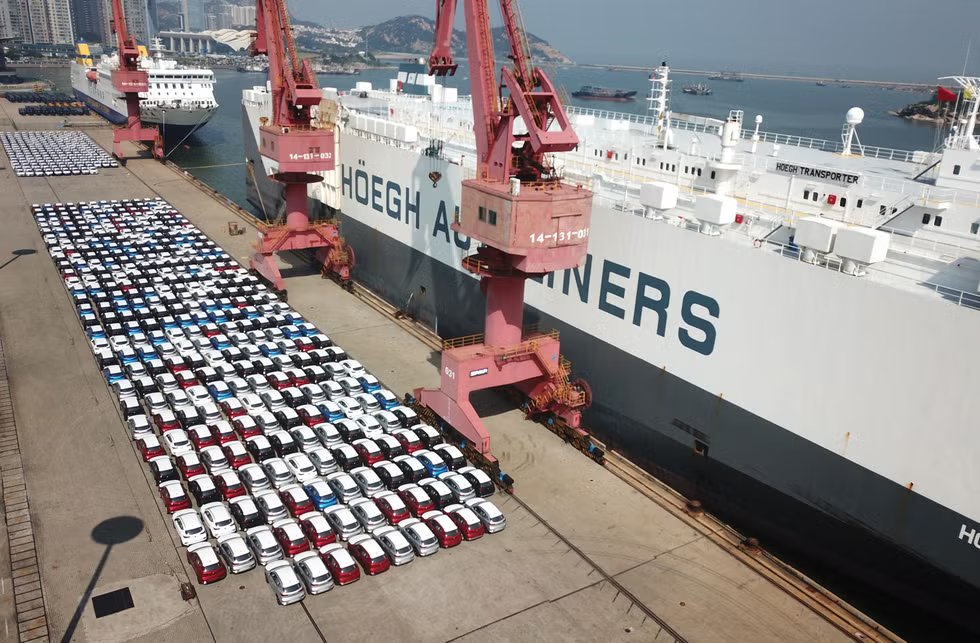
Cars waiting to be shipped from the Port of Lianyungang in China.
One option Carney suggested would be to expand an agreement from earlier this year that lets in 49,000 Chinese EVs with a 6.1 percent tariff.
“It’s a massive blunder, but he’s the guy in charge,” says Asian auto industry expert Michael Dunne, of Dunne Insights, via email. “If he thinks China will treat him better than the US, he’s naive.”
Trump also is not closed to the possibility of letting Chinese vehicles into the US, telling The Ingraham Angle on Fox News in September, “If China wanted to come in and open a plant to build their cars here, I’d be open with that.”
Meanwhile, the Connected Vehicle Security Act, introduced last April by Sens. Bernie Moreno (R-OH) and Elissa Slotkin (D-MI), which would “ban the import, sale, and operation of vehicles manufactured in China” has remained stalled in the Senate. It will not come up again, if at all, before Trump’s Canadian tariff deadline.
In his press conference last Friday, Trump maintained that the US trade deficit with Canada is $80 billion, though according to Newsweek, the official US figure for 2025 was $48 billion.

A Canadian auto worker.
“I said, when it’s down to zero, come over and let’s start talking,” Trump said of his conversation with the Canadian PM.
Carney said he wants Canadian auto workers to have the “best possible” opportunities integrated into the North American market. Trump’s threat of a 50% tariff on Canadian-assembled cars and trucks would not allow such integration, he said.
He seeks an interim agreement with Washington to lower Canadian import tariffs on steel, aluminum and lumber imports as well as on autos. The US and Canada failed to reach a deal to renew the first Trump administration’s US-Mexico-Canada trade agreement (which replaced the North American Free Trade Agreement going back to the Clinton administration) by last July’s deadline.
USMCA renewal is in a sort of long-term limbo. If the three countries fail to reach an agreement to renew, it remains in effect to July 1, 2036, unless at least one side terminates it earlier. That side would be the US, if Trump’s 50 percent tariff takes effect in a bit more than a month.
Canada’s autoworkers already have taken a hit. Stellantis recently canceled plans to assemble the Jeep Compass in Brampton, Ontario, and is shifting production to another legacy Chrysler plant, in Belvidere, Illinois. Stellantis sold the Brampton plant to armored vehicle manufacturer Roshell and laid off 2,200 factory workers there, according to news reports.
Carney called Stellantis’ sale of Brampton, completed Nov. 9, “unacceptable” and said it violated obligations the automaker made to the government in exchange for taxpayer financing, according to the Wall Street Journal. The report quoted a spokeswoman saying Stellantis is prepared to pay back federal and regional governments for the incentives. According to federal accounting records, Stellantis received Canadian $220 million (about US$155 million) for retooling of the Brampton and Windsor assembly plants.
Windsor, Ontario, assembly, just south of Detroit, remains important to Stellantis as the sole plant for the Chrysler Pacifica minivan.

The Stellantis Windsor Assembly Plant in Windsor, Ontario, Canada.
“Toyota and Honda are very likely to maintain their facilities for the long-term, but the Detroit Three plants are always at risk,” Sam Fiorani, vice president of global vehicle forecasting for AutoForecast Solutions, says via email. “GM recently ended production at the Ingersoll plant and maintains production at the Oshawa truck plant where the Silverado HD and Sierra HD are being produced. Ford just launched production of the Super Duty trucks at its Oakville plant.”
Not including the Brampton plant Stellantis just sold to Roshell, production capacity in Canada is 1.65 million units with a 70 percent+ utilization rate, Fiorani said. In addition to assembly plants, GM and Ford operate “crucial” Canadian powertrain plants. If Stellantis found an alternative source for the minivan and GM and Ford could move their engine/transmission plants out of Canada, the country’s assembly plants “could be at risk,” he added.
Canada is expected to purchase 1.9 million new vehicles this year, compared with 16 million in the US, according to Fiorani. That makes our neighbor to the north too small for significant Chinese investment.
However, just like everything else regarding Chinese commerce, automakers are in it for the long haul.
“Chinese automakers already have a presence in Mexico, but opening Canada more broadly to Chinese vehicles, and potentially Chinese manufacturing investment, could introduce significant competitive pressure on the North American automotive industry from both sides of the US border,” says Darryll Harrison Jr., founder and principal in strategic communications and business advisory firm Harrison Advisory Studio. “This becomes particularly interesting if Chinese automakers establish a meaningful manufacturing presence in both countries, leveraging local labor, suppliers, and infrastructure.”

A BYD showroom in Mexico City.
A former global communications executive for GM and Charge Point, Harrison points to the growing number of battery manufacturing and development sites being constructed in the US with direct or indirect Chinese involvement through joint ventures.
“Chinese automakers don’t necessarily need access to the US market tomorrow to benefit from these developments,” Harrison says. “They could spend years building manufacturing capacity, supply-chain relationships, institutional knowledge, brand recognition, and regional operating experience while waiting for the US market environment to change. By being patient and building, a stronger presence in Canada and Mexico could be a precursor to future US market entry, even if today’s trade and regulatory barriers remain firmly in place.”
As a kid growing up in Metro Milwaukee, Todd Lassa impressed childhood friends with his ability to identify cars on the street by year, make, and model. But when American automakers put an end to yearly sheetmetal changes, Lassa turned his attention toward underpowered British sports cars with built-in oil leaks. After a varied early journalism career, he joined Autoweek, then worked in Motor Trend’s and Automobile’s Detroit bureaus, before escaping for Mountain Maryland with his wife, three dogs, three sports cars (only one of them British), and three bicycles. Lassa is founding editor of thehustings.news, which has nothing to do with cars.

