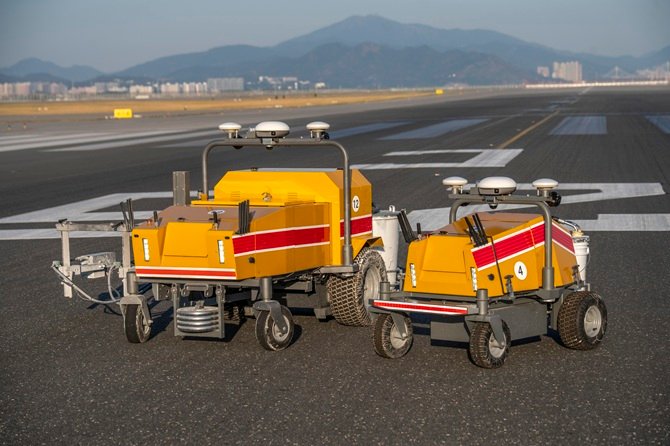
Hong Kong International Airport (HKIA) has announced the use of automated vehicle technology to repaint runway markings.
Carried out in a bid to further boost operational efficiency, as well as broaden the application of automation technology, Airport Authority Hong Kong (AAHK) is progressively transitioning different tasks to robots.
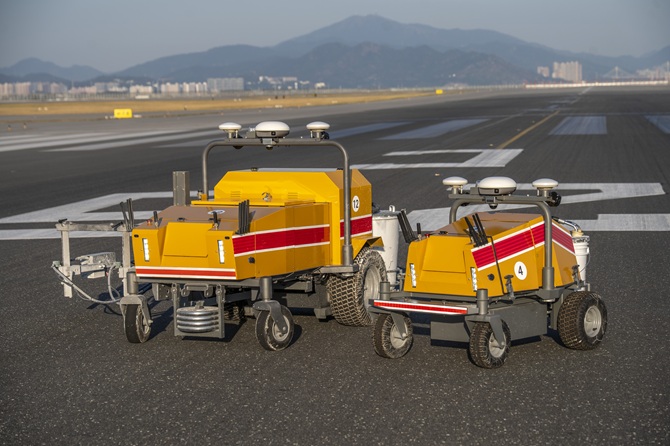
HKIA is the first airport in the world to utilise autonomous robots to repaint runway markings
© HKIA
HKIA is the first airport in the world to deploy autonomous robots to repaint runway markings, which consist of a variety of lines and markings that guide aircraft during take-off and landing. These markings require repainting at intervals ranging from weekly to every six months, and AAHK has collaborated with a technology company to develop and pilot autonomous robots on its runways – the responsibilities of which includes this repainting process.
Deployment of the autonomous painting robots, which are referred to as Brushman, is expected to offer a variety of benefits, including enhanced efficiency, improved occupational safety, and optimised manpower allocation.
Previously, the runway repainting process took around two to four hours per session and required the skills of roughly five to six airfield assistants per night shift. In contrast, autonomous robots are capable of completing the repainting process in one to two hours, reducing the need for staff whilst lowering potential risks with regards to errors and workplace accidents.
The autonomous marking robots paint lines along a preset route on a closed runway under the monitoring of an on-site operator, who is able to intervene via remote control or replenish paint when necessary. This, again, allows staff to be redeployed in other roles in order to enhance the potential efficiency of wider airport operations.
Utilising Real-Time Kinematic (RTK) positioning based on global navigation satellite systems; the robots integrate data from four major satellite systems, detect obstacles in real time and halt to avoid collisions in order to meet the stringent safety requirements for runway operations.

