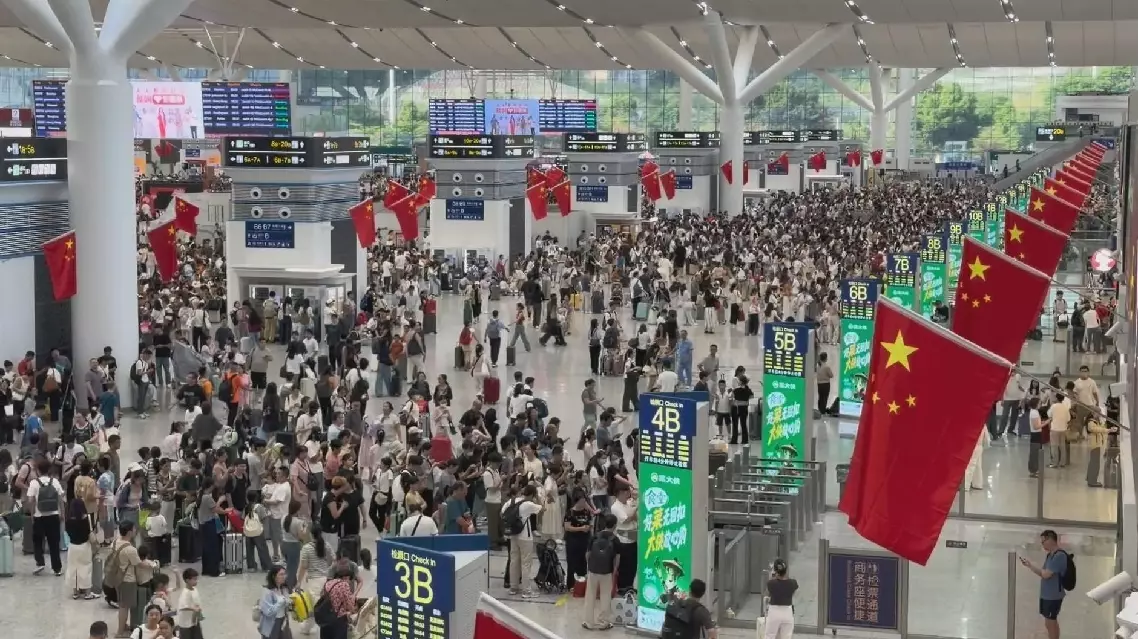
Travelers ventured further afield to explore more scenic regions across China during the country’s week-long National Day holiday which concluded Wednesday, with many opting to embark on longer trips and undertake cross-provincial tours in search of more diverse destinations.
Referred to in China as “Golden Week”, the National Day holiday runs from Oct. 1 to 7 and is one of the country’s busiest annual travel periods.
With the traditional Mid-Autumn Festival landing just days before the National Day, one in 10 holidaymakers sought to stretch the occasion into an extended getaway by combining the two holiday periods, with many enjoying trips of more than eight days, according to data from travel platform Trip.com.
Those longer getaways also carried travelers farther, with the average travel distance reaching 345 kilometers and cross-provincial trips accounting for 53 percent of the total, up two percentage points year on year, data from China Mobile’s Wutong big-data platform showed.
The appetite to explore further afield took Li Xiaocheng, a tourist from southwest China’s Chongqing Municipality, thousands of kilometers to the Taxkorgan Tajik Autonomous County in northwest China’s Xinjiang Uygur Autonomous Region, in search of culture and scenery far removed from those of her hometown.
“I came to Taxkorgan mainly to experience the local culture and customs, as well as the natural scenery. Today, there are quite a few local markets set up here, and I find them really special. It gives me a chance to truly experience the everyday life of the local people,” said Li.
The desire to see more also reshaped itineraries, as nearly 30 percent of tourists opted to visit two or more cities over the holiday, mostly within the same province, with the southwestern provinces of Yunnan and Sichuan and the eastern province of Jiangxi among the popular choices for such multi-city tours.
The multi-city habit, however, was not confined to the roads, as bookings for flights to two or more destinations rose 70 percent year on year, data from the major services platform Meituan showed.
The same shift has pushed lesser-known destinations into the spotlight, with some travelers trading the country’s biggest-name attractions for places they had never planned to visit.
“I’m from Heilongjiang, and this is also my first time visiting Ya’an. We originally planned to visit some of the bigger tourist attractions, but we didn’t expect to end up in Ya’an. Then we saw a Sichuan Opera performance on Bayi Road, and I thought it was really great,” said Zhu Sijia, a tourist from northeast China’s Heilongjiang Province.
The return travel rush began on Tuesday, with the flows mainly heading toward first-tier cities such as Guangzhou, Shenzhen and Beijing. The average daily active users of new energy vehicle-related mobile applications on Tuesday and Wednesday increased 15 percent from the same period last year, pointing to strong demand for car travel and charging as the traffic built up on the roads home.
Inbound tourism also gathered pace during the break, with Asia and Europe accounting for nearly 70 percent of arrivals, while the number of long-haul visitors from North America, South America and Oceania rose 23 percent.
The appeal for international visitors has now extended beyond China’s iconic landmarks. In Heze City, in the eastern province of Shandong, foreign visitors spent the holiday in local villages, trying their hands at paper cutting and gourd carving.
“The people here have been so nice. The trip to the village has been spectacular. And the food here has been amazing,” said foreign tourist Ahlam Faisal Aln.
Across the holiday, the choices of travelers pointed to a growing appetite for longer journeys, richer experiences and more diverse spending — one that is injecting fresh momentum into China’s holiday economy.

Longer trips, diversified destinations drive China’s National Day holiday travel boom
As cities around the world look for faster ways to respond to residents, locals in London have been sharing their experiences with Britain’s public services — along with their questions about how China handles citizens’ grievances, ahead of the 2026 Beijing Forum on Swift Response to Public Complaints.
The event will be held on Oct. 12 and 13 in the Chinese capital under the core concept of “People’s City, Better Life,” focusing on the modernization of digital and intelligent technologies in cities and the empowerment of urban governance. More than 3,200 participants are expected to attend, including over 240 international guests from more than 70 countries and regions.
In the run-up to the forum, a reporter for the China Global Television Network (CGTN) hit the streets of London to hear what local residents think about public services, and what they want to know about China’s system for handling public complaints.
Some residents said they have used the UK’s emergency hotline 999 and the National Health Service’s non-emergency helpline 111, and found the public service websites fairly easy to use and navigate.
“I’m a citizen of Camden Council, so I have used Camden Council a lot for any of the issues that I had, especially in my buildings. I have used services like 999, 111, and they’ve all been really great, to be honest. I haven’t had many issues with the public sector in terms of any questions or support that I needed,” said Ikram Bride, a fundraiser.
Marissa Gupta, a branch manager, said she regularly uses the website of her local council in Cornwall, in southwest England, to report problems in her area.
“I live in Cornwall and, as most people around the country, we’ve had a lot of potholes and so I often go on the Cornwall Council website and report the potholes. I found that the websites are good and you get a lot of feedback from them. Emails to say what the process is, what point of the process it’s in. And also asking for feedback to find out how you found that service, so I found those really good,” said Gupta.
However, not all the feedback was positive, with some finding that help could be slow to arrive.
“I’ve used 999 to ask for help for my grandparents. Sometimes it’s not effective because they can take long in case of emergencies. It was fairly easy to use and navigate, but they did take a while to respond,” said Emily Carter, a student.
The residents were also asked about Beijing’s “Swift Response to Public Complaints” mechanism, with many expressing a keen interest in it.
“I would love to know more about the way in which they work,” said Bride.
“I’d like to know if citizens can track their complaints and see if action has been taken upon it,” said Carter.
Others were curious about the technology behind China’s public service system, including whether artificial intelligence is used.
“Does the government use artificial intelligence to analyze citizens’ data and information?” asked Justine Barton, an office worker.

Londoners eye China’s public services ahead of Beijing forum on swift response to public complaints